All species › Swifts › Swifts › White-tipped Swift
White-tipped Swift | Aeronautes montivagus
Kleine andesgierzwaluw | Vencejo filipunteado | Andorinhão-serrano
White-tipped Swift is a medium-sized, black-and-white swift of montane forest, gorges and cliffs. In the guide area it lives in the Venezuelan Andes, the coastal range and on the tepuis of the Guiana Shield. Its English and Spanish names refer to the white tail tip of the male.

Voice
A rapid, dry and shrill trill, often repeated by small groups flying along the cliffs.
Recording: Willem-Pier Vellinga — CC BY-NC-SA 3.0 · xeno-canto
Identification
12–13 cm, with narrow wings and a slightly forked tail. The plumage is sooty black, with a white throat extending as a narrow point down the centre of the breast and a white patch on the rear flanks, visible in flight as a white smudge beside the rump. The male has white tips to the tail feathers; in the female they are greyish or absent.
Confusion species
Lesser Swallow-tailed Swift Panyptila cayennensis has a white collar and a long, usually closed, pointed tail, and lives lower, over lowland forest. White-collared Swift Streptoprocne zonaris is much larger, with a complete white collar. Swifts of the genus Chaetura have a short, square tail and no white on the throat and flanks.
Habitat
Montane forest, forest edges, open slopes and especially gorges, ravines and cliffs, in Venezuela mostly between about 800 and 2500 m, on the tepuis and inselbergs also lower. It hunts flying insects in the air, often in small groups and sometimes with other swifts. It nests in crevices in cliffs and sometimes in buildings.
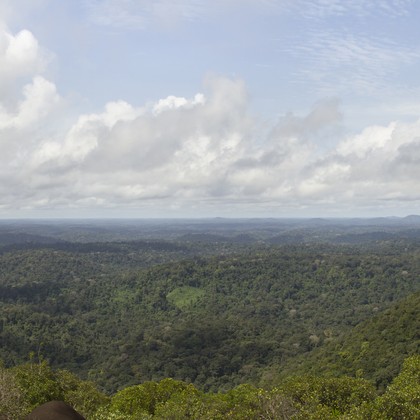
Where the bird is most at home, classified by the vegetation units of Amazonia and the Guianas.




Range and movements
In Venezuela in the Andes of Táchira, Mérida and Trujillo, in the Serranía de Perijá, in the coastal range and on the tepuis of Bolívar and Amazonas. In Guyana in the Pakaraima Mountains. In Brazil only in the far north, on the tepuis and high mountains of Roraima and Amazonas, such as Pico da Neblina. Only isolated records from Suriname and French Guiana. Outside the guide area in the Andes from Colombia to Bolivia.
- Resident
- dark = core range, pale = thinly spread
How and when to look
Watch from a viewpoint by a gorge or cliff in the Andes of Mérida, in the coastal range or on the tepuis of the Gran Sabana, especially in the morning; small groups then fly fast along the walls and give their trills.
Conservation status
Least Concern. The species is widespread in the mountains and depends less on closed forest than many other montane birds.
Scientific name
Aeronautes montivagus | (d'Orbigny, ACVMD & de Lafresnaye, 1837)
D'Orbigny, ACVMD & de Lafresnaye described the species in 1837 as Cypselus montivagus; because it was later moved to another genus, the author and year stand in brackets. The genus Aeronautes was introduced in 1892 by Hartert. Aeronautes is Greek, from aēr 'air' and nautēs 'sailor': 'air-sailor', after the fast, gliding flight. montivagus is Latin for 'mountain-wandering', from mons, montis 'mountain' and vagus 'wandering', after its Andean range. The specimen the first description was based on came from between Samaipata and Santa Cruz de la Sierra, Bolivia.