All species › Passerines › Tyrant flycatchers and allies › Riverside Tyrant
Riverside Tyrant | Knipolegus orenocensis
Riviermoortiran | Viudita ribereña | Maria-preta-ribeirinha
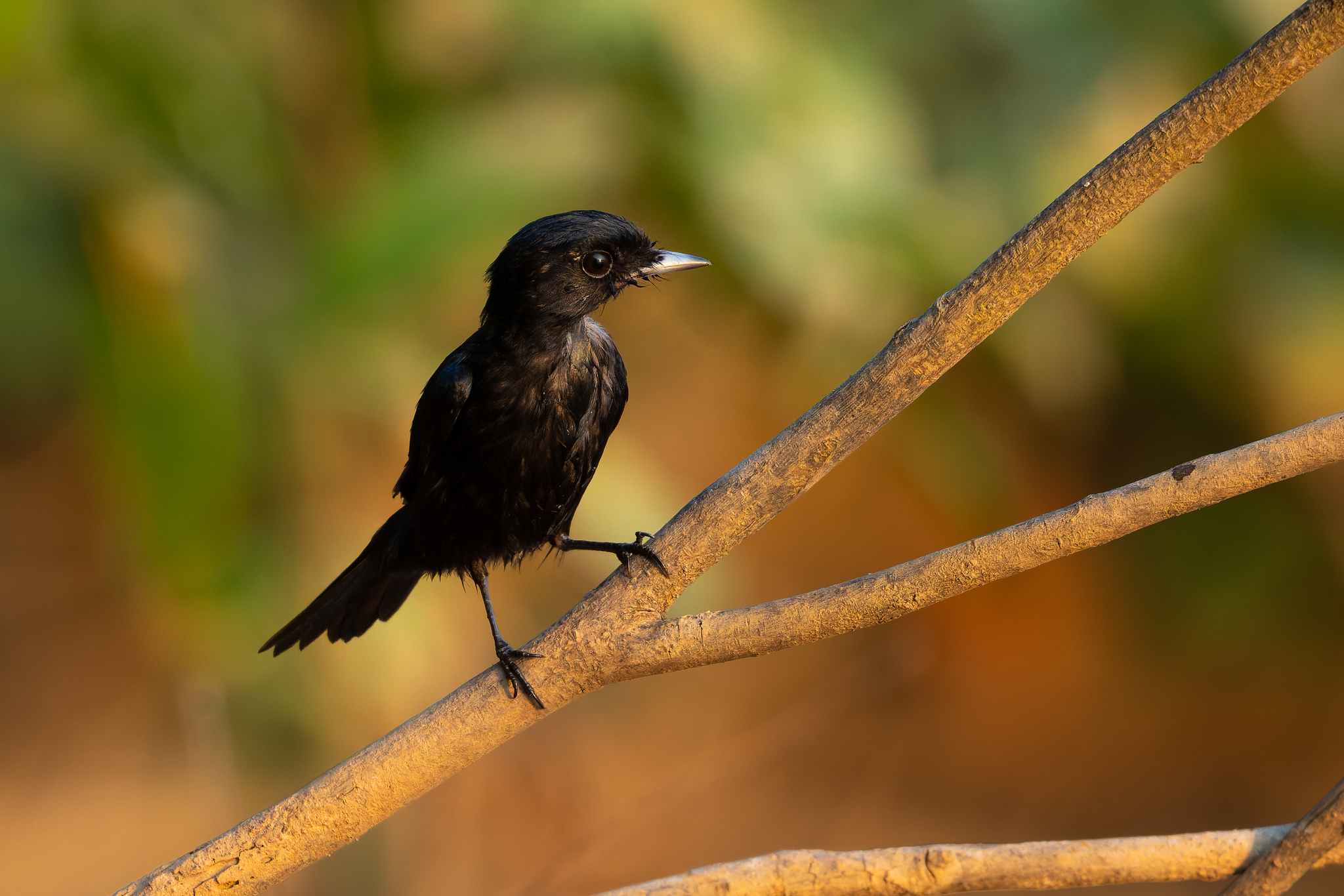
The Riverside Tyrant is a flycatcher of young growth on river islands and sandbars along the large rivers of the Amazon and Orinoco basins. It lives almost exclusively in the early stages of riverside vegetation, such as young Cecropia, willows and tall grass. There are three subspecies, which differ mainly in the female plumage.
Voice
A series of melodious notes ending in a rasping, hiccuping sound; the call is a soft, liquid whistle. In display the male makes short flights with audible wingbeats.
Recording: GABRIEL LEITE — CC BY-NC-SA 4.0 · xeno-canto
Identification
15 cm, slim, with a small crest and a fairly long tail. The male is plain dark slate-grey to blackish, darkest on the head; the nominate form along the Orinoco is slightly paler grey. The female of the nominate form is slate-grey with an olive tinge; the female of sclateri along the Solimões is sooty grey above and whitish below, with heavy dark streaks on breast and flanks. The bill is greyish.
Confusion species
Amazonian Black Tyrant Knipolegus poecilocercus is smaller; the male is glossy blue-black, the female brown with a rusty rump and tail edges, and it lives in the understorey of igapó and várzea, not on open river islands. Drab Water Tyrant Ochthornis littoralis is sandy brown and perches low on trunks and banks at the water's edge. River Tyrannulet Serpophaga hypoleuca is smaller, grey and white, and forages among the leaves of the same shrubs.
Habitat
Young scrub and early regrowth on river islands, sandbars and banks of large, silt-laden whitewater rivers, with young Cecropia, willows, cane and tall grass; in the lowlands. It perches low to mid-level in the shrubs and sallies for insects. The nest is a cup of plant material in a shrub.
Where the bird is most at home, classified by the vegetation units of Amazonia and the Guianas.



Range and movements
Brazil: local along the Solimões and the Amazon and the lower reaches of large tributaries, east into Pará, including the mouths of the Xingu and the Tapajós. Venezuela: along the middle and lower Orinoco and adjacent parts of the Apure. Guyana, Suriname and French Guiana: not known. Outside the guide area in eastern Colombia, north-eastern Ecuador and north-eastern Peru.
- Resident
- dark = core range, pale = thinly spread
How and when to look
Travel by boat along river islands with young Cecropia and willow regrowth, for example near Manaus, Santarém or on the Orinoco, and look for dark birds perched low in the scrub. They can usually be reached only by boat.
Conservation status
Least Concern. The species depends on river islands that are constantly changed by floods; dams that alter the river regime can locally affect its habitat.
Scientific name
Knipolegus orenocensis | Berlepsch, 1884
Berlepsch described the species in 1884 and placed it straight away in the genus where it still stands. The genus Knipolegus was introduced in 1826 by Boie. Knipolegus is Greek, from knips 'insect' and legō 'to pick': 'insect-picker'. orenocensis means 'of the Orinoco', the Venezuelan river where it was collected. The specimen the first description was based on came from Ciudad Bolívar on the Orinoco, Venezuela.