All species › Passerines › Tyrant flycatchers and allies › Rufous-tailed Tyrant
Rufous-tailed Tyrant | Knipolegus poecilurus
Roodstaartmoortiran | Viudita colirrufa | Maria-preta-de-cauda-ruiva
The Rufous-tailed Tyrant is a small, greyish-brown flycatcher of forest edges and shrubby clearings in the mountains. Unlike in its black relatives, both sexes are alike in colour. In the guide area it lives in the Venezuelan Andes, the Sierra de Perijá, the Coastal Cordillera and on the tepuis of the Guiana Shield.

Voice
Usually silent. Gives a thin, high tseep and a soft, repeated ticking.
Recording: Andrew Spencer — CC BY-NC-SA 3.0 · xeno-canto
Identification
13–14 cm. The upperparts are greyish-brown, the crown slightly greyer. The wings are dark with two pale wing bars and pale edges to the secondaries. The throat is pale grey, the breast grey, the belly pale yellow to ochre. The tail feathers are dark with rufous inner webs, so that the tail looks largely rufous from below and in flight. The eye is red. The sexes are alike.
Confusion species
Cinnamon Flycatcher Pyrrhomyias cinnamomeus is smaller, with cinnamon underparts and rufous wing bars, and often perches in pairs along forest edges. Smoke-colored Pewee Contopus fumigatus is larger, plain dark grey, crested, and perches high on a bare branch. The female Amazonian Black Tyrant Knipolegus poecilocercus also has rufous in the tail, but has a dark eye and lives in flooded lowland forest.
Habitat
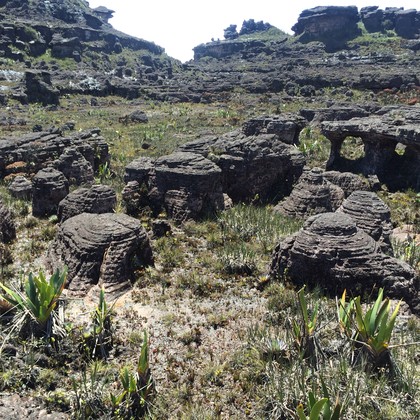
Edges of cloud forest and montane forest, shrubby clearings, roadsides and young regrowth, in Venezuela roughly between 900 and 2500 m, on the tepuis also in sandstone scrub. It perches low to mid-level in shrubs and sallies for insects, often close to the ground. The nest is a cup of moss and fibres in a shrub or against a bank.
Where the bird is most at home, classified by the vegetation units of Amazonia and the Guianas.



Range and movements
Venezuela: in the Andes from Táchira to Lara, in the Sierra de Perijá, in the Coastal Cordillera and on the tepuis of Bolívar and Amazonas. Guyana: on the tepuis of the Pakaraima Mountains. Brazil: a few sites on the tepuis of northern Roraima. Suriname: a few reports; regular occurrence not confirmed. French Guiana: not known. Outside the guide area in the Andes from Colombia to Bolivia.
- Resident
- dark = core range, pale = thinly spread
How and when to look
Walk roads through montane forest in the Venezuelan Andes, for example around Mérida, or in the Gran Sabana, and look in shrubby edges and clearings for a greyish-brown flycatcher perched low. Note the red eye and the rufous in the tail when it flies up.
Conservation status
Least Concern. The species benefits locally from forest edges and regrowth, but depends on montane forest as a whole, which is locally being cleared in the Venezuelan Andes and the Coastal Cordillera.
Scientific name
Knipolegus poecilurus | (Sclater, 1862)
Sclater described the species in 1862 as Empidochanes poecilurus; because it was later moved to another genus, the author and year stand in brackets. The genus Knipolegus was introduced in 1826 by Boie. Knipolegus is Greek, from knips 'insect' and legō 'to pick': 'insect-picker'. poecilurus is Greek, from poikilos 'variegated' and oura 'tail', after the partly rufous tail feathers. The specimen the first description was based on came from 'Bogotá', Colombia (trade skin).