All species › Passerines › Ovenbirds and woodcreepers › Scaled Spinetail
Scaled Spinetail | Cranioleuca muelleri
Geschubde stekelstaart | Curutié escamoso | João-escamoso
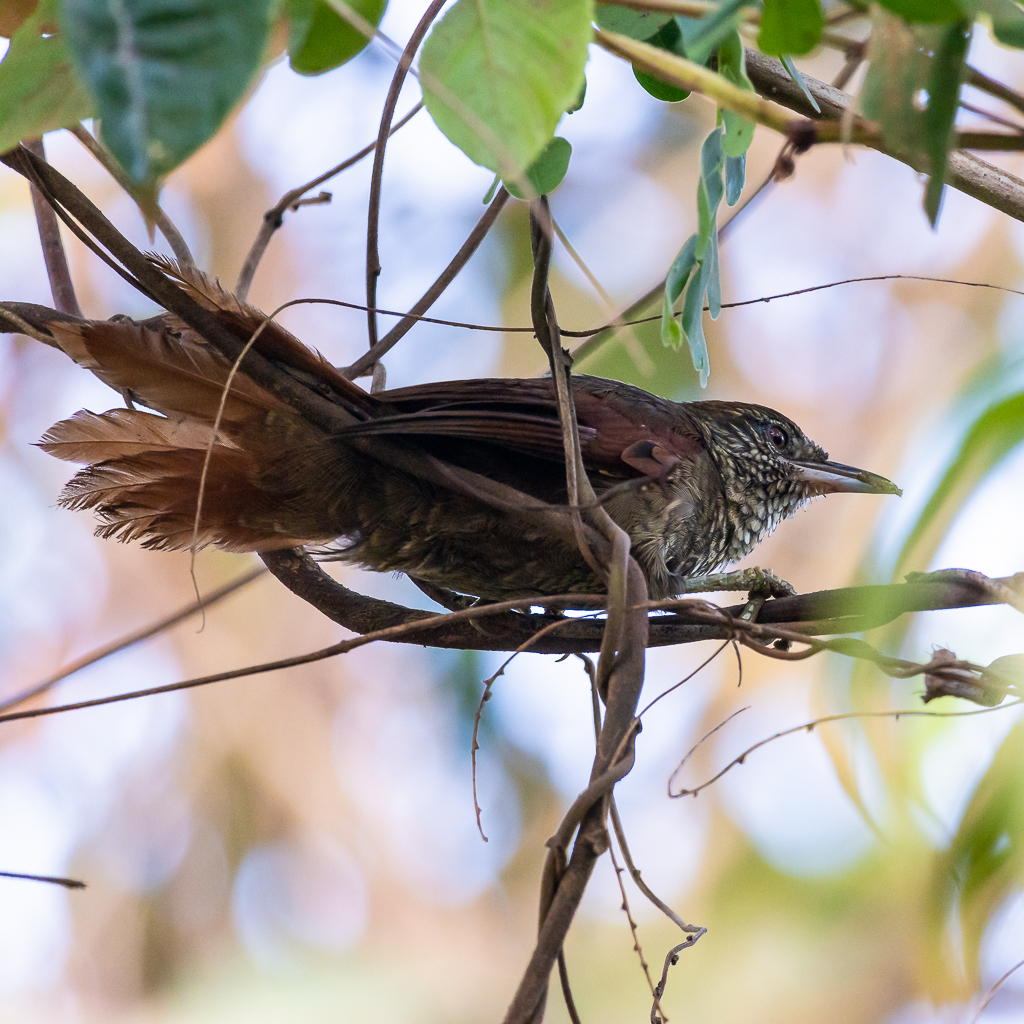
The Scaled Spinetail is endemic to Brazil and restricted to the várzea along the lower Amazon. It is named for the dark feather edges on breast and belly, which give the underparts a scaled pattern. It lives in pairs in the undergrowth and middle storey of flooded forest.
Voice
A fast, high trill that first rises and then fades, often given by both birds of a pair. Also short, sharp contact calls.
Recording: GABRIEL LEITE — CC BY-NC-SA 4.0 · xeno-canto
Identification
14–15 cm, with a long, graduated tail of stiffened, pointed feathers. The upperparts are dark brown, crown, wings and tail rufous. A pale supercilium runs above the eye. Breast and belly are pale buff-brown; the feathers have dark olive edges, so the underparts look coarsely scaled. The sexes are alike.
Confusion species
Rusty-Backed Spinetail Cranioleuca vulpina of river islands and banks has plain, unscaled dull greyish underparts and a rufous back. Speckled Spinetail Thripophaga gutturata has a yellow throat and fine black spots on throat and breast, and lives higher in the canopy. Yellow-Chinned Spinetail Certhiaxis cinnamomeus has white underparts without scaling and lives in open marsh.
Habitat
Seasonally flooded forest (várzea) and the scrub along banks and on islands of the lower Amazon, locally at mangrove edges near the mouth; from sea level to about 200 m. It forages in the undergrowth and middle storey along branches, lianas and dead leaves for insects and spiders. The nest is a ball of plant material in the vegetation.
Where the bird is most at home, classified by the vegetation units of Amazonia and the Guianas.



Range and movements
Brazil: endemic, along the lower Amazon from the far east of Amazonas through Pará to eastern and southern Amapá and Mexiana Island in the mouth. Not known from the other countries of the guide area or beyond.
- Resident
- dark = core range, pale = thinly spread
How and when to look
In the várzea around Santarém and on the islands of the Amazon mouth, mainly from a boat along the forest edge. Listen for the fast trill of a pair in the early morning.
Conservation status
Least Concern (IUCN). The range is small; logging, cattle ranching and conversion of várzea forest along the Amazon are threats.
Scientific name
Cranioleuca muelleri | (Hellmayr, 1911)
Hellmayr described the species in 1911 as Siptornis Mülleri; because it was later moved to another genus, the author and year stand in brackets. The genus Cranioleuca was introduced in 1853 by Reichenbach. Cranioleuca is Greek, from kranion 'skull, head' and leukos 'white', after the white crown of the type species C. albiceps. muelleri honours the German herpetologist Lorenz Müller (1868–1953), who collected in Brazil, including on Marajó and Mexiana. The specimen the first description was based on came from Fazenda Nazaré, Mexiana Island, Pará, Brazil.