All species › Passerines › Ovenbirds and woodcreepers › Tepui Spinetail
Tepui Spinetail | Cranioleuca demissa
Tepuistekelstaart | Curutié de tepuí | João-do-tepui
The Tepui Spinetail is a spinetail of the montane forests on and around the tepuis of the Guiana Shield, where Venezuela, Guyana and Brazil meet. It lives in pairs or small groups in the canopy and often joins mixed foraging flocks. Two forms are recognised, which differ in the colour of the face and underparts.

Voice
The song is a thin, high series of notes that descends and accelerates. The alarm call is a short, dry, high rattle.
Recording: JAYRSON ARAUJO DE OLIVEIRA — CC BY-NC-SA 4.0 · shortened to the first 60 s, mono · xeno-canto
Identification
14–15 cm, slender, with a long, graduated tail whose barbless feather tips project as spines. Crown, wings and tail are rufous, the back warm brown. A whitish supercilium marks the dull brown face. The throat is whitish, the underparts grey. Birds of the tepuis of southern Venezuela (form cardonai) have a more olive supercilium and face and olive-brown rather than grey underparts. The sexes are alike. Juveniles have a brown crown, a more olive back and buff underparts.
Confusion species
McConnell's Spinetail Synallaxis macconnelli of the same mountains lives low in the undergrowth, is darker and lacks a pale supercilium. Roraiman Barbtail Roraimia adusta has a blackish mask and a spotted white throat and climbs trunks and branches like a treecreeper. No other Cranioleuca species occurs at this elevation in the guide area.
Habitat
Evergreen montane forest, forest edges and tall scrub on the slopes and summits of tepuis, mainly between 1100 and 2450 m; locally also gallery forest in the Gran Sabana. It forages in the canopy and middle storey, climbing along branches, moss and dead leaves in search of insects and spiders. Little is known of the nest; in related species it is a ball of moss and plant fibres hanging from a branch.
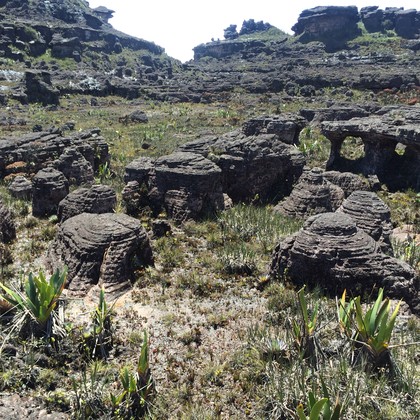
Where the bird is most at home, classified by the vegetation units of Amazonia and the Guianas.

Range and movements
Venezuela: tepuis and the Gran Sabana in Bolívar and the tepuis of Amazonas. Guyana: the tepuis of the west and centre of the country, including the Pakaraima Mountains. Brazil: only in northern Roraima, on the border with Venezuela and Guyana. The species occurs only in the guide area.
- Resident
- dark = core range, pale = thinly spread
How and when to look
On the slopes of Roraima and along the road to the Sierra de Lema in Bolívar, at forest edges above 1100 m. Watch mixed foraging flocks in the canopy and listen for the thin, descending song in the early morning.
Conservation status
Least Concern (IUCN). The habitat on the tepuis is largely intact; fires and mining in the Gran Sabana are a local threat.
Scientific name
Cranioleuca demissa | (Salvin & Godman, 1884)
Salvin & Godman described the species in 1884 as Synallaxis demissa; because it was later moved to another genus, the author and year stand in brackets. The genus Cranioleuca was introduced in 1853 by Reichenbach. Cranioleuca is Greek, from kranion 'skull, head' and leukos 'white', after the white crown of the type species C. albiceps. demissa is Latin for 'modest, humble', from demittere 'to lower', probably after the plain plumage. The specimen the first description was based on came from Mount Roraima, Guyana.