All species › Passerines › Tyrant flycatchers and allies › Acadian Flycatcher
Acadian Flycatcher | Empidonax virescens
Beukenfeetiran | Mosquero verdoso | Papa-moscas-acadiano
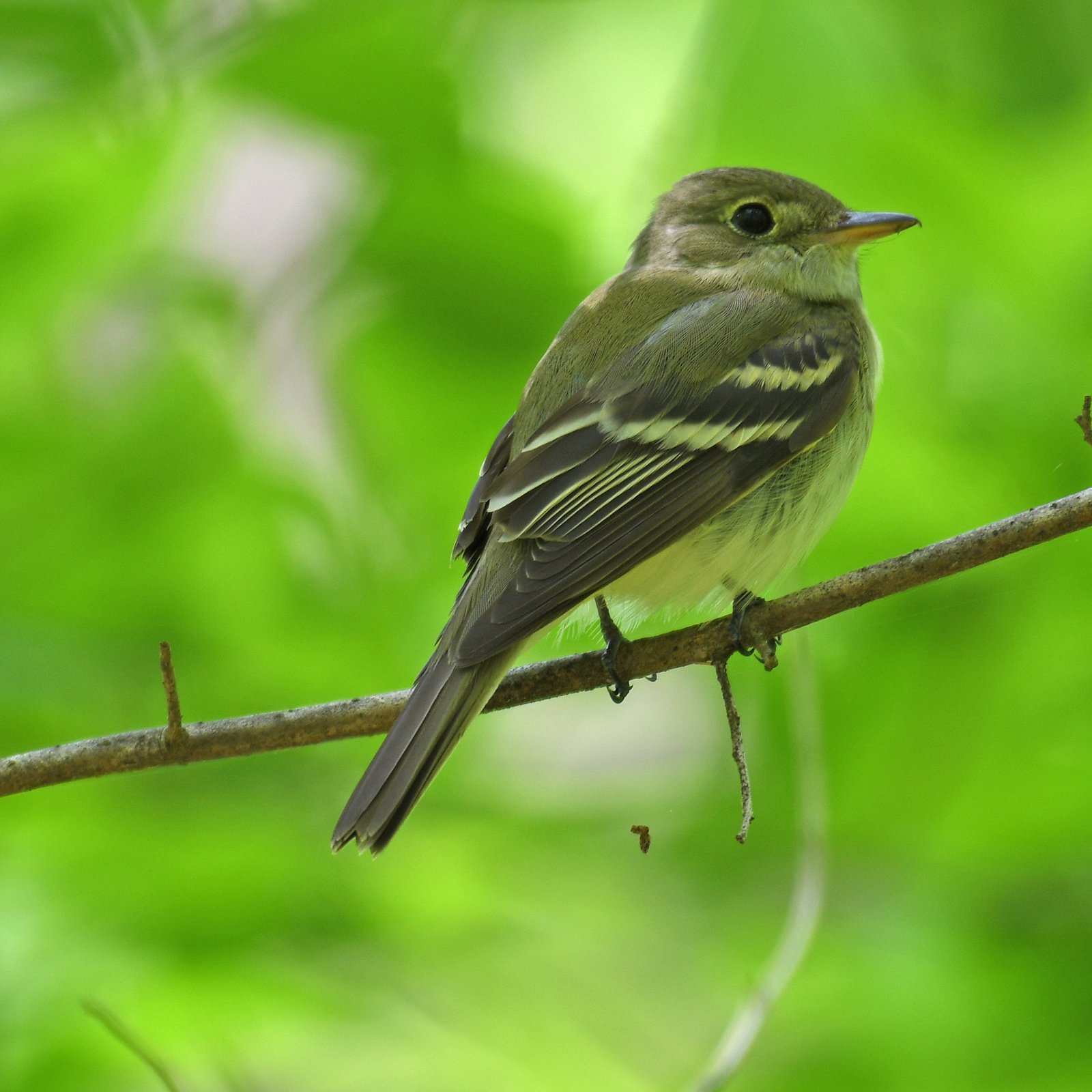
The Acadian Flycatcher is a North American Empidonax flycatcher that breeds in deciduous forest in the eastern United States and winters from Central America to north-western South America. In the guide area it is a winter visitor in western and northern Colombia and western Ecuador. Like all Empidonax flycatchers, it is best identified in the field by call, structure and habitat.
Voice
In winter mainly a sharp, explosive peet or pweet. The song, a short, explosive peet-sah, is sometimes heard in winter or just before spring migration.
Recording: Mario Reyes Jr — CC BY-NC-SA 4.0 · xeno-canto
Identification
14–15 cm, with a fairly large head, a broad bill with a pale lower mandible, and long primaries projecting well beyond the secondaries. The upperparts are greenish olive, with a narrow, yellowish-white eye-ring. The wings are dark with two distinct, whitish to buff wing bars. The throat is whitish, the breast with a faint olive-grey wash and the belly pale yellow. The sexes are alike. Birds in fresh plumage in autumn are yellower below and have buffier wing bars.
Confusion species
Alder Flycatcher Empidonax alnorum and Willow Flycatcher Empidonax traillii are browner olive above, with a less distinct eye-ring and shorter primaries, and live more in open scrub; their calls differ. Black-billed Flycatcher Aphanotriccus audax is smaller, with an all-black bill, a white spot in front of the eye and shorter wings. Grey-breasted Flycatcher Lathrotriccus griseipectus in western Ecuador has a grey head and breast and conspicuous white spectacles. Eastern Wood Pewee Contopus virens is larger, greyer, lacks an eye-ring, and perches upright on open branches.
Habitat
Understorey and mid-storey of humid lowland forest and lower montane forest, forest edge, secondary forest and shaded coffee and cacao plantations, from sea level to about 1500 m. It sits rather quietly on a branch in the shade and catches insects in short sallies to leaves or in the air. It does not breed in the guide area.
Where the bird is most at home, classified by the vegetation units of the Andes and the west coast.


Range and movements
Colombia: winter visitor in the west and north, in the Pacific and Caribbean lowlands and the Magdalena and Cauca valleys, and on the lower slopes of the Andes. Ecuador: winter visitor in the west, mainly in the north-west. In Peru and Bolivia not or hardly recorded; absent from the Galápagos. Outside the guide area the species breeds in the eastern United States and also winters in Central America and north-western Venezuela.
- Winter visitor (c. Oct–Mar)
- dark = core range, pale = thinly spread
How and when to look
Between September and April, listen in the understorey of humid forest in western Colombia and north-western Ecuador for a sharp peet; the bird often sits still in the shade and reveals itself mainly by this call.
Conservation status
Least Concern. The North American breeding population is large, but the species is sensitive to forest fragmentation on the breeding grounds and to forest loss in its winter range.
Scientific name
Empidonax virescens | (Vieillot, 1818)
Vieillot described the species in 1818 as Platyrhynchos virescens; because it was later moved to another genus, the author and year stand in brackets. The genus Empidonax was introduced in 1855 by Cabanis. The genus name combines Ancient Greek empis, 'gnat', with anax, 'lord' or 'master': 'lord of the gnats'. Latin virescens, 'greenish', after the olive-green upperparts. The specimen the first description was based on came from Philadelphia, Pennsylvania, United States.