All species › Passerines › Tyrant flycatchers and allies › Yellow-browed Tody-Flycatcher
Yellow-browed Tody-Flycatcher | Todirostrum chrysocrotaphum
Geelbrauwschoffelsnavel | Titirijí cejiamarillo | Ferreirinho-de-sobrancelha
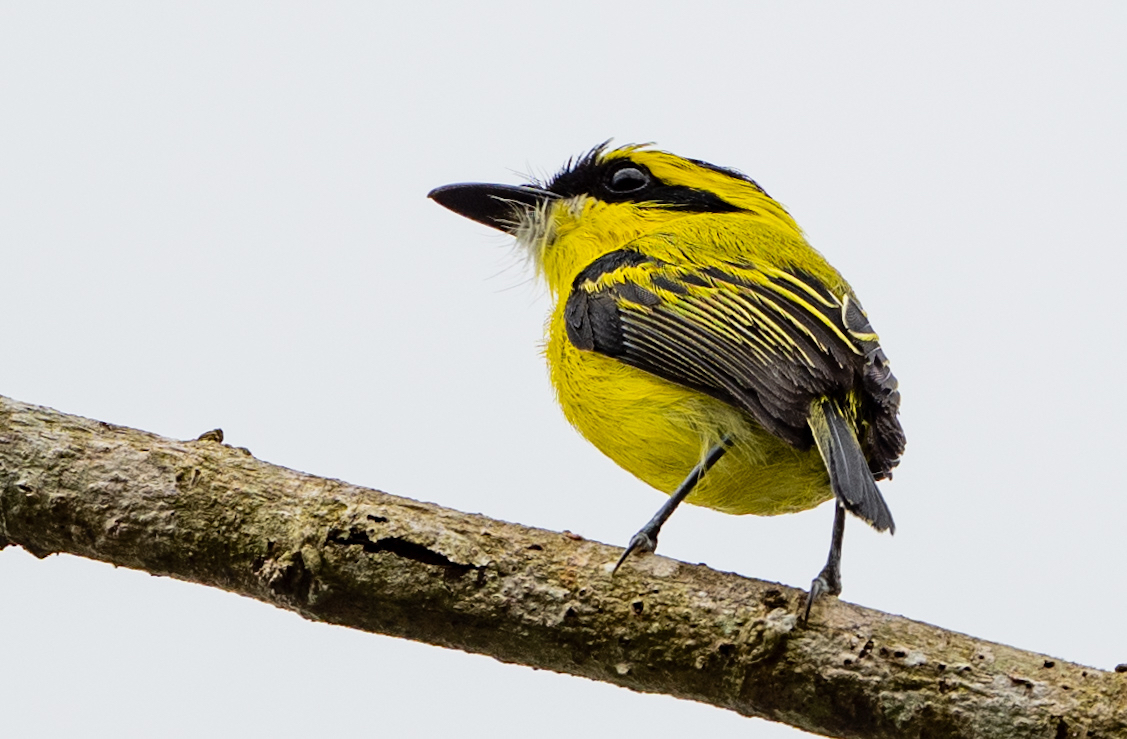
The Yellow-browed Tody-Flycatcher is a small tyrant of the canopy of Amazonian rainforest. It usually stays high in the treetops and is often first identified by its call. The black crown with a yellow eyebrow separates it from the other lowland tody-flycatchers.
Voice
A rapid series of high, dry tik notes, sometimes running into a short rattle, given from a treetop.
Recording: Sidnei Dantas — CC BY-NC-SA 4.0 · xeno-canto
Identification
9 cm, with a long, flat bill and a short tail. The crown is black, with a yellow stripe above the eye that extends behind it; the side of the head is blackish. The back is olive-green, the wings black with yellow edgings. The throat is white, the rest of the underparts bright yellow. Birds in the north of the guide area have black spots on the breast, which become smaller or are absent towards the south. The eye is dark. The sexes are alike.
Confusion species
Spotted Tody-Flycatcher Todirostrum maculatum has a grey head without an eyebrow, a yellow eye and dense black streaks on the throat and breast, and lives in riverside scrub. Common Tody-Flycatcher Todirostrum cinereum has a grey hindcrown, a pale eye and a yellow throat. Black-headed Tody-Flycatcher Todirostrum nigriceps lacks the yellow eyebrow and lives west of the Andes.
Habitat
The canopy and edges of humid lowland forest, both terra firme and várzea, also tall trees near clearings and along rivers, up to about 900 m. It forages in pairs, often with mixed canopy flocks, for insects in the foliage. The nest is a hanging pouch.
Where the bird is most at home, classified by the vegetation units of the Andes and the west coast.


Range and movements
Colombia: in the eastern lowlands east of the Andes, mainly in the south. Ecuador: in the eastern lowlands. Peru: throughout the Amazonian lowlands. Bolivia: in the north, in Pando, Beni and northern La Paz. Absent from the Galápagos. Outside the guide area in Amazonian Brazil and southern Venezuela.
- Resident
- dark = core range, pale = thinly spread
How and when to look
Search from a canopy tower or along a river with a view of the treetops; follow mixed canopy flocks and listen for the rapid series of high ticks.
Conservation status
Least Concern. The species has a large range in Amazonia, but depends on forest.
Scientific name
Todirostrum chrysocrotaphum | Strickland, 1850
Strickland described the species in 1850 and placed it straight away in the genus where it still stands. The genus Todirostrum was introduced in 1831 by Lesson. The genus name combines the genus Todus (todies) with Latin rostrum, 'bill', after the flat, tody-like bill. The species name comes from Greek chrysos, 'gold', and krotaphos, 'temple', after the yellow eyebrow. The specimen the first description was based on came from Peru.