All species › Passerines › Tyrant flycatchers and allies › Black-headed Tody-Flycatcher
Black-headed Tody-Flycatcher | Todirostrum nigriceps
Zwartkopschoffelsnavel | Espatulilla cabecinegra | Ferreirinho-de-cabeça-preta
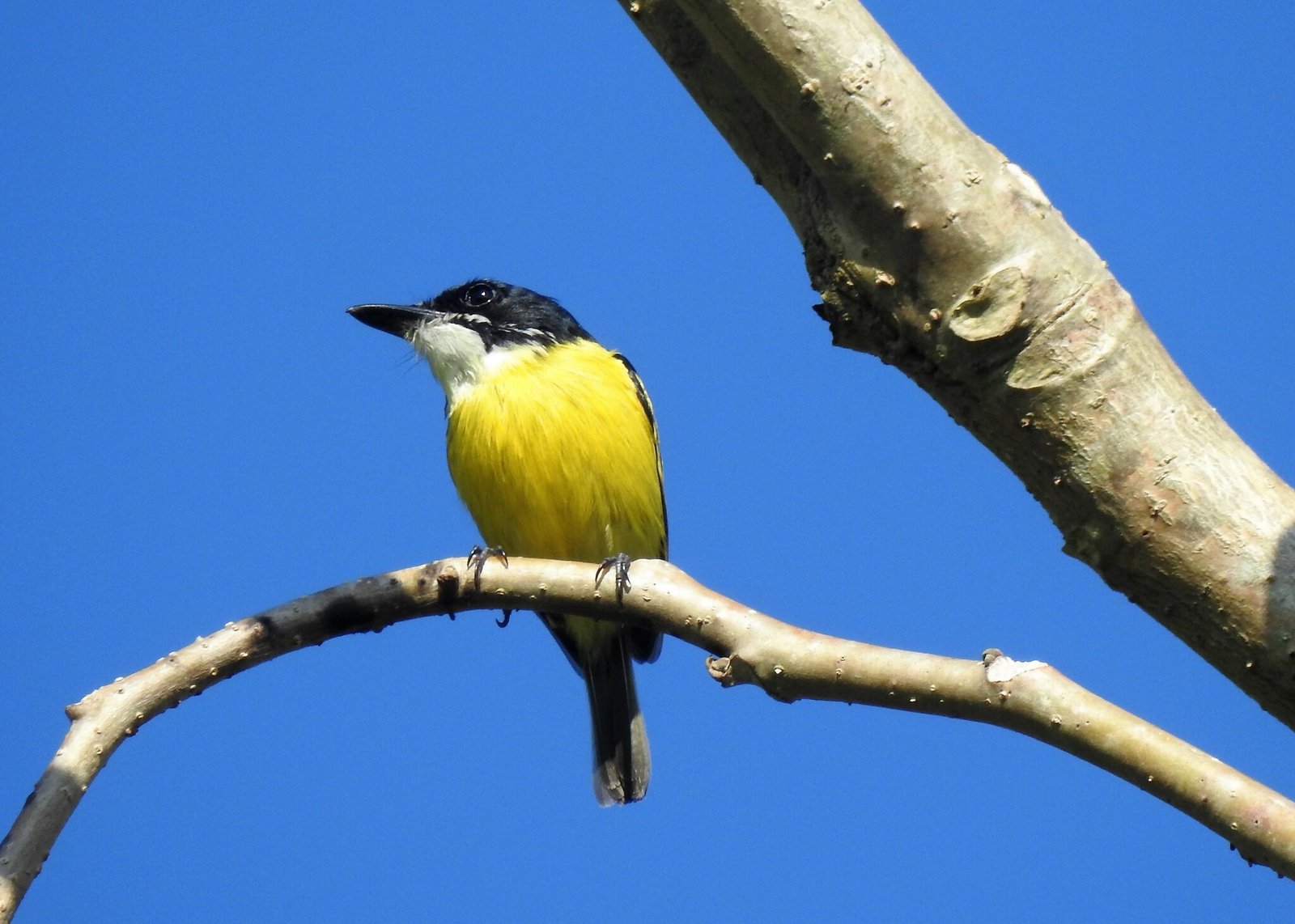
The Black-headed Tody-Flycatcher is one of the smallest tody-flycatchers, an inhabitant of the canopy of humid lowland forest west of the Andes. It usually stays high in the treetops and is often detected only by its call. The glossy black head is sharply demarcated from the green back.
Voice
A rapid series of five to eight high, sharp chip notes, repeated from a treetop.
Recording: Juan Freile — CC BY-NC-SA 4.0 · xeno-canto
Identification
8.5–9 cm, small and compact, with a long, flat bill and a short tail. The head is glossy black, sharply demarcated from the bright olive-green back. The wings are black with yellow edgings and two yellow wing bars. The throat is white, the rest of the underparts bright yellow. The eye is dark. The sexes are alike.
Confusion species
Common Tody-Flycatcher Todirostrum cinereum has a grey hindcrown that grades into a greyish-green back, a yellow throat, a pale eye and a longer tail with white tips, and lives lower, in scrub and gardens. Yellow-browed Tody-Flycatcher Todirostrum chrysocrotaphum has a yellow eyebrow and lives east of the Andes.
Habitat
The canopy and edges of humid lowland forest and tall secondary forest, also shade trees in plantations and trees in clearings near forest, up to about 1000 m. It forages in pairs, sometimes with mixed flocks, for insects in the foliage of the treetops. The nest is a hanging pouch high in a tree.
Where the bird is most at home, classified by the vegetation units of the Andes and the west coast.


Range and movements
Colombia: in the lowlands along the Pacific coast, in the north and in the middle Magdalena valley. Ecuador: in the north-west, mainly in Esmeraldas and adjacent provinces. Absent from Peru, Bolivia and the Galápagos. Outside the guide area from Costa Rica and Panama to north-western Venezuela.
- Resident
- dark = core range, pale = thinly spread
How and when to look
Listen along forest edges and clearings in the Chocó lowlands for the series of high chip notes, then scan the treetops; a telescope helps when viewing birds high in the canopy.
Conservation status
Least Concern. The species tolerates some disturbance but depends on trees; deforestation in the western lowlands is reducing its habitat.
Scientific name
Todirostrum nigriceps | Sclater, 1855
Sclater described the species in 1855 and placed it straight away in the genus where it still stands. The genus Todirostrum was introduced in 1831 by Lesson. The genus name combines the genus Todus (todies) with Latin rostrum, 'bill', after the flat, tody-like bill. The species name comes from Latin niger, 'black', and -ceps, 'headed', after the black head. The specimen the first description was based on came from Sierra Nevada de Santa Marta, Colombia.