All species › Passerines › Tyrant flycatchers and allies › Common Tody-Flycatcher
Common Tody-Flycatcher | Todirostrum cinereum
Geelbuikschoffelsnavel | Espatulilla común | Ferreirinho-relógio
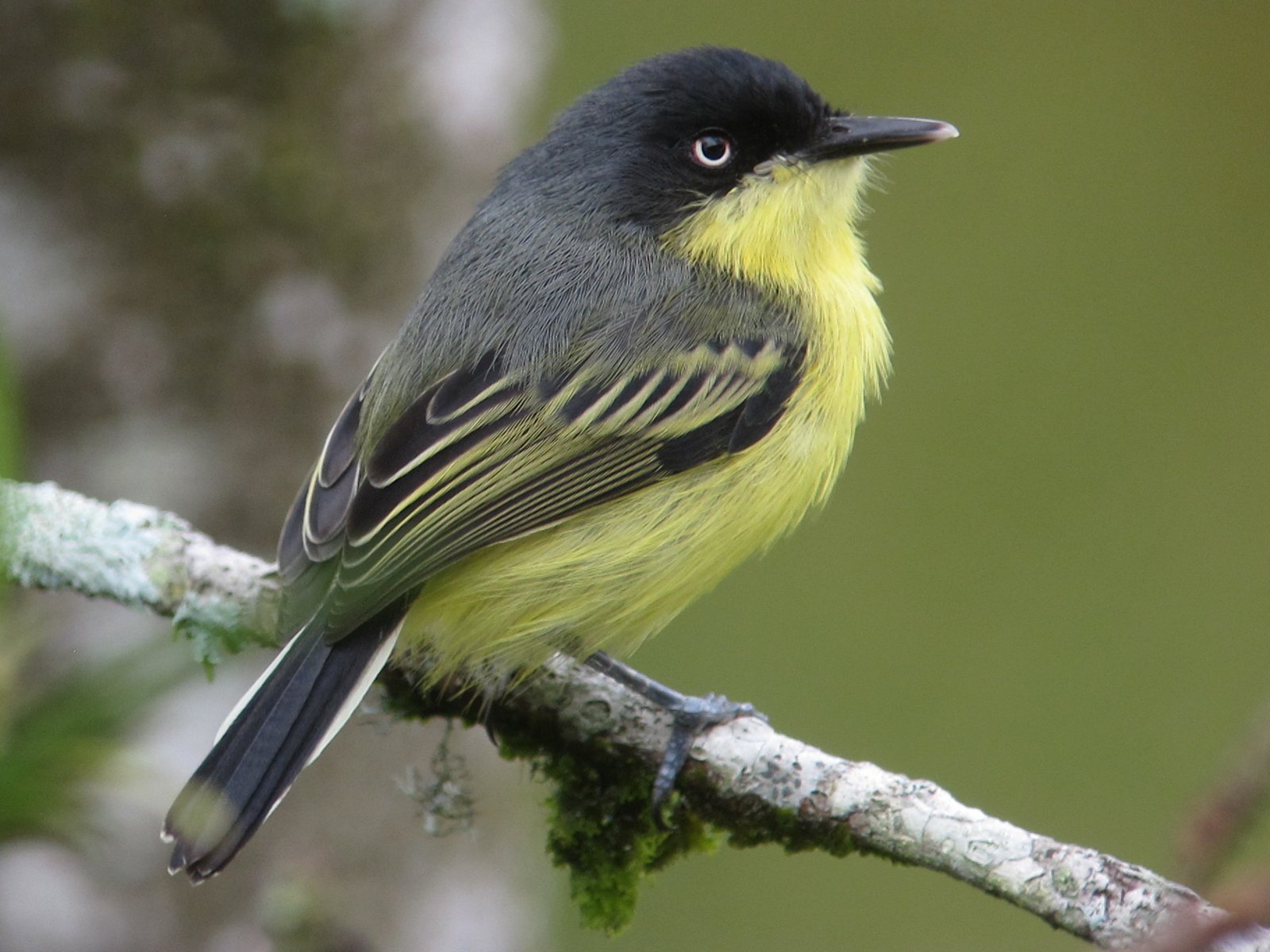
The Common Tody-Flycatcher is one of the most widespread small tyrants of tropical America, an inhabitant of forest edges, scrub and gardens. It moves sideways through the foliage, wagging its cocked tail from side to side. The long, flat bill is slightly widened at the tip.
Voice
A short, dry rattle and single, sharp tik notes, often in a quick series. Pairs call to each other frequently.
Recording: Fernando Igor de Godoy — CC BY-NC-SA 4.0 · xeno-canto
Identification
9–10 cm, with a long, flat bill and a tail that is often cocked. The forehead and forecrown are black, merging into a grey hindcrown and nape. The back is olive-green, the wings black with yellow edgings. The tail is black with white tips. The entire underparts are yellow, the throat slightly paler. The eye is pale yellow to white. The sexes are alike; young birds are duller, with a dark eye.
Confusion species
Spotted Tody-Flycatcher Todirostrum maculatum has a black-streaked throat and breast and lives along Amazonian rivers. Black-headed Tody-Flycatcher Todirostrum nigriceps has a glossy black head sharply contrasting with a bright green back, a white throat and a dark eye, and stays high in the canopy. Yellow-browed Tody-Flycatcher Todirostrum chrysocrotaphum has a yellow eyebrow and a dark eye. Slaty-headed Tody-Flycatcher Poecilotriccus sylvia has a grey head and greyish-white underparts.
Habitat
Forest edges, scrub, secondary forest, coffee plantations, parks and gardens, also in dry regions; mainly in the lowlands, but locally up to about 1900 m. It forages in pairs in the lower and middle strata for insects, which it picks from the undersides of leaves. The nest is a hanging, pear-shaped pouch with a side entrance.
Where the bird is most at home, classified by the vegetation units of the Andes and the west coast.


Range and movements
Colombia: widespread in the lowlands and on the lower slopes, including the Magdalena and Cauca valleys. Ecuador: widespread in the west, local in the east. Peru: in the north-west and locally in the eastern lowlands and foothills. Bolivia: local in the lowlands and foothills of the north and centre. Absent from the Galápagos. Outside the guide area from southern Mexico to Venezuela, the Guianas and Brazil.
- Resident
- dark = core range, pale = thinly spread
How and when to look
Look in gardens, parks and forest edges in the lowlands; watch for a small yellow bird that shuffles sideways along branches, wagging its tail.
Conservation status
Least Concern. The species benefits from open, human-shaped landscapes and also lives in towns.
Scientific name
Todirostrum cinereum | (Linnaeus, 1766)
Linnaeus described the species in 1766 as [Todus] cinereus; because it was later moved to another genus, the author and year stand in brackets. The genus Todirostrum was introduced in 1831 by Lesson. The genus name combines the genus Todus (todies) with Latin rostrum, 'bill', after the flat, tody-like bill. The species name is Latin cinereus, 'ash-grey', after the grey back and head. The specimen the first description was based on came from Suriname.