All species › Passerines › Tyrant flycatchers and allies › Alder Flycatcher
Alder Flycatcher | Empidonax alnorum
Elzenfeetiran | Mosquero ailero | Papa-moscas-de-alder
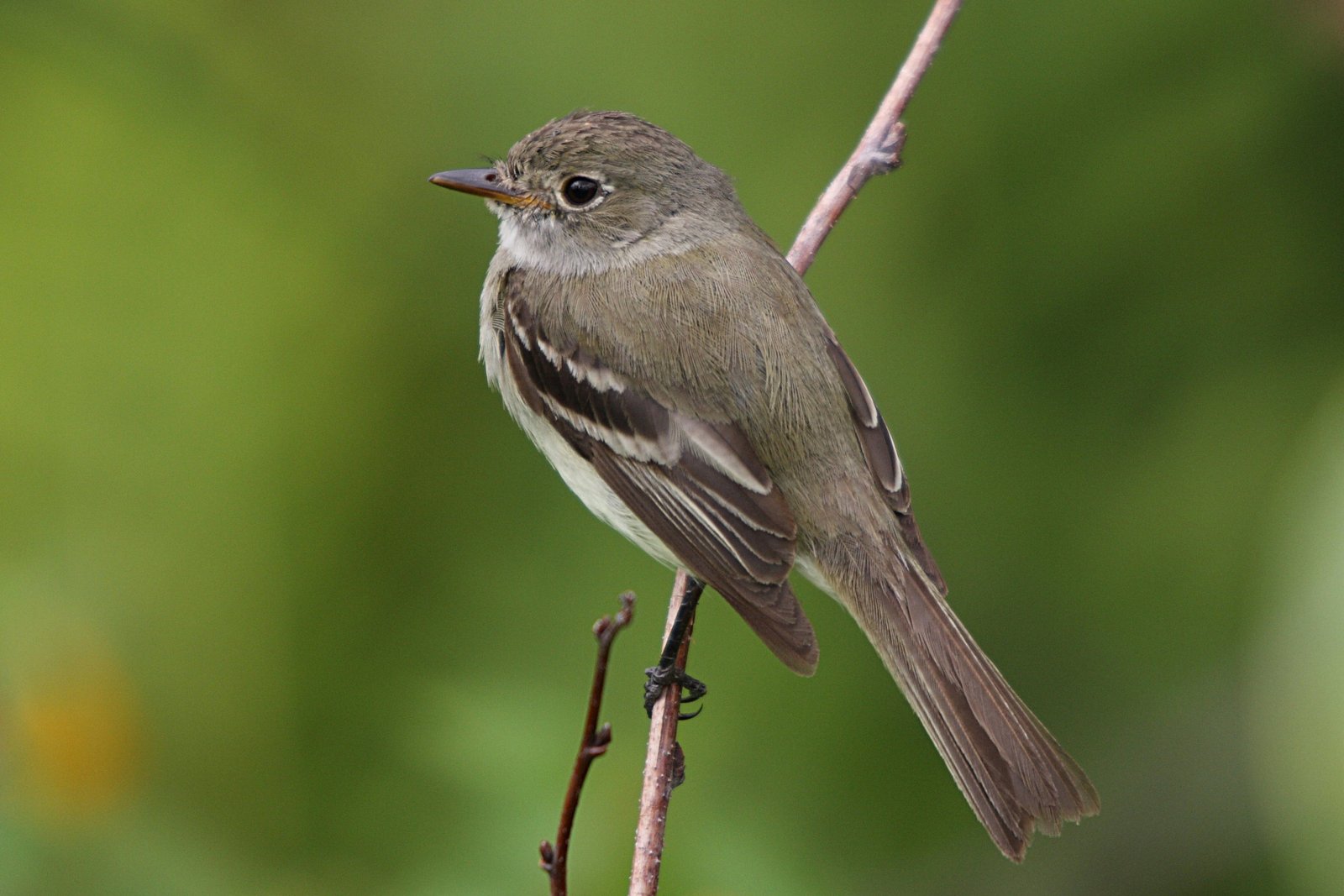
The Alder Flycatcher breeds in alder and willow thickets from Alaska and Canada to the north-eastern United States and migrates over a long distance to South America. In the guide area it is a winter visitor and passage migrant, mainly in the Amazonian lowlands. In the field it can only be separated with certainty from Willow Flycatcher by voice.
Voice
The call is a flat, short pip or kep. The song, also heard on the wintering grounds mainly in spring, is a burry free-BEE-o stressed on the middle syllable.
Recording: Stanislas Wroza — CC BY-NC-SA 4.0 · xeno-canto
Identification
14–15 cm. A small, slim flycatcher with a fairly broad bill whose lower mandible is pale orange-yellow. The upperparts are olive-brown to greenish olive, with a narrow, often indistinct white eye-ring. The throat is white, the breast washed greyish olive and the belly whitish with a pale yellow tinge. The dark wings show two pale wing-bars, buffier in first-winter birds. Sexes alike.
Confusion species
Willow Flycatcher Empidonax traillii is almost identical, on average slightly browner, with a weaker eye-ring and shorter primary projection; without a call or song a bird often cannot be named. Euler's Flycatcher Lathrotriccus euleri is browner, with cinnamon-buff wing-bars, and lives in the forest interior. Eastern Wood Pewee Contopus virens and Western Wood Pewee Contopus sordidulus are larger, with longer wings, a darker breast vest and no eye-ring. Fuscous Flycatcher Cnemotriccus fuscatus has a long pale supercilium.
Habitat
In winter in riverside scrub, on river islands with young scrub and cane, in second growth, clearings and forest edges, mainly below 1000 m; on migration also higher in the Andes. It perches low to mid-height in bushes and sallies for insects; sometimes eats berries. Breeds in North America in damp thickets; the nest is a loose cup low in a shrub.
Where the bird is most at home, classified by the vegetation units of the Andes and the west coast.


Range and movements
Colombia: mainly a passage migrant, in the east also a winter visitor. Ecuador: winter visitor and passage migrant in the eastern lowlands; on migration also on the western side. Peru: common winter visitor in the Amazonian lowlands, passage migrant in the Andes. Bolivia: winter visitor in the north and east. Absent from the Galápagos. Winters in South America east of the Andes, south to northern Argentina.
- Winter visitor (c. Oct–Mar)
- Passage (Mar–Apr, Oct–Nov)
- dark = core range, pale = thinly spread
How and when to look
From November to March, search river islands and riverside scrub in the Amazonian lowlands, for example along the Amazon near Iquitos or the Madre de Dios, and listen for the flat pip. In March and April birds sing more often, which makes identification certain.
Conservation status
Least Concern. Widespread and numerous on the breeding grounds; in the guide area a regular winter visitor.
Scientific name
Empidonax alnorum | Brewster, 1895
Brewster described the species in 1895 and placed it straight away in the genus where it still stands. The genus Empidonax was introduced in 1855 by Cabanis. The genus name combines Ancient Greek empis, 'gnat', with anax, 'lord' or 'master': 'lord of the gnats'. Latin alnorum, 'of the alders', after the alder thickets where it breeds. The specimen the first description was based on came from Upton, Maine, United States.