All species › Passerines › Tyrant flycatchers and allies › Willow Flycatcher
Willow Flycatcher | Empidonax traillii
Wilgenfeetiran | Mosquero saucero | Papa-moscas-do-salgueiro
The Willow Flycatcher breeds in willow thickets and damp scrub across much of the United States and southern Canada. It winters from Mexico to north-western South America, further south than most birds wintering in Central America but further north than Alder Flycatcher. The two species were long treated as one, 'Traill's Flycatcher'.
Voice
The call is a dry, upslurred whit, clearly different from the pip of Alder Flycatcher. The song is a sneezy fitz-bew, sometimes also heard on the wintering grounds.
Recording: Greg Irving — CC BY-NC-SA 4.0 · xeno-canto
Identification
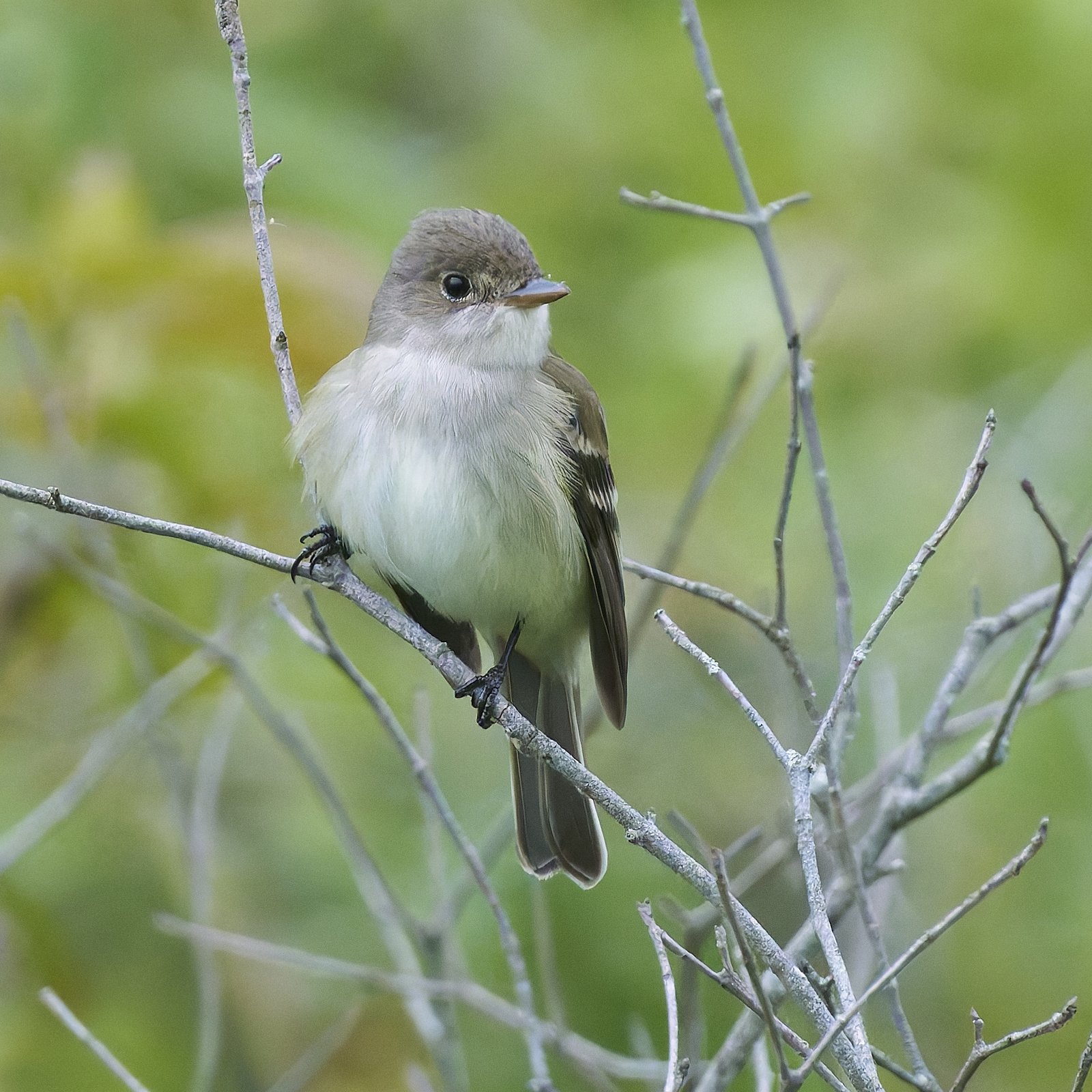
14–15 cm. Small and slim, with a fairly broad bill and a pale orange-yellow lower mandible. The upperparts are brownish olive, the eye-ring narrow and often barely visible. The throat is white, the breast washed greyish brown and the belly whitish with a faint yellow tinge. The wings show two pale wing-bars. Sexes alike.
Confusion species
Alder Flycatcher Empidonax alnorum is almost identical, on average slightly greener, with a slightly clearer eye-ring and longer primary projection; only the voice gives certainty. Acadian Flycatcher Empidonax virescens is greener above and has a clearer yellowish eye-ring. The wood pewees Contopus virens and Contopus sordidulus are larger, with long wings and no eye-ring. Euler's Flycatcher Lathrotriccus euleri has cinnamon-buff wing-bars.
Habitat
In winter in scrub near water, rank growth, riverside vegetation, wet pastures with bushes and forest edges in the lowlands, mostly below 1500 m. It perches low to mid-height on an open twig and sallies for insects. Breeds in North America in willow thickets; the nest is a compact cup in a shrub fork.
Where the bird is most at home, classified by the vegetation units of the Andes and the west coast.


Range and movements
Colombia: scarce winter visitor, mainly in the north and in the Magdalena and Cauca valleys. Ecuador: rare winter visitor with scattered records. Peru and Bolivia: at most rare; status uncertain because of confusion with Alder Flycatcher. Absent from the Galápagos. Winters mainly from Mexico to Panama and in northern South America.
- Winter visitor (c. Oct–Mar)
- Passage (Mar–Apr, Oct–Nov)
- dark = core range, pale = thinly spread
How and when to look
From November to March, search scrub near water in northern Colombia and listen for the dry whit. Note the call of every Empidonax; without voice the species remains unidentified.
Conservation status
Least Concern. Widespread, but declining in parts of the breeding range through loss of riverside vegetation; the subspecies of the south-western United States is endangered there.
Scientific name
Empidonax traillii | (Audubon, 1828)
Audubon described the species in 1828 as Muscicapa traillii; because it was later moved to another genus, the author and year stand in brackets. The genus Empidonax was introduced in 1855 by Cabanis. The genus name combines Ancient Greek empis, 'gnat', with anax, 'lord' or 'master': 'lord of the gnats'. Audubon honoured his friend Thomas Stewart Traill (1781–1862), a Scottish physician and zoologist and professor at Edinburgh. The specimen the first description was based on came from Arkansas River, United States.