All species › Passerines › Tyrant flycatchers and allies › Lesser Wagtail-Tyrant
Lesser Wagtail-Tyrant | Stigmatura napensis
Kleine kwikstaarttiran | Rabicano menor | Papa-moscas-do-sertão
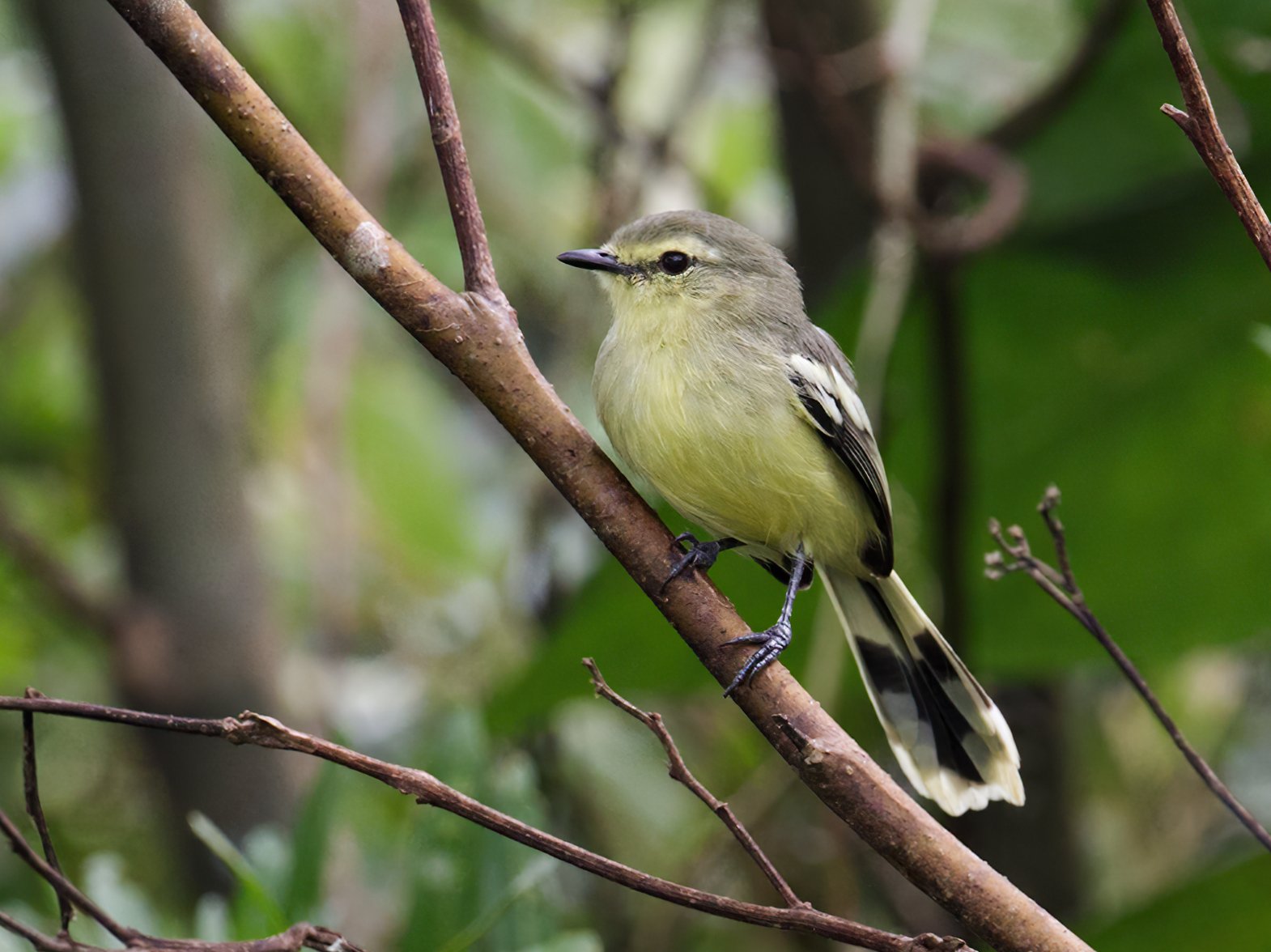
The Lesser Wagtail-Tyrant is a slender, yellow and greyish-olive tyrant with a long tail, found almost only on river islands in western Amazonia. It often holds the tail cocked and swings it from side to side, showing the white tail tips. Pairs sing in duet.
Voice
Pairs sing in duet, mainly in the early morning and late afternoon: one bird gives a descending, accelerating rattle, the other repeats a soft, melodious note. The call is a rich heeu. Birds in the Orinoco basin sing a different duet.
Recording: Juan Freile — CC BY-NC-SA 4.0 · xeno-canto
Identification
13 cm, with a thin black bill and a long, graduated tail. The crown and upperparts are greyish olive. The face is pale yellow, with a narrow yellow supercilium and a blackish eyeline. The throat and underparts are yellow, the breast washed olive. The wings are dusky, with white edges forming a white patch on the closed wing. The tail is dusky, with broad white tips to the outer feathers. The sexes are alike.
Confusion species
River Tyrannulet Serpophaga hypoleuca shares the habitat, but is grey and white, without yellow, and has a shorter tail without white tips. Plain Inezia Inezia inornata, which occurs on river islands as a migrant, is smaller and greyer, with a short tail and a white eye-ring. Tropical Gnatcatcher Polioptila plumbea moves its tail in a similar way, but is blue-grey and white.
Habitat
Young vegetation on river islands and along riverbanks, with Tessaria, tall grass, young willows and Cecropia, mostly below 300 m, in Colombia up to about 800 m. It searches for insects in shrubs and low trees, usually in pairs, with much tail movement. The nest is an open cup in a shrub.
Where the bird is most at home, classified by the vegetation units of the Andes and the west coast.


Range and movements
Colombia: along the Amazon on the border with Peru, and in Guainía in the Orinoco basin. Ecuador: along the Napo and the Aguarico. Peru: along the Napo, the Marañón, the Ucayali and the Amazon. Absent from Bolivia and the Galápagos. Outside the guide area along the Amazon and its tributaries in Brazil and in the far west of Venezuela.
- Resident
- dark = core range, pale = thinly spread
How and when to look
Search river islands with young shrubs and Tessaria, for example on boat trips on the Napo or on the Amazon near Iquitos and Leticia. The duet is often heard before the bird is seen.
Conservation status
Least Concern. The species depends on young island vegetation, which the river dynamics keep creating anew.
Scientific name
Stigmatura napensis | Chapman, 1926
Chapman described the species in 1926 and placed it straight away in the genus where it still stands. The genus Stigmatura was introduced in 1866 by Sclater & Salvin. The genus name comes from Greek stigma, 'spot', and oura, 'tail': 'spotted tail', after the white markings on the tail. The species name refers to the Napo River (Ecuador and Peru). The specimen the first description was based on came from Mouth of the Curaray on the Napo, Loreto, Peru.