All species › Passerines › Tyrant flycatchers and allies › Greater Wagtail-Tyrant
Greater Wagtail-Tyrant | Stigmatura budytoides
Grote kwikstaarttiran | Rabicano mayor | Alegrinho-balança-rabo
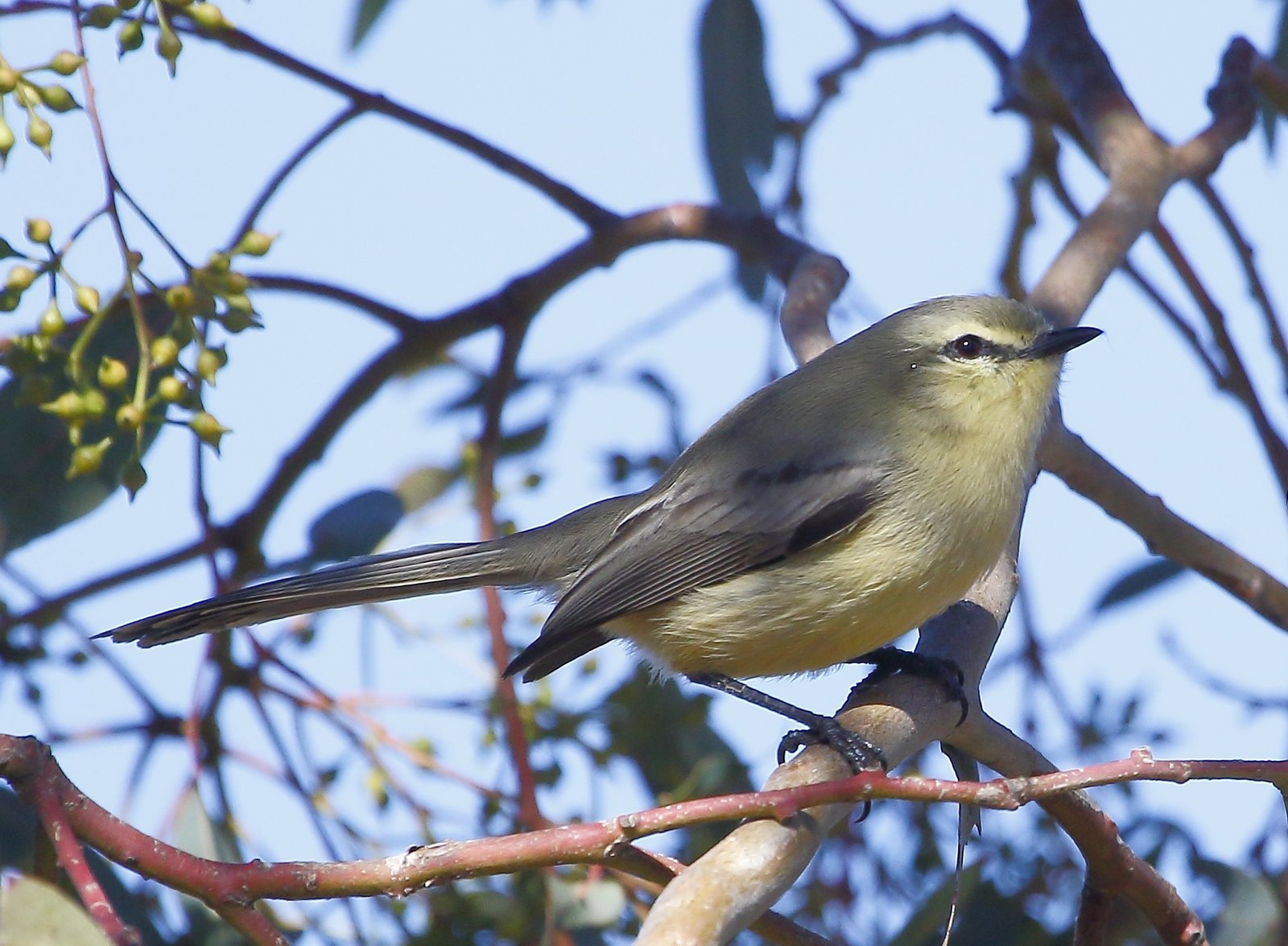
The Greater Wagtail-Tyrant is a long-tailed, yellow and greyish-olive tyrant of the dry scrub of the Chaco and the dry valleys of Bolivia. Like its smaller relative it often holds the tail cocked and swings it from side to side. Pairs stay together all year and sing in duet.
Voice
Pairs sing in duet: one bird gives a high, liquid series of notes, the other a lower trill. The call is a short churt, sometimes in series, and a more complex chatter is sometimes heard.
Recording: Jacob Wijpkema — CC BY-NC-SA 4.0 · xeno-canto
Identification
15 cm, with a fairly long black bill and a long, graduated tail. The crown and upperparts are greyish olive. There is a bright yellow supercilium and a blackish eyeline. The underparts are bright yellow, the breast slightly washed buff. The wings are dusky, with white edges forming a large white patch on the closed wing. The tail is dusky, with white tips to the outer feathers and a white base to the outermost pair. The sexes are alike.
Confusion species
Lesser Wagtail-Tyrant Stigmatura napensis is smaller and lives on river islands in Amazonia, far from the range of this species. Plain Inezia Inezia inornata lives in the same dry forest, but is smaller and greyer below, with a short tail and a white eye-ring. Masked Gnatcatcher Polioptila dumicola moves its tail in a similar way, but is blue-grey without yellow.
Habitat
Dry scrub, thorn forest and dry deciduous woodland of the Chaco, and gallery forest in savanna, from the lowlands to about 1000 m, in the dry valleys of Bolivia up to about 2700 m. It searches for insects in pairs in shrubs and low trees, with much tail movement. The nest is an open cup in a shrub.
Where the bird is most at home, classified by the vegetation units of the Andes and the west coast.


Range and movements
Bolivia: in the dry inter-Andean valleys and the Chaco of Cochabamba, Santa Cruz and Chuquisaca, south to the border with Argentina. Absent from Colombia, Ecuador, Peru and the Galápagos. Outside the guide area in western Paraguay, in Argentina south to Río Negro, and with a smaller form in the caatinga of north-eastern Brazil.
- Resident
- dark = core range, pale = thinly spread
How and when to look
Search thorn scrub in the dry valleys south-west of Santa Cruz and in the Chaco; listen for the duet and look for a bird with a long, swinging tail at the top of a shrub.
Conservation status
Least Concern. The species is widespread in dry scrub, but deforestation in the Chaco reduces its habitat locally.
Scientific name
Stigmatura budytoides | (d'Orbigny, ACVMD & de Lafresnaye, 1837)
D'Orbigny, ACVMD & de Lafresnaye described the species in 1837 as C[ulicivora] budytoides; because it was later moved to another genus, the author and year stand in brackets. The genus Stigmatura was introduced in 1866 by Sclater & Salvin. The genus name comes from Greek stigma, 'spot', and oura, 'tail': 'spotted tail', after the white markings on the tail. The species name combines Budytes, an old genus name for wagtails, with Greek -oidēs, 'resembling': 'wagtail-like', after the way it wags its long tail. The specimen the first description was based on came from Vallegrande, Santa Cruz, Bolivia.