All species › Passerines › Tyrant flycatchers and allies › Rufous Flycatcher
Rufous Flycatcher | Myiarchus semirufus
Rosse tiran | Copetón rufo | Maria-cavaleira-ruiva
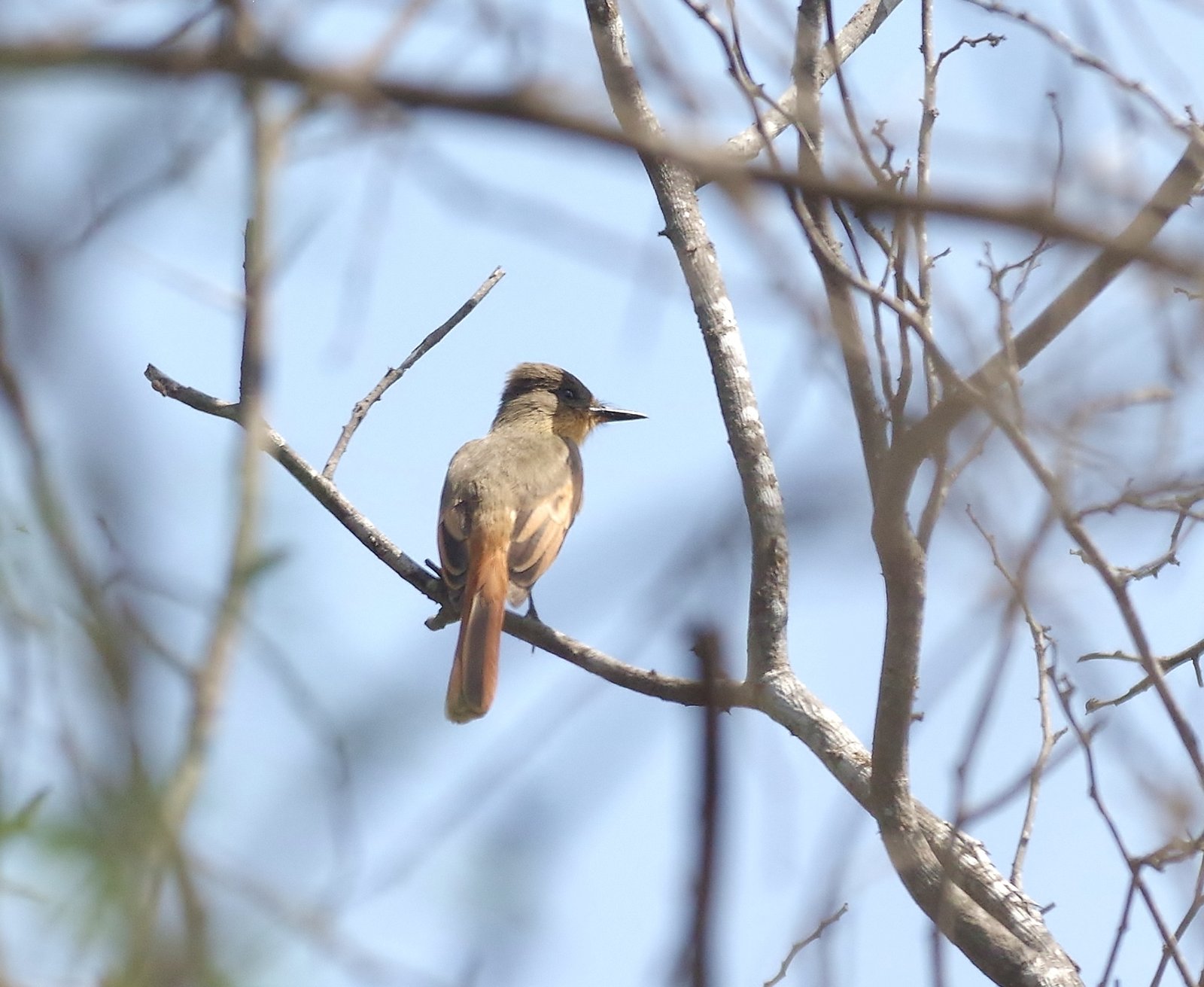
The Rufous Flycatcher is the only Myiarchus with entirely rufous underparts. It occurs only in the dry coastal lowlands of north-western Peru, where it is tied to woodland and scrub of algarrobo (Prosopis). The loss of this woodland has caused its population to decline.
Voice
Rolling, rattling calls and short, clear whistles; in the morning repeated series of such notes.
Recording: Jerome Fischer — CC BY-NC-SA 4.0 · xeno-canto
Identification
18 cm, with a black bill and a small, rounded crest. The upperparts are dark greyish brown, the crown slightly darker. Throat, breast and belly are uniformly cinnamon to rufous. The wings are dark, with broad rufous edges to the coverts and flight feathers. The tail is largely rufous, with darker central feathers. The sexes are alike; juveniles have broader rufous edges to the wing feathers.
Confusion species
Sooty-crowned Flycatcher Myiarchus phaeocephalus and Dusky-capped Flycatcher Myiarchus tuberculifer have a grey throat and breast and a yellow belly. Ochraceous Attila Attila torridus is larger, with a heavy, hook-tipped bill, paler ochre underparts and an olive back; it lives in more humid forest.
Habitat
Dry woodland and scrub of algarrobo and other thorny shrubs, riparian woodland along desert rivers and scrubby field edges, mainly below 500 m. It catches insects in short sallies from a perch in the shrubs. It nests in tree cavities, like other members of the genus.
Where the bird is most at home, classified by the vegetation units of the Andes and the west coast.


Range and movements
Peru: in the coastal lowlands from Tumbes south to northern Lima department, with the largest numbers in Piura, Lambayeque and La Libertad. Absent from Colombia, Ecuador, Bolivia and the Galápagos. The species does not occur outside Peru.
- Resident
- dark = core range, pale = thinly spread
How and when to look
Search the algarrobo woodland of Lambayeque, for example in Bosque de Pómac, in the early morning, when the birds call from the tops of shrubs.
Conservation status
Vulnerable. The range is small and fragmented. Algarrobo woodland is cleared for farming, irrigation projects and charcoal, and the species has declined strongly in the south of its range.
Scientific name
Myiarchus semirufus | Sclater & Salvin, 1878
Sclater & Salvin described the species in 1878 and placed it straight away in the genus where it still stands. The genus Myiarchus was introduced in 1844 by Cabanis. The genus name comes from Greek muia, 'fly', and arkhos, 'ruler, chief'. The species name comes from Latin semi, 'half', and rufus, 'red, rufous'. The specimen the first description was based on came from Pacasmayo, Peru.