All species › Passerines › Tyrant flycatchers and allies › Dusky-capped Flycatcher
Dusky-capped Flycatcher | Myiarchus tuberculifer
Donkerkaptiran | Copetón capirotado | Maria-cavaleira-pequena
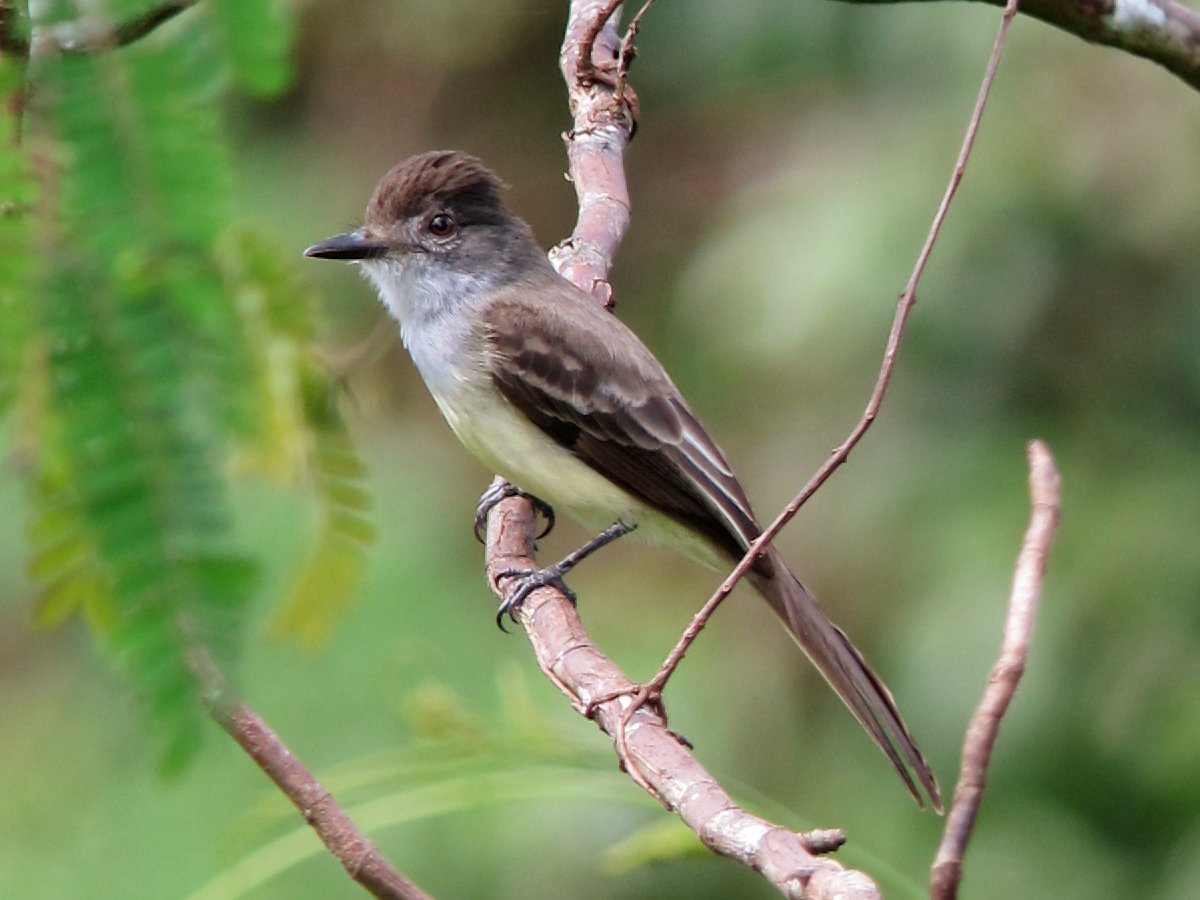
The Dusky-capped Flycatcher is the smallest Myiarchus of the guide area and the most widespread, from the lowlands to high in the Andes. The blackish cap, sharply set off from the olive back, distinguishes it from related species. Its plaintive, descending whistle is often heard at forest edges.
Voice
A plaintive, drawn-out, descending whistle like wheeeeur, also a short wheet and series of whistles at dawn.
Recording: José María Loaiza B. — CC BY-NC-SA 4.0 · xeno-canto
Identification
16–18 cm, with a slender, black bill. The crown is blackish to sooty brown and contrasts with the olive-green back. The throat and breast are pale grey, the belly bright yellow. The wings are dark, with faint pale wing bars and narrow rufous edges to the flight feathers; the tail also has narrow rufous edges. Andean birds (atriceps) are larger and have a blacker cap. The sexes are alike.
Confusion species
Sooty-crowned Flycatcher Myiarchus phaeocephalus is larger, with a greyer crown that grades into the back. Short-crested Flycatcher Myiarchus ferox and Swainson's Flycatcher Myiarchus swainsoni are larger and plainer, without a contrasting cap. Pale-edged Flycatcher Myiarchus cephalotes, in montane forest, is larger, with pale edges to the outer tail feathers.
Habitat
Humid and dry forest, forest edges, secondary forest, clearings with trees and plantations, from sea level to about 3000 m. It often forages at middle and upper levels and catches insects in short sallies or gleans them from leaves. It nests in tree cavities.
Where the bird is most at home, classified by the vegetation units of the Andes and the west coast.


Range and movements
In Colombia throughout the country, in the lowlands and on the Andean slopes. In Ecuador in the west, the east and on both Andean slopes. In Peru in the Amazonian lowlands, on the eastern slope and in the north-west. In Bolivia in the lowlands and the Yungas. Absent from the Galápagos. Outside the guide area from the south-western United States through Central America to Brazil and northern Argentina.
- Resident
- dark = core range, pale = thinly spread
How and when to look
Listen for the descending whistle at forest edges and along trails; the bird often sits still on a branch in the half-light below the canopy.
Conservation status
Least Concern. The species has a very large range and tolerates forest edges and secondary forest.
Scientific name
Myiarchus tuberculifer | (d'Orbigny, ACVMD & de Lafresnaye, 1837)
D'Orbigny, ACVMD & de Lafresnaye described the species in 1837 as T[yrannus] tuberculifer; because it was later moved to another genus, the author and year stand in brackets. The genus Myiarchus was introduced in 1844 by Cabanis. The genus name comes from Greek muia, 'fly', and arkhos, 'ruler, chief'. The species name comes from Latin tuberculum, 'small swelling, knob', and -fer, 'bearing'. The describers d'Orbigny and de Lafresnaye (1837) mentioned two small horny knobs on the inner side of the wing, near the bend. The specimen the first description was based on came from Guarayos, Santa Cruz, Bolivia.