All species › Passerines › Tyrant flycatchers and allies › Swainson's Flycatcher
Swainson's Flycatcher | Myiarchus swainsoni
Swainsons tiran | Copetón de Swainson | Irré
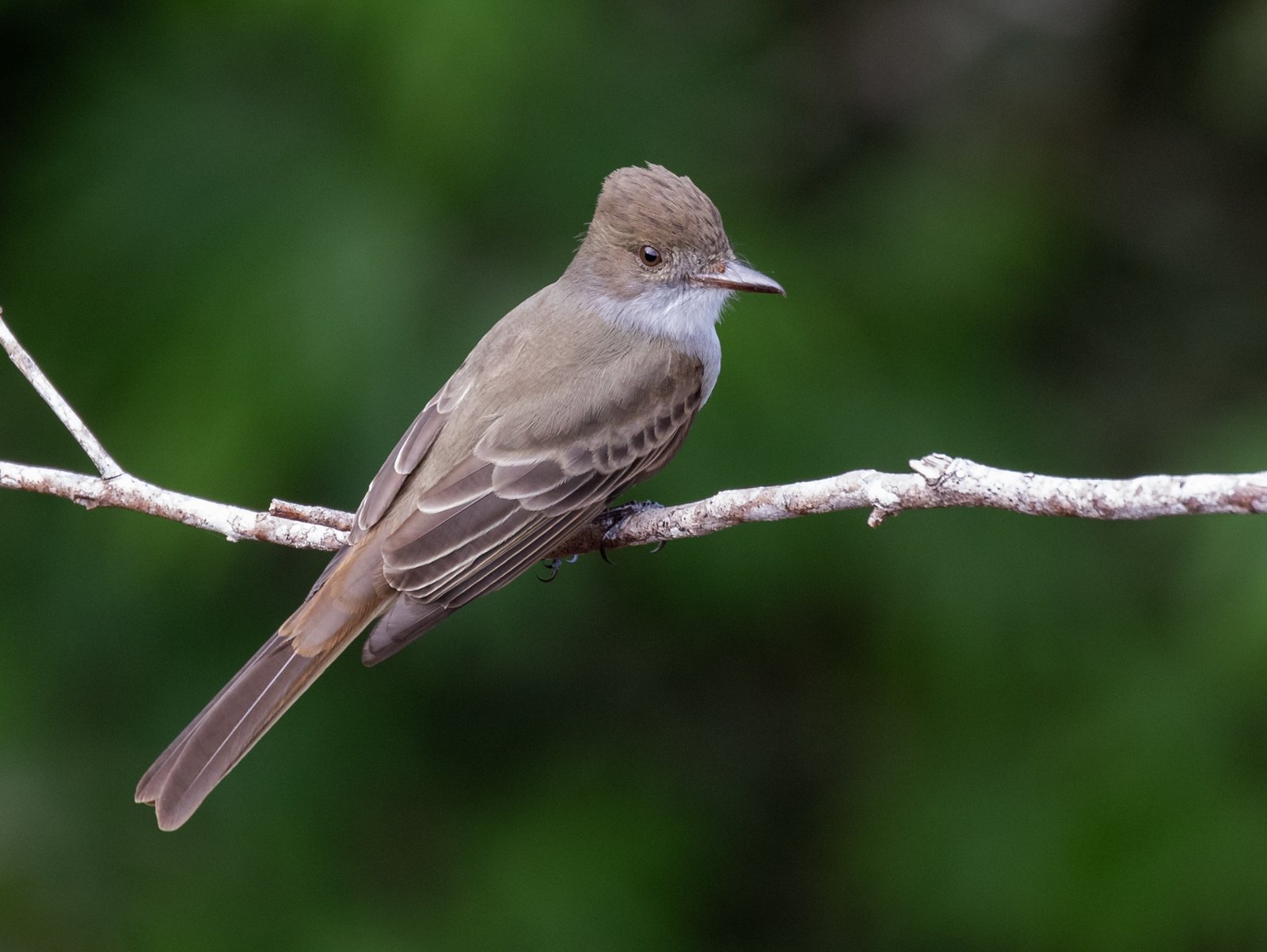
Swainson's Flycatcher is a plain Myiarchus with several subspecies, some of them resident and others moving as austral migrants to Amazonia in the austral winter. The guide area thus hosts breeders, residents and winter visitors of different origins. It closely resembles Short-crested Flycatcher.
Voice
Mostly silent outside the breeding season; a soft wheet or whip and a short, descending whistle. At dawn series of whistles.
Recording: Fabrício Grigolin — CC BY-NC-SA 4.0 · xeno-canto
Identification
19–20 cm. The upperparts are dull greyish brown to olive-brown, the crown barely darker. The throat and breast are pale grey, the belly pale yellow. The wings have pale, whitish edges to the coverts and tertials and little or no rufous; the tail is brown without rufous. In some birds the base of the lower mandible is pale, pinkish or orangey. The sexes are alike.
Confusion species
Short-crested Flycatcher Myiarchus ferox is darker, with an all-black bill and a different call. Brown-crested Flycatcher Myiarchus tyrannulus has much rufous in the wing and tail. Dusky-capped Flycatcher Myiarchus tuberculifer is smaller, with a dark cap. Great Crested Flycatcher Myiarchus crinitus, a northern winter visitor, has a dark grey breast and rufous in the wing and tail.
Habitat
Forest edges, savanna woodland, gallery forest, várzea and vegetated river islands, Chaco dry forest and cerrado, mainly in the lowlands up to about 1000 m. It catches insects in short sallies from a perch and also eats berries. It nests in tree cavities.
Where the bird is most at home, classified by the vegetation units of the Andes and the west coast.


Range and movements
In Bolivia a breeding bird in the eastern and southern lowlands, with wintering birds in the north. In Peru, Ecuador and Colombia mainly a winter visitor to the Amazonian lowlands in the austral winter (roughly April to October); in eastern Colombia also a resident population. Absent west of the Andes and from the Galápagos. Outside the guide area in Venezuela, the Guianas, Brazil, Paraguay, Argentina and Uruguay.
- Resident
- dark = core range, pale = thinly spread
How and when to look
In the austral winter search forest edges and river islands in the Amazonian lowlands; in Bolivia in the breeding season (roughly October to March) in savanna woodland and Chaco forest. Note the pale lower mandible.
Conservation status
Least Concern. The species has a very large range and tolerates semi-open country.
Scientific name
Myiarchus swainsoni | Cabanis & Heine, 1860
Cabanis & Heine described the species in 1860 and placed it straight away in the genus where it still stands. The genus Myiarchus was introduced in 1844 by Cabanis. The genus name comes from Greek muia, 'fly', and arkhos, 'ruler, chief'. The species name honours William Swainson (1789–1855), an English naturalist and ornithologist. The specimen the first description was based on came from Rio de Janeiro, Brazil.