All species › Kingfishers, bee-eaters and rollers › Kingfishers › Amazon Kingfisher
Amazon Kingfisher | Chloroceryle amazona
Amazone-ijsvogel | Martín pescador amazónico | Martim-pescador-verde
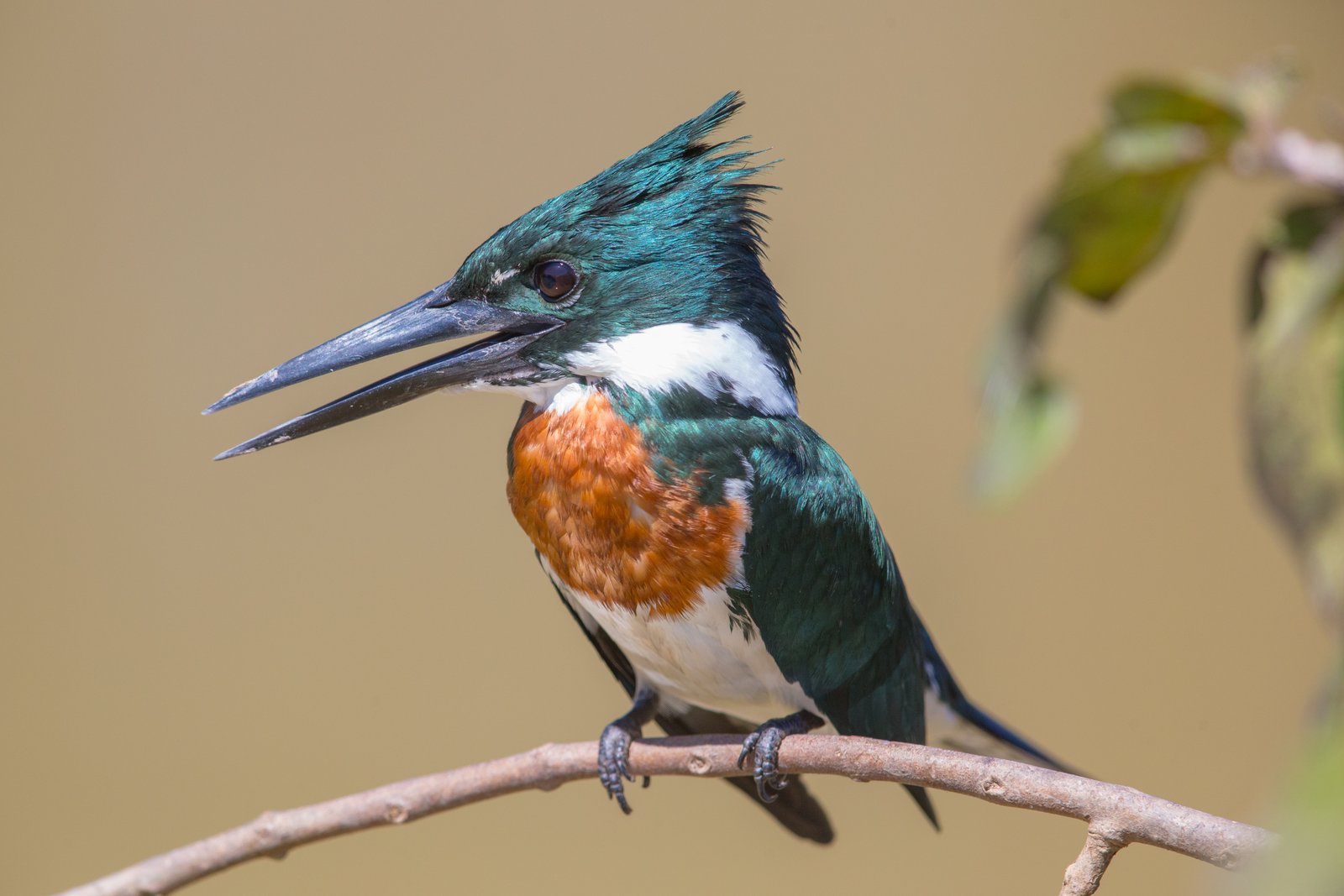
The Amazon Kingfisher is the largest of the green kingfishers, medium-sized and heavily built, with a strikingly long bill. It is dark oily green above and white below; the male has a rufous breast band. Along clear rivers and lakes in the lowlands it is one of the most frequently seen kingfishers.
Voice
A hard, dry tek or trrt, often in flight, and a series of whistled notes that speeds up.
Recording: Ricardo José Mitidieri — CC BY-NC-SA 4.0 · xeno-canto
Identification
29–30 cm, with a small, shaggy crest and a long, heavy, black bill. The upperparts are dark, glossy oily green, with no or at most a few white spots on the wings. A white collar runs from the throat round the neck. The male has a broad rufous breast band and a white belly with green streaks on the flanks. The female lacks the rufous band and instead has green patches on the sides of the breast, sometimes a broken green band. Juveniles resemble the female, with pale spots on the wings.
Confusion species
Green Kingfisher Chloroceryle americana has the same colours but is much smaller, with a shorter bill, obvious white spots on the wings and much white on the outer tail. Ringed Kingfisher Megaceryle torquata is larger and blue-grey above, with a rufous belly.
Habitat
Open riverbanks, lakes, oxbow lakes, marshes and mangroves in the lowlands; also along canals and ponds in open country. Mostly below 1000 m, locally higher along rivers in the foothills. It perches on a low to mid-height branch over water and dives for fish. The nest is in a burrow it digs in a steep bank.
Where the bird is most at home, classified by the vegetation units of the Andes and the west coast.


Range and movements
In Colombia in the lowlands on both sides of the Andes, including the Magdalena valley and the Caribbean lowlands. In Ecuador in the western and eastern lowlands. In Peru mainly in the Amazonian lowlands; on the Pacific side only in the far north-west. In Bolivia in the northern and eastern lowlands. Absent from the Galápagos. Outside the guide area from Mexico to northern Argentina.
- Resident
- dark = core range, pale = thinly spread
How and when to look
Search open riverbanks and the edges of oxbow lakes in the Amazonian lowlands, where it sits on low branches over the water. From a boat it often moves ahead from branch to branch.
Conservation status
Least Concern. Widespread and fairly common; locally sensitive to pollution and siltation of the water.
Scientific name
Chloroceryle amazona | (Latham, 1790)
Latham described the species in 1790 as Alcedo amazona; because it was later moved to another genus, the author and year stand in brackets. The genus Chloroceryle was introduced in 1848 by Kaup. The genus name combines Greek khlōros, 'green', with the genus Ceryle (from Greek kērulos, a mythical sea bird). The species name refers to the Amazon. The specimen the first description was based on came from Cayenne, French Guiana.