All species › Kingfishers, bee-eaters and rollers › Kingfishers › Ringed Kingfisher
Ringed Kingfisher | Megaceryle torquata
Amerikaanse reuzenijsvogel | Martín pescador grande | Martim-pescador-grande
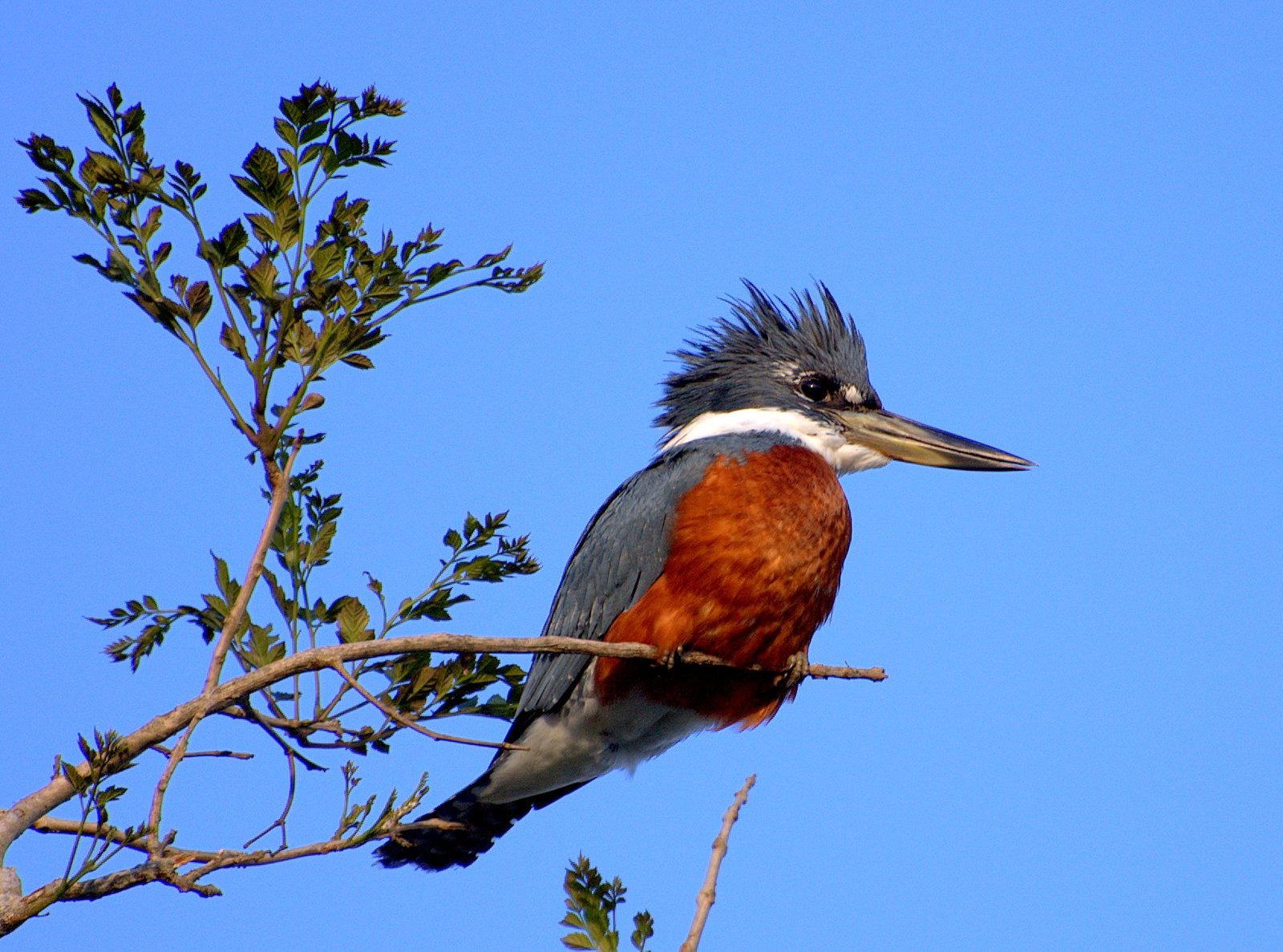
The Ringed Kingfisher is the largest kingfisher in the guide area, nearly forty centimetres long. It is blue-grey above and rufous below, with a white collar and a ragged crest. Along the big lowland rivers it is a regular sight, flying high over the water and calling loudly.
Voice
A loud, harsh klek or chack, often in flight, and a long rattling series of such notes, more powerful than in the other kingfishers.
Recording: JAYRSON ARAUJO DE OLIVEIRA — CC BY-NC-SA 4.0 · xeno-canto
Identification
38–41 cm, with a large, shaggy-crested head and a very heavy, straight, dark bill with a paler base. The upperparts are blue-grey, with small white spots on wings and tail; a broad white collar runs from the throat round the neck. The male has the breast and belly entirely rufous, with white undertail coverts. The female has a blue-grey breast band, below it a narrow white band, and then a rufous belly. In flight the underwings are white in the male and rufous in the female. Juveniles resemble the female, with a rust-tinged breast.
Confusion species
Belted Kingfisher Megaceryle alcyon, a scarce winter visitor, is smaller and has a white belly; the female has only a narrow rufous band across the belly. Amazon Kingfisher Chloroceryle amazona is smaller and dark oily green above, with a white belly.
Habitat
Broad rivers, lakes, oxbow lakes, lagoons, mangroves and estuaries in the lowlands, also reservoirs and fish farms; mostly below 1000 m, locally higher in valleys. It often sits high on a dead branch over the water and dives for fairly large fish; it hovers less often than Belted Kingfisher. The nest is at the end of a long burrow it digs in a steep sand or clay bank.
Where the bird is most at home, classified by the vegetation units of the Andes and the west coast.


Range and movements
In Colombia in the lowlands on both sides of the Andes, also in the Magdalena and Cauca valleys. In Ecuador in the western and eastern lowlands. In Peru mainly in the Amazonian lowlands; on the Pacific side only in the far north-west. In Bolivia in the northern and eastern lowlands. Absent from the Galápagos. Outside the guide area from Mexico and the Caribbean to Tierra del Fuego.
- Resident
- dark = core range, pale = thinly spread
How and when to look
From a boat or bank along the large Amazonian rivers and oxbow lakes, watch tall bare branches above the water. It often flies in a straight line across the river and gives itself away by its harsh klek.
Conservation status
Least Concern. Common and widespread; it locally benefits from reservoirs and fish farms, but is sensitive to heavy water pollution.
Scientific name
Megaceryle torquata | (Linnaeus, 1766)
Linnaeus described the species in 1766 as Alcedo torquata; because it was later moved to another genus, the author and year stand in brackets. The genus Megaceryle was introduced in 1848 by Kaup. The genus name combines Greek megas, 'great', with the genus Ceryle (from Greek kērulos, a mythical sea bird). The species name is Latin torquatus, 'collared', after the white neck ring. The specimen the first description was based on came from Martinique and Mexico.