All species › Kingfishers, bee-eaters and rollers › Kingfishers › Belted Kingfisher
Belted Kingfisher | Megaceryle alcyon
Bandijsvogel | Martín gigante norteamericano | Martim-pescador-norte-americano
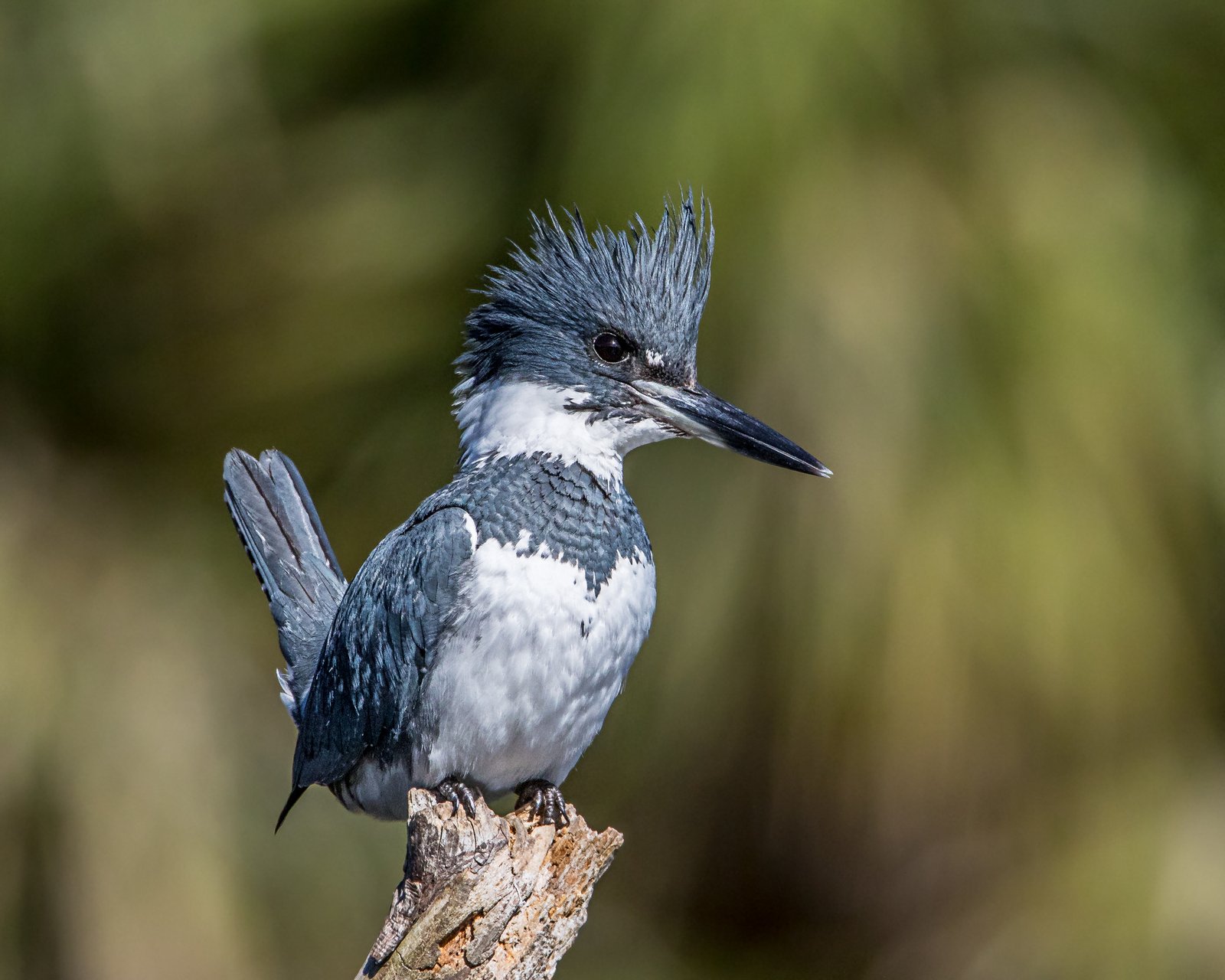
The Belted Kingfisher is the kingfisher of North America, which in the northern winter travels in small numbers as far as northern South America. It is a large, blue-grey kingfisher with a ragged crest and a white collar. In this species the female is more colourful than the male: only she has a rufous band across the belly.
Voice
A loud, dry, rattling series, krrrrrrr or kek-kek-kek-kek, often in flight and when flushed.
Recording: Rory Nefdt — CC BY-NC-SA 4.0 · xeno-canto
Identification
28–35 cm, with a large head, a ragged, double-pointed crest and a heavy, straight, black bill. The upperparts are slate blue-grey, with small white spots on the wings and tail. A broad white collar runs round the neck, and there is a white spot in front of the eye. A blue-grey band crosses the breast, and the rest of the underparts are white. The female has an additional rufous band across the belly that continues onto the flanks. Juveniles have a rust-tinged breast band.
Confusion species
Ringed Kingfisher Megaceryle torquata is larger, with a much heavier bill, and has an entirely rufous belly; in the female of that species only the breast is blue-grey. Amazon Kingfisher Chloroceryle amazona is dark oily green rather than blue-grey and lacks a grey breast band.
Habitat
Rivers, lakes, lagoons, mangroves, estuaries and ponds, also artificial waters such as fish farms, from the coast into the Andes; in the guide area mainly in the lowlands and lower valleys, locally above 2500 m. It perches on a branch or wire over water or hovers, and dives from there for fish; it also takes crustaceans and insects. It breeds only in North America, in a burrow it digs in a steep bank.
Where the bird is most at home, classified by the vegetation units of the Andes and the west coast.


Range and movements
In Colombia a scarce winter visitor, mainly in the north and along the Caribbean coast, also scattered in the Andean valleys and the lowlands. In Ecuador rare, with scattered records. In Peru and Bolivia only very few records. Not known from the Galápagos. Breeds in Alaska, Canada and the United States; winters south to Central America, the Caribbean and northern South America.
- Winter visitor (c. Oct–Mar)
- dark = core range, pale = thinly spread
How and when to look
Search larger lakes, lagoons and rivers in northern Colombia from November to March. It often gives itself away first by its rattling call, and then sits in the open on a prominent perch over the water.
Conservation status
Least Concern. The North American population has declined over recent decades but remains large.
Scientific name
Megaceryle alcyon | (Linnaeus, 1758)
Linnaeus described the species in 1758 as Alcedo Alcyon; because it was later moved to another genus, the author and year stand in brackets. The genus Megaceryle was introduced in 1848 by Kaup. The genus name combines Greek megas, 'great', with the genus Ceryle (from Greek kērulos, a mythical sea bird). The species name comes from Greek alkuōn, 'kingfisher'. The specimen the first description was based on came from South Carolina, United States.