All species › Kingfishers, bee-eaters and rollers › Motmots › Andean Motmot
Andean Motmot | Momotus aequatorialis
Hooglandmotmot | Momoto andino | Udu-andino
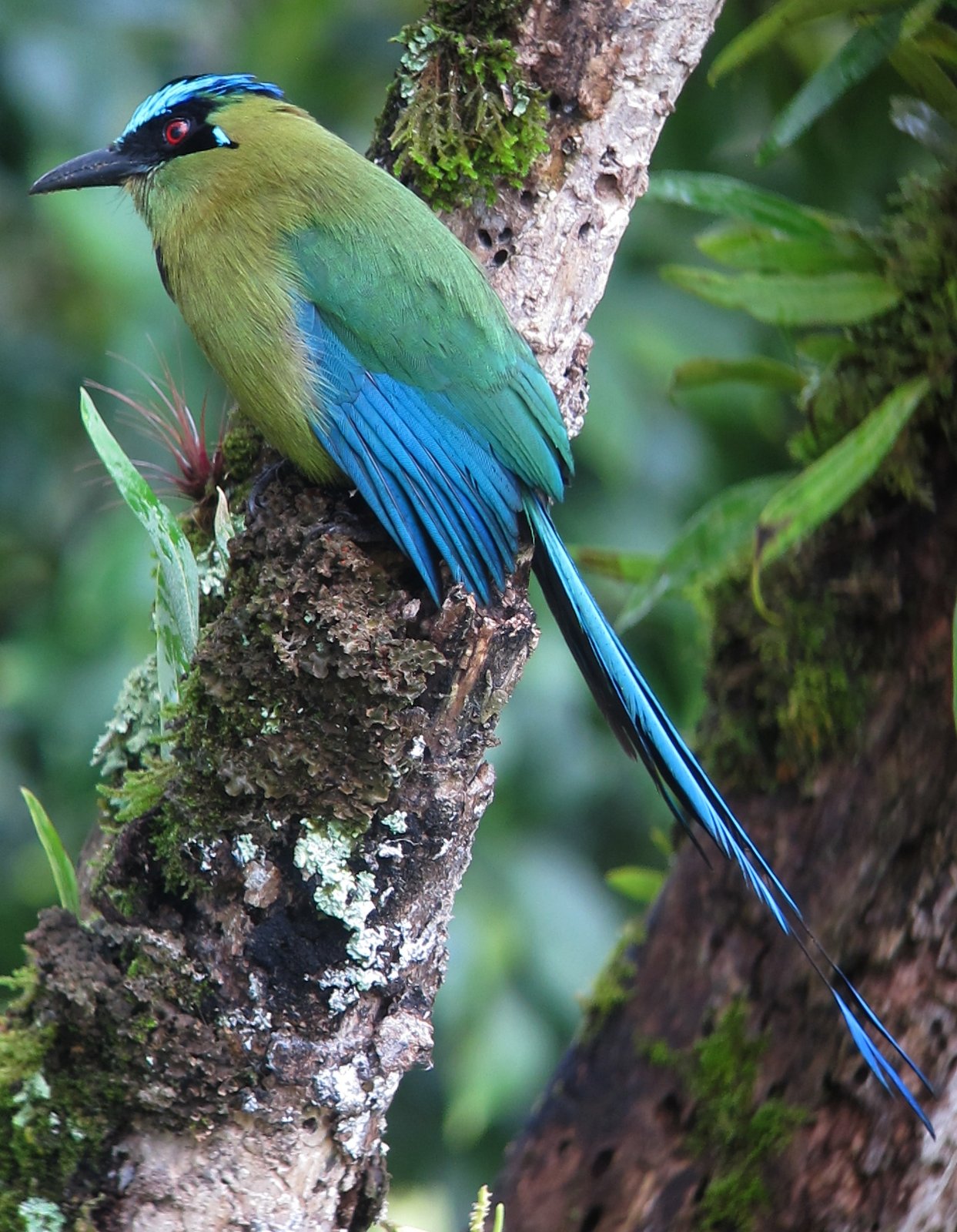
The Andean Motmot is the largest Momotus motmot and the only motmot that lives high in the Andes, in montane forest from Colombia to Bolivia. It sits motionless and upright on a branch, swinging its long, racquet-tipped tail like a pendulum. It lives higher than the other motmots and replaces Amazonian Motmot on the mountain slopes.
Voice
A low, hollow, doubled call, like hoo-doo, also a rolling, quavering call, mainly in the twilight before dawn.
Recording: Zsombor Károlyi — CC BY-NC-SA 4.0 · xeno-canto
Identification
43–48 cm, including the long tail with black-tipped racquets. The crown is black, surrounded by a broad turquoise to blue band. A broad black mask is edged blue-green below. The upperparts are green, the underparts green to olive-green, with one or two black spots on the breast. The iris is red. The sexes are alike; juveniles are duller, with a smaller crown pattern.
Confusion species
Amazonian Motmot Momotus momota is smaller, more rufous below, with a narrower blue crown band, and lives in the lowlands. Whooping Motmot Momotus subrufescens is smaller and more cinnamon below and lives in the lowlands west of the Andes. Rufous Motmot Baryphthengus martii has an all-rufous head and breast and lives lower.
Habitat
Humid montane forest, cloud forest, forest edges, old secondary forest and shaded coffee plantations, at roughly 1000 to 2800 m. It sits still at mid-height for long periods and sallies for large insects, small lizards and other small animals, and also eats fruit. It nests in a long tunnel in an earth bank, often a road cutting.
Where the bird is most at home, classified by the vegetation units of the Andes and the west coast.


Range and movements
In Colombia on the slopes of all three cordilleras and in the mountains of the north. In Ecuador mainly on the eastern slope of the Andes. In Peru on the eastern slope of the Andes from north to south. In Bolivia in the Yungas. Absent from the Galápagos. Outside the guide area only in a small area on the Venezuela–Colombia border.
- Resident
- dark = core range, pale = thinly spread
How and when to look
In shaded coffee plantations and along mountain roads through forest edges at middle elevations, such as in the coffee region of Colombia and along the roads over the eastern slope in Ecuador and Peru. In the early morning the hollow calls give the birds away.
Conservation status
Least Concern. The species tolerates semi-open landscapes with trees, such as shaded coffee plantations.
Scientific name
Momotus aequatorialis | Gould, 1858
Gould described the species in 1858 and placed it straight away in the genus where it still stands. The genus Momotus was introduced in 1760 by Brisson. The genus name is a Latinisation of momot or motmot, a Mexican (Nahuatl) name for these birds. The species name aequatorialis means 'of the equator' and refers to Ecuador, not necessarily the type locality. The specimen the first description was based on came from Archidona, Ecuador.