All species › Kingfishers, bee-eaters and rollers › Kingfishers › American Pygmy Kingfisher
American Pygmy Kingfisher | Chloroceryle aenea
Groene dwergijsvogel | Martín pescador enano | Martim-pescador-miúdo
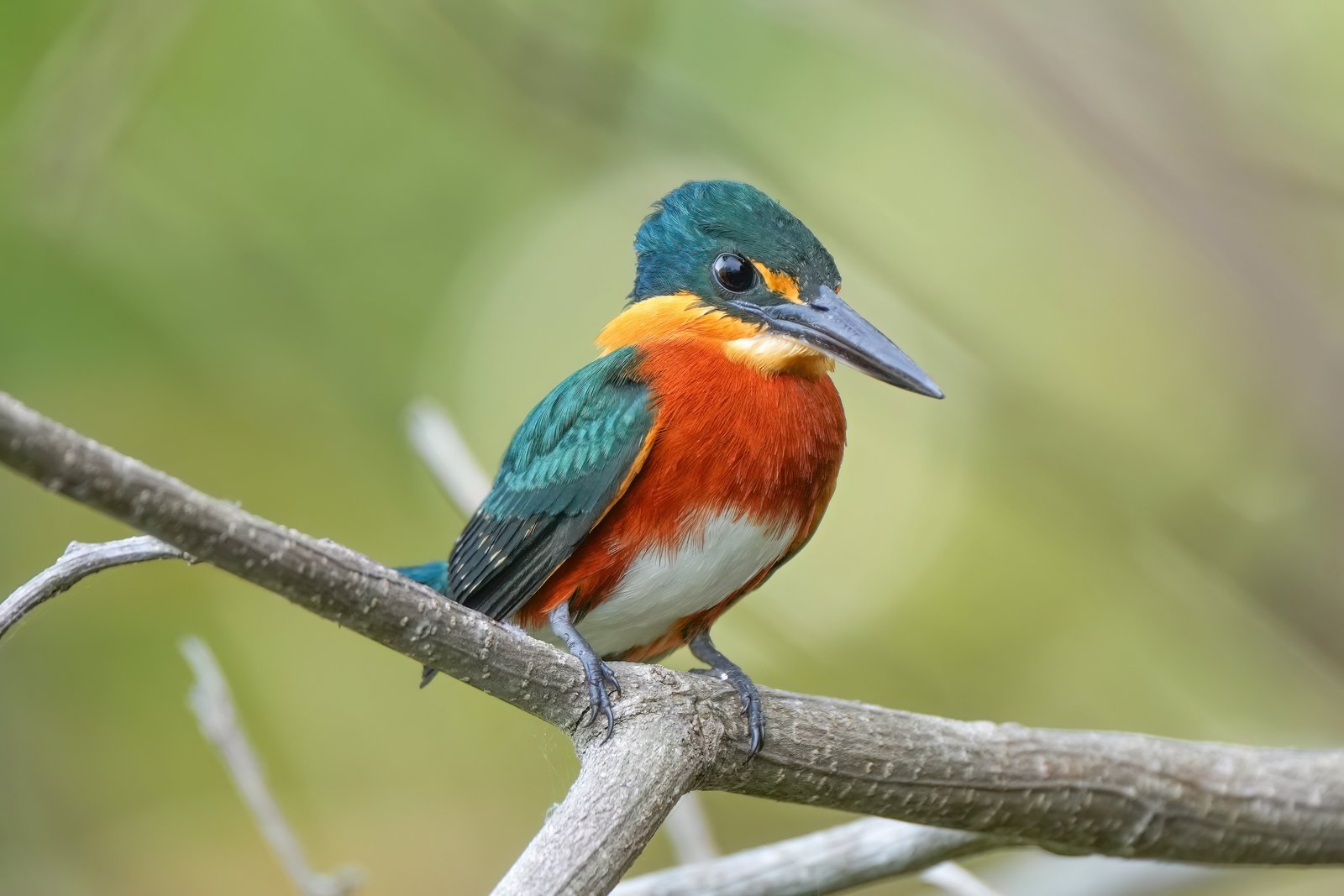
The American Pygmy Kingfisher is the smallest kingfisher in the guide area, barely larger than a sparrow. It is dark green above and orange-rufous below and lives hidden along small, shaded forest streams and in flooded forest. It often sits low and still on a twig just above the water.
Voice
A soft, dry tik or tsik, often repeated, and a fine, buzzy rattle.
Recording: Jerome Fischer — CC BY-NC-SA 4.0 · xeno-canto
Identification
13 cm, with a relatively long, black bill and a short tail. The upperparts are dark, glossy green, with a few small pale spots on the wings. The throat and sides of the neck are pale buff, the breast and flanks orange-rufous, and the centre of the belly and the undertail coverts are white. The female has a narrow, dark green band across the breast. Juveniles are duller, with pale spots on the wings.
Confusion species
Green-and-rufous Kingfisher Chloroceryle inda has a similar colour pattern, but is much larger, with fine pale spots on the back and wings and an entirely rufous belly without a white centre. Green Kingfisher Chloroceryle americana is larger, with a white throat and collar and a white belly.
Habitat
Small, shaded forest streams, flooded forest, swamp forest and the edges of oxbow lakes, also mangroves; almost exclusively in the lowlands, mostly below 600 m. It sits low in dense vegetation over shallow water and dives for small fish and aquatic insects; it also catches insects in the air. The nest is in a short burrow in a bank or in the root plate of a fallen tree.
Where the bird is most at home, classified by the vegetation units of the Andes and the west coast.


Range and movements
In Colombia in the lowlands on both sides of the Andes, from the Pacific coast and the Caribbean lowlands to Amazonia. In Ecuador in the western and eastern lowlands. In Peru in the Amazonian lowlands. In Bolivia in the northern and eastern lowlands. Absent from the Galápagos. Outside the guide area from southern Mexico to Amazonian Brazil.
- Resident
- dark = core range, pale = thinly spread
How and when to look
Search narrow forest streams and flooded forest, ideally from a canoe or along a trail that follows a stream. It often sits motionless on a low twig and flies off fast and low; the soft tik helps to locate it.
Conservation status
Least Concern. Widespread, but tied to shaded water in forest and therefore sensitive to clearance along streams.
Scientific name
Chloroceryle aenea | (Pallas, 1764)
Pallas described the species in 1764 as Alcedo aenea; because it was later moved to another genus, the author and year stand in brackets. The genus Chloroceryle was introduced in 1848 by Kaup. The genus name combines Greek khlōros, 'green', with the genus Ceryle (from Greek kērulos, a mythical sea bird). The species name is Latin aeneus, 'bronze', after the sheen of the upperparts. The specimen the first description was based on came from Suriname.