All species › Kingfishers, bee-eaters and rollers › Kingfishers › Green Kingfisher
Green Kingfisher | Chloroceryle americana
Groene ijsvogel | Martín pescador verde | Martim-pescador-pequeno
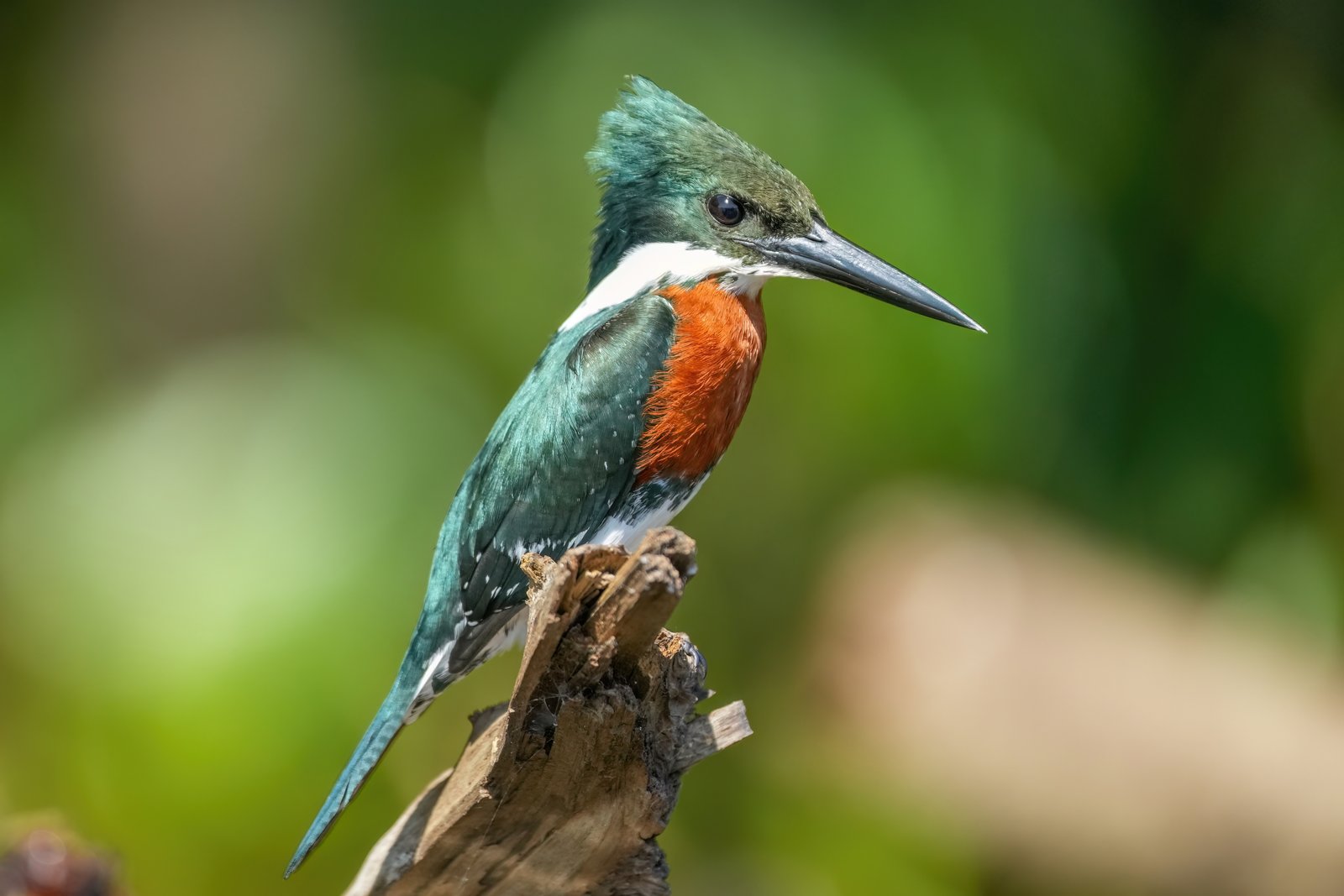
The Green Kingfisher is a small, dark green kingfisher with a white collar, and the most widespread kingfisher in the guide area. It occurs on almost any clear water, from broad lowland rivers to fast-flowing streams in the Andean valleys. In flight the extensive white on the sides of the tail stands out.
Voice
A dry, clicking tik or chik, often repeated, and a soft, buzzy rattle in flight.
Recording: Franco Vushurovich — CC BY-NC-SA 4.0 · xeno-canto
Identification
19–21 cm, with a long, black bill and a small crest. The upperparts are dark oily green, with rows of white spots on the wings; the outer tail feathers are largely white. The throat and collar are white. The male has a broad rufous breast band and green spots on the flanks, and the belly is white. The female has no rufous, but two green, spotted bands across the white breast. Juveniles resemble the female, with pale spots on the head.
Confusion species
Amazon Kingfisher Chloroceryle amazona has the same colours but is much larger, with a heavier bill, few or no white spots on the wings and no white in the tail. Green-and-rufous Kingfisher Chloroceryle inda has entirely rufous underparts. American Pygmy Kingfisher Chloroceryle aenea is much smaller, with orange-rufous underparts.
Habitat
Rivers, streams, lakes, canals, ponds and mangroves, both in open country and along forest edges; it prefers clear, shallow water. From sea level to about 1500 m, locally higher in dry Andean valleys. It perches low on a branch, stone or wire over water and dives for small fish; it sometimes hovers briefly. The nest is in a burrow it digs in a bank.
Where the bird is most at home, classified by the vegetation units of the Andes and the west coast.


Range and movements
In Colombia widespread in the lowlands and in the Andean valleys. In Ecuador in the western and eastern lowlands and in the lower valleys. In Peru in the Amazonian lowlands and foothills and in the north-west. In Bolivia in the lowlands and the lower Andean valleys. Absent from the Galápagos. Outside the guide area from the southern United States to central Argentina.
- Resident
- dark = core range, pale = thinly spread
How and when to look
Search clear, shallow rivers and streams with stony banks, also in open farmland. It flies fast and low over the water, often giving its clicking tik; on landing, watch for the white in the tail.
Conservation status
Least Concern. Common and widespread; sensitive to siltation and pollution of rivers, including from gold mining.
Scientific name
Chloroceryle americana | (Gmelin, 1788)
Gmelin described the species in 1788 as Alcedo americana; because it was later moved to another genus, the author and year stand in brackets. The genus Chloroceryle was introduced in 1848 by Kaup. The genus name combines Greek khlōros, 'green', with the genus Ceryle (from Greek kērulos, a mythical sea bird). The species name is Latin for 'American'. The specimen the first description was based on came from Cayenne, French Guiana.