All species › Kingfishers, bee-eaters and rollers › Kingfishers › Green-and-rufous Kingfisher
Green-and-rufous Kingfisher | Chloroceryle inda
Groen-bruine ijsvogel | Martín pescador verdirrufo | Martim-pescador-da-mata
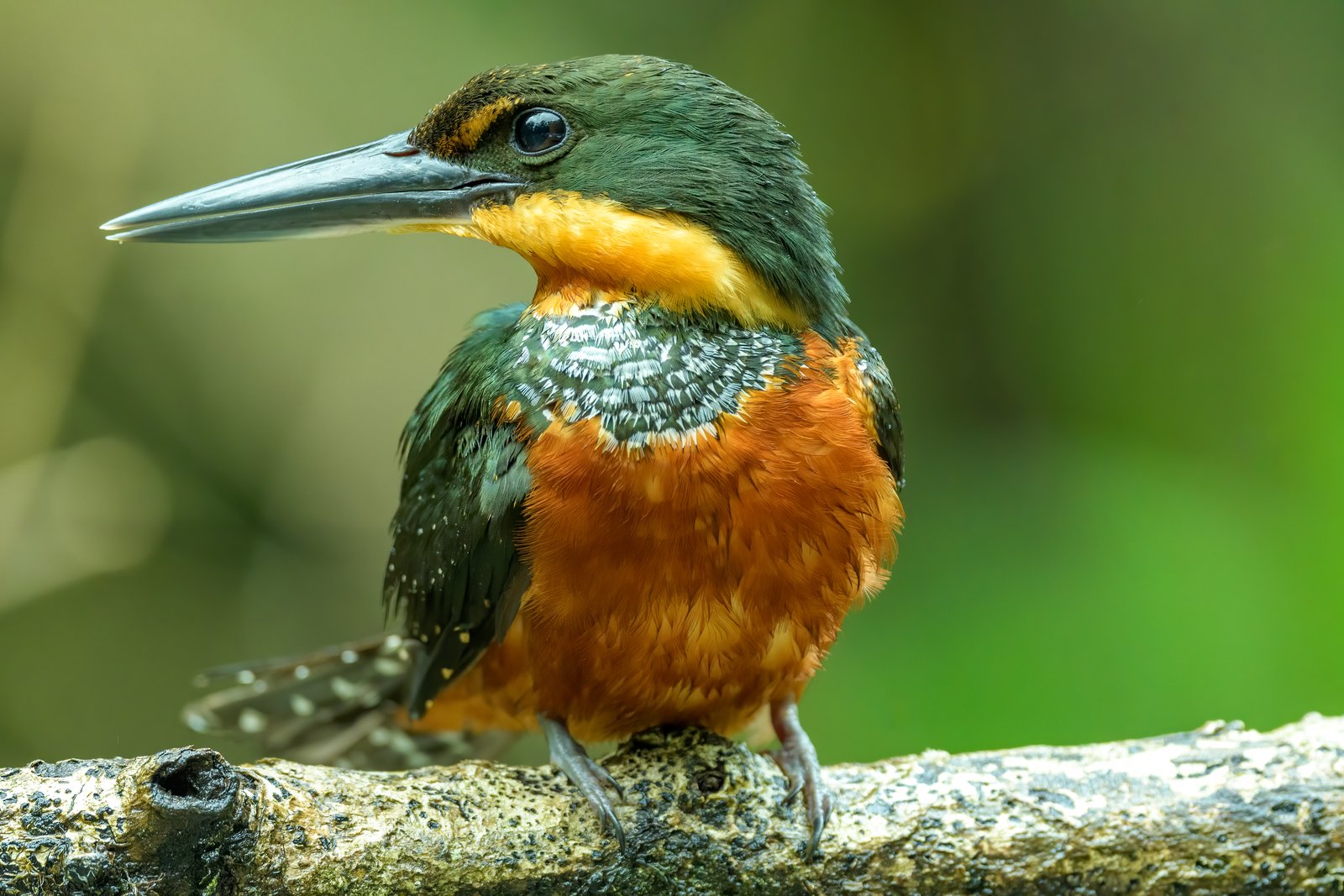
The Green-and-rufous Kingfisher is a medium-sized, dark green kingfisher with entirely rufous underparts. It lives unobtrusively in the shade of flooded forest and along narrow forest streams in the lowlands. Despite its size it is inconspicuous in the dark forest.
Voice
A soft chack or chuk, and a series of whistled notes that speeds up and rises.
Recording: JAYRSON ARAUJO DE OLIVEIRA — CC BY-NC-SA 4.0 · xeno-canto
Identification
22–24 cm, with a long, black bill. The upperparts are dark oily green, with fine buff spots and bars on the back, wings and tail. The throat and cheeks are paler orange-buff, and the rest of the underparts is deep rufous. The female has a green-and-white scaled band across the breast. Juveniles resemble the female but are duller.
Confusion species
American Pygmy Kingfisher Chloroceryle aenea has a similar colour pattern, but is much smaller, with a white centre to the belly and no fine spots on the back. Green Kingfisher Chloroceryle americana and Amazon Kingfisher Chloroceryle amazona have a white collar and a white belly.
Habitat
Flooded forest, swamp forest, palm swamps and the shaded edges of oxbow lakes, and narrow streams in humid lowland forest, mostly below 500 m. It sits low in the shade over water and dives for fish and other aquatic animals. The nest is in a burrow in a bank or in the root plate of a fallen tree.
Where the bird is most at home, classified by the vegetation units of the Andes and the west coast.


Range and movements
In Colombia in the Pacific lowlands, the northern lowlands and Amazonia. In Ecuador in the eastern lowlands and locally in the north-west. In Peru in the Amazonian lowlands. In Bolivia in the northern and eastern lowlands. Absent from the Galápagos. Outside the guide area from Nicaragua to Amazonian and eastern Brazil.
- Resident
- dark = core range, pale = thinly spread
How and when to look
Search from a canoe in flooded forest and along shaded backwaters of rivers and oxbow lakes. It often sits low and still just above the water and, when disturbed, flies off low under the canopy.
Conservation status
Least Concern. Widespread, but dependent on forest along water and therefore sensitive to deforestation.
Scientific name
Chloroceryle inda | (Linnaeus, 1766)
Linnaeus described the species in 1766 as Alcedo inda; because it was later moved to another genus, the author and year stand in brackets. The genus Chloroceryle was introduced in 1848 by Kaup. The genus name combines Greek khlōros, 'green', with the genus Ceryle (from Greek kērulos, a mythical sea bird). The species name is Latin indus, 'Indian', here for the West Indies, where Linnaeus wrongly placed the species. The specimen the first description was based on came from The Guianas.