All species › Jacamars and puffbirds › Jacamars › White-throated Jacamar
White-throated Jacamar | Brachygalba albogularis
Witkeelglansvogel | Jacamará gorjiblanco | Agulha-de-garganta-branca
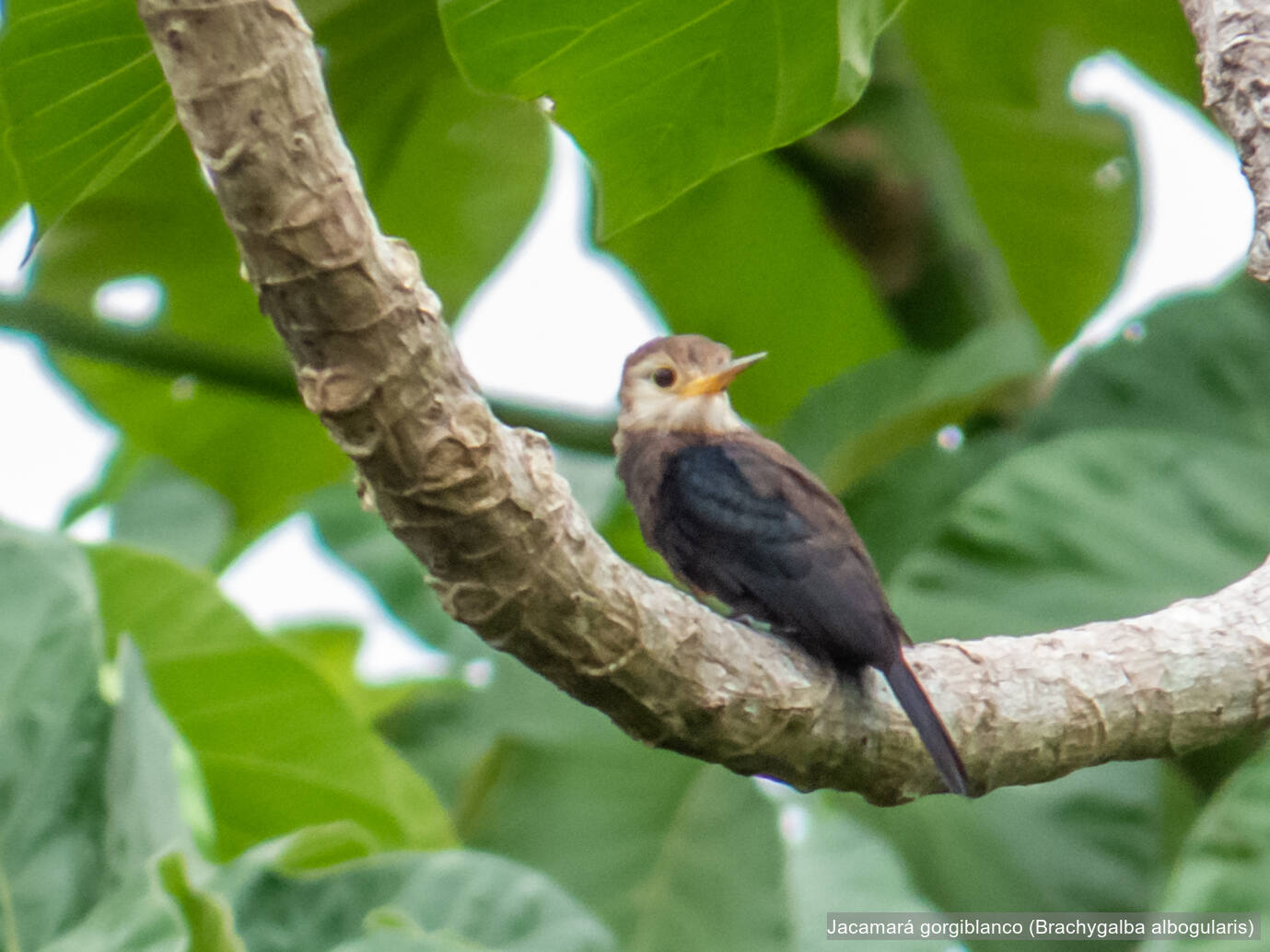
The White-throated Jacamar is a small, dark jacamar with a yellow bill and a white face and throat, found along whitewater rivers in south-western Amazonia. It lives in pairs or family groups that hunt insects from bare branches. Its range is small and lies around the point where Peru, Bolivia and Brazil meet.
Voice
A high, thin series of whistles, like pee-pipi-peeee tewee tewee tewee. The call is a plaintive, rising psweet.
Recording: Jacob Wijpkema — CC BY-NC-SA 4.0 · xeno-canto
Identification
16 cm, with a long, straight, pointed yellow bill and a fairly short tail. The face and throat are white, the crown dark. The upperparts are blackish brown with a blue-green gloss. The breast and flanks are dark brown to blackish, and the centre of the belly is chestnut. The female resembles the male, but the chestnut belly patch may be larger.
Confusion species
Brown Jacamar Brachygalba lugubris has a black bill, a brown, finely streaked head without a white face, and a paler belly. Purus Jacamar Galbalcyrhynchus purusianus is larger and chestnut, with a thick pink bill. Bluish-fronted Jacamar Galbula cyanescens is larger and glossy green, with a long tail and a rufous belly.
Habitat
Edges of várzea forest and young growth along whitewater rivers, also on river islands and in stands of wild cane (Gynerium) and bamboo, from the lowlands up to about 600 m. It perches from mid-level up to the canopy on bare branches and sallies for flying insects such as wasps, bees and butterflies. It nests in a tunnel in a steep bank; several adults help feed the young.
Where the bird is most at home, classified by the vegetation units of the Andes and the west coast.


Range and movements
In Peru locally in the southern and central Amazonian lowlands, including Madre de Dios and Ucayali. In Bolivia only in the far north, near the borders with Peru and Brazil. Absent from Colombia, Ecuador and the Galápagos. Outside the guide area in western Amazonian Brazil.
- Resident
- dark = core range, pale = thinly spread
How and when to look
Search riverbanks and river islands in Madre de Dios, for example around Puerto Maldonado and in Manu, for bare branches above the forest edge. The birds often perch there several together.
Conservation status
Least Concern. The species is local, but its riverside habitat is constantly renewed by the dynamics of the rivers.
Scientific name
Brachygalba albogularis | (Spix, 1824)
Spix described the species in 1824 as Galbula albogularis; because it was later moved to another genus, the author and year stand in brackets. The genus Brachygalba was introduced in 1854 by Bonaparte. The genus name combines Greek brakhus, 'short', with Galbula, the jacamar genus. The species name albogularis comes from Latin albus, 'white', and gula, 'throat': 'white-throated'. The specimen the first description was based on came from Javari River, Brazil.