All species › Jacamars and puffbirds › Jacamars › Brown Jacamar
Brown Jacamar | Brachygalba lugubris
Bruinkeelglansvogel | Jacamará pardo | Ariramba-preta
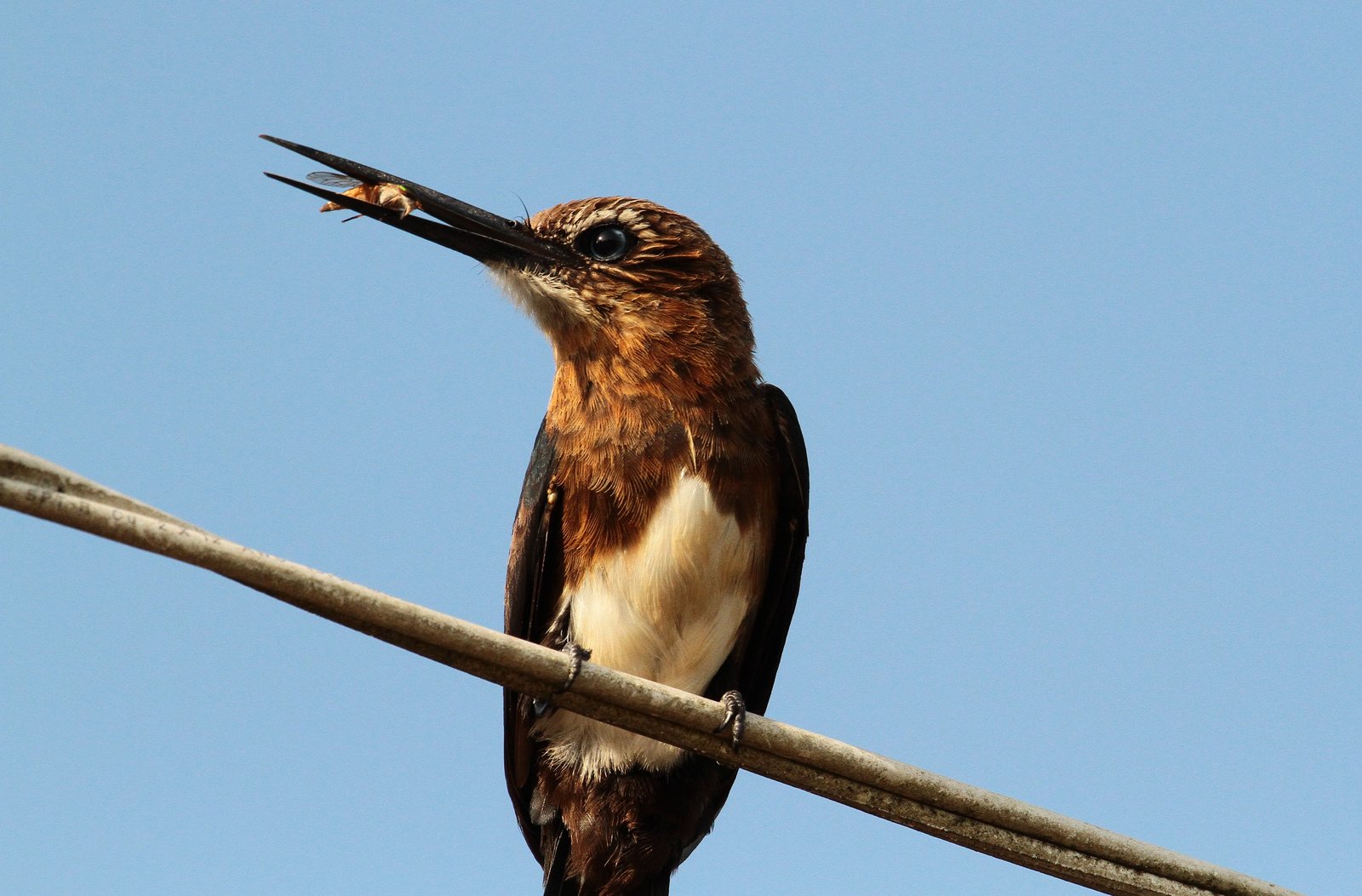
The Brown Jacamar is a small, mainly brown jacamar with a long black bill, found along forest edges, gallery forest and riverbanks in northern South America. It lives in pairs or small groups that perch upright on bare branches and catch insects in the air from there. Of the Brachygalba species it has by far the largest range.
Voice
High, thin, rising whistles, like peeeeyr, often accelerating into a short series or trill; groups often call together.
Recording: Fabrício Grigolin — CC BY-NC-SA 4.0 · xeno-canto
Identification
17–18 cm, with a long, straight black bill and a fairly short tail. The head is brown with fine pale streaks, and the throat is paler brown or buff. The back, wings and tail are dark brown with a faint blue-green gloss. The breast is dark brown; the belly is white to buff, depending on the population. The sexes are nearly alike.
Confusion species
White-throated Jacamar Brachygalba albogularis has a yellow bill and a white face and throat. Pale-headed Jacamar Brachygalba goeringi has a pale, greyish-brown head, a white belly and a chestnut band across the upper belly. Swallow-winged Puffbird Chelidoptera tenebrosa uses the same kind of bare branches, but is blackish with a short bill. Galbula jacamars are larger and glossy green.
Habitat
Edges of humid forest and gallery forest, white-sand forest, riverbanks, wooded savannas and clearings, from the lowlands up to about 500 m, locally higher. It perches on bare branches at the forest edge and sallies for flying insects such as butterflies, wasps and flies. It nests in a tunnel in an earth bank.
Where the bird is most at home, classified by the vegetation units of the Andes and the west coast.


Range and movements
In Colombia east of the Andes, in the llanos and Amazonia. In Ecuador rare and local in the north-eastern lowlands. In Peru local in the north-east. In Bolivia in the north and east of the lowlands. Absent from the Galápagos. Outside the guide area in Venezuela, the Guianas and much of Brazil.
- Resident
- dark = core range, pale = thinly spread
How and when to look
Search riverbanks, roadsides and forest edges in the llanos and the white-sand areas of eastern Colombia, for example around Inírida, for groups of small birds on bare branches.
Conservation status
Least Concern. The species has a large range and tolerates open, partly wooded landscapes.
Scientific name
Brachygalba lugubris | (Swainson, 1838)
Swainson described the species in 1838 as Galbula lugubris; because it was later moved to another genus, the author and year stand in brackets. The genus Brachygalba was introduced in 1854 by Bonaparte. The genus name combines Greek brakhus, 'short', with Galbula, the jacamar genus. The species name lugubris is Latin for 'mournful', after the dark plumage. The specimen the first description was based on came from Kanuku Mountains, Guyana.