All species › Trogons › Trogons › Amazonian Black-throated Trogon
Amazonian Black-throated Trogon | Trogon rufus
Amazonezwartkeeltrogon | Trogón golinegro | Surucuá-de-barriga-amarela
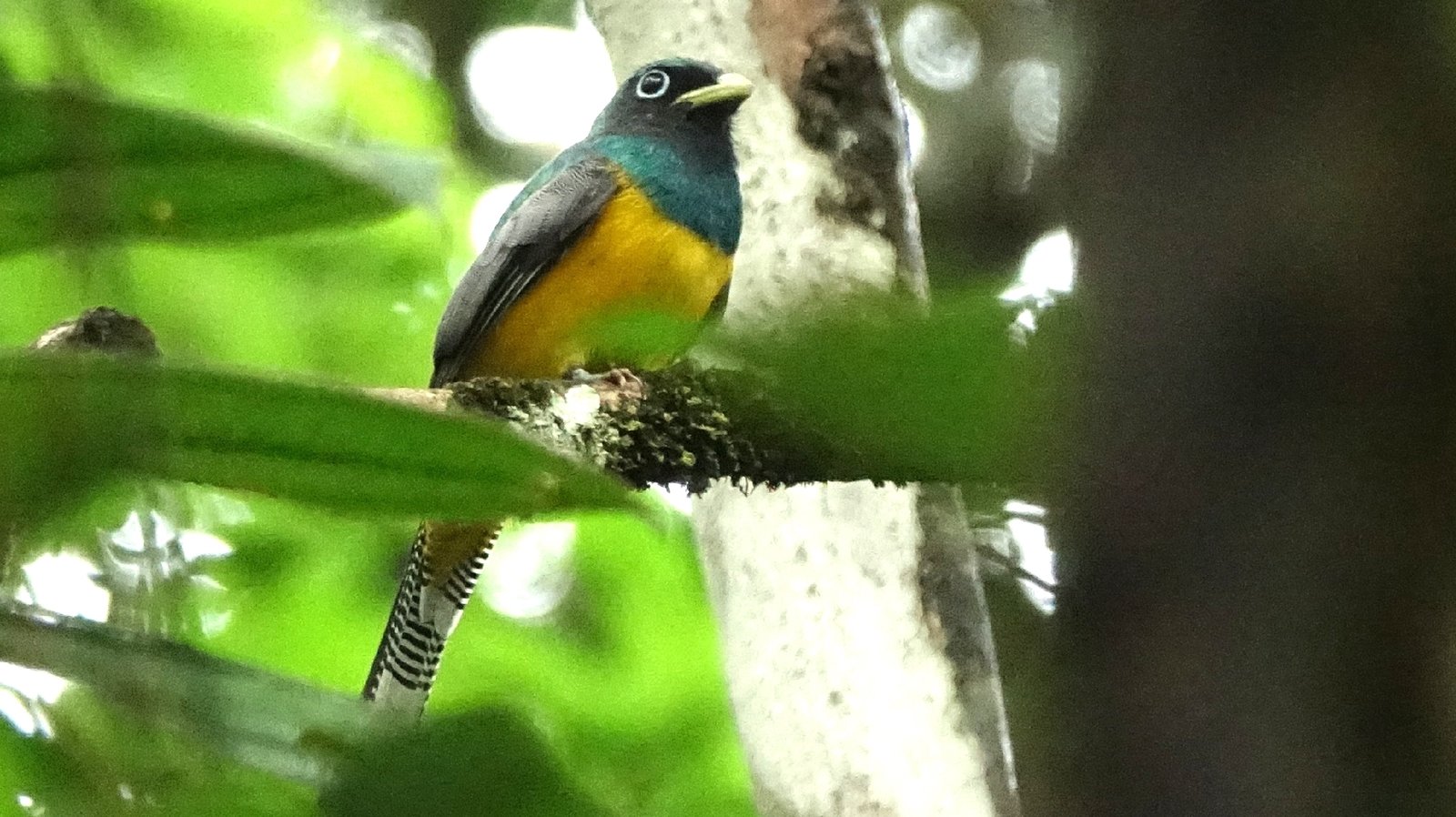
The Amazonian Black-throated Trogon is a yellow-bellied trogon of the lower levels of Amazonian rainforest. It is the only yellow-bellied trogon in the guide area in which the male has a green head and breast. The formerly broadly defined Black-throated Trogon has been split; this species comprises the forms of Amazonia.
Voice
The song consists of two to four slow, plaintive whistles, coo coo coo, with distinct pauses, slower than in most other trogons. The call is a soft, rattling chatter.
Recording: Miguel Angelo Biz — CC BY-NC-SA 4.0 · xeno-canto
Identification
23–25 cm. The male is glossy green on the head, breast and back, with a black face and throat, a pale blue eye-ring and a yellowish-green bill. A narrow white band lies below the green breast, and the belly is yellow. The undertail is finely barred black and white, with broad white tips. The female is brown on the head, breast and back, with a yellow belly, a white spot in front of and behind the eye and a dark upper mandible. Juveniles resemble the female.
Confusion species
Amazonian Trogon Trogon ramonianus and Green-backed Trogon Trogon viridis have a blue head and breast in the male, and their females are grey, not brown. Collared Trogon Trogon collaris is similar in shape and pattern, but has a red belly. In western Colombia and Ecuador there are related black-throated trogons that are now placed in other species; the Andes separate them from this species.
Habitat
The interior of humid terra firme lowland forest and flooded forest, less often forest edges, mainly below 1000 m, locally into the foothills. It usually perches in the lower and middle levels, lower than other trogons. It eats insects, including caterpillars, and fruit. It nests in a cavity in rotten wood or a termite nest.
Where the bird is most at home, classified by the vegetation units of the Andes and the west coast.


Range and movements
In Colombia in the Amazonian south-east. In Ecuador and Peru in the lowlands and foothills east of the Andes. In Bolivia in the northern lowlands. Absent from the Galápagos. Outside the guide area in Amazonian Brazil, southern Venezuela and the Guianas.
- Resident
- dark = core range, pale = thinly spread
How and when to look
Walk slowly along trails through the interior of Amazonian forest and listen for the slow, plaintive whistles; the bird often sits still on a horizontal branch a few metres up.
Conservation status
Not evaluated as a separate species; the former, broadly defined Black-throated Trogon was listed as Least Concern. The species depends on closed forest and is declining locally through deforestation.
Scientific name
Trogon rufus | Gmelin, 1788
Gmelin described the species in 1788 and placed it straight away in the genus where it still stands. The genus Trogon was introduced in 1760 by Brisson. The genus name comes from Greek trōgōn, 'nibbling', from trōgō, 'to gnaw'; trogons gnaw out their nest holes in rotten wood. Rufus is Latin for 'reddish', after the rufous-brown female. The specimen the first description was based on came from Cayenne, French Guiana.