All species › Trogons › Trogons › Blue-crowned Trogon
Blue-crowned Trogon | Trogon curucui
Blauwkruintrogon | Trogón coroniazul | Surucuá-de-barriga-vermelha
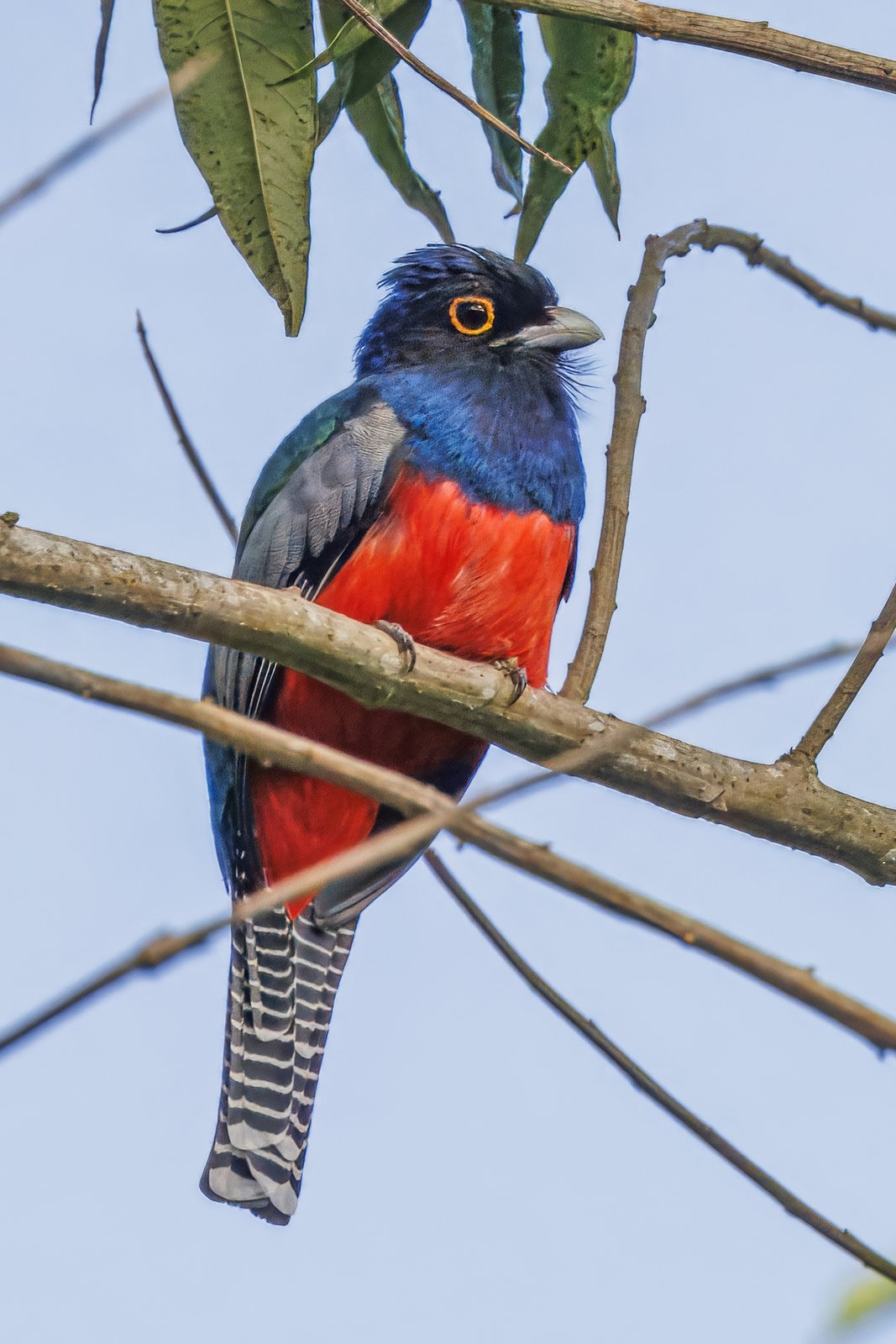
The Blue-crowned Trogon is a medium-sized trogon of the lowlands east of the Andes, with a blue head and breast and a red belly. It often sits still on a branch for long periods in the middle and upper levels of the forest. Of the red-bellied trogons of the Amazonian lowlands it is the only one with a blue head.
Voice
The song is a long series of soft, whistled coo notes that first accelerates and then drops slightly in pitch. The call is a short, rattling chatter.
Recording: JAYRSON ARAUJO DE OLIVEIRA — CC BY-NC-SA 4.0 · xeno-canto
Identification
24–26 cm. The male has a dark violet-blue head and breast, a blackish face and throat, a red eye-ring and a pale greenish-yellow bill. The back is green to bluish green. A narrow white band lies below the breast, and the belly is red. The undertail is finely barred black and white, with white tips. The female is grey on the head, breast and back, with a red belly and a broken white eye-ring (a white spot in front of and behind the eye). Juveniles resemble the female.
Confusion species
Collared Trogon Trogon collaris has a green head and breast in the male; the female is brown rather than grey. Black-tailed Trogon Trogon melanurus is larger, with a green head and breast and a dark, unbarred undertail. Amazonian Trogon Trogon ramonianus and Green-backed Trogon Trogon viridis have a similar blue head, but a yellow belly.
Habitat
Humid terra firme lowland forest, flooded forest, forest edges, secondary forest and semi-open woodland, mainly below 1000 m, locally higher in the foothills. In Bolivia also in drier forest. It eats insects, snatched from leaves in a short sally, and fruit. It nests in a cavity dug out of a termite nest or rotten wood.
Where the bird is most at home, classified by the vegetation units of the Andes and the west coast.


Range and movements
In Colombia in the Amazonian south-east. In Ecuador and Peru in the lowlands and foothills east of the Andes. In Bolivia widespread in the lowlands of the north and east. Absent from the Galápagos. Outside the guide area in western and central Brazil, south to Paraguay and northern Argentina.
- Resident
- dark = core range, pale = thinly spread
How and when to look
In Amazonian forest, listen for the song in the early morning and then scan the middle levels of the forest; birds often sit on the same branch for a long time. Also at forest edges and along trails through secondary forest.
Conservation status
Least Concern. The range is large and the species tolerates some disturbance of the forest.
Scientific name
Trogon curucui | Linnaeus, 1766
Linnaeus described the species in 1766 and placed it straight away in the genus where it still stands. The genus Trogon was introduced in 1760 by Brisson. The genus name comes from Greek trōgōn, 'nibbling', from trōgō, 'to gnaw'; trogons gnaw out their nest holes in rotten wood. The specific name comes from curucui, the Tupi name of the bird recorded by Marcgrave in Brazil; it imitates the call. The specimen the first description was based on came from Brazil.