All species › Trogons › Trogons › Amazonian Trogon
Amazonian Trogon | Trogon ramonianus
Amazonetrogon | Trogón amazónico | Surucuá-pequeno
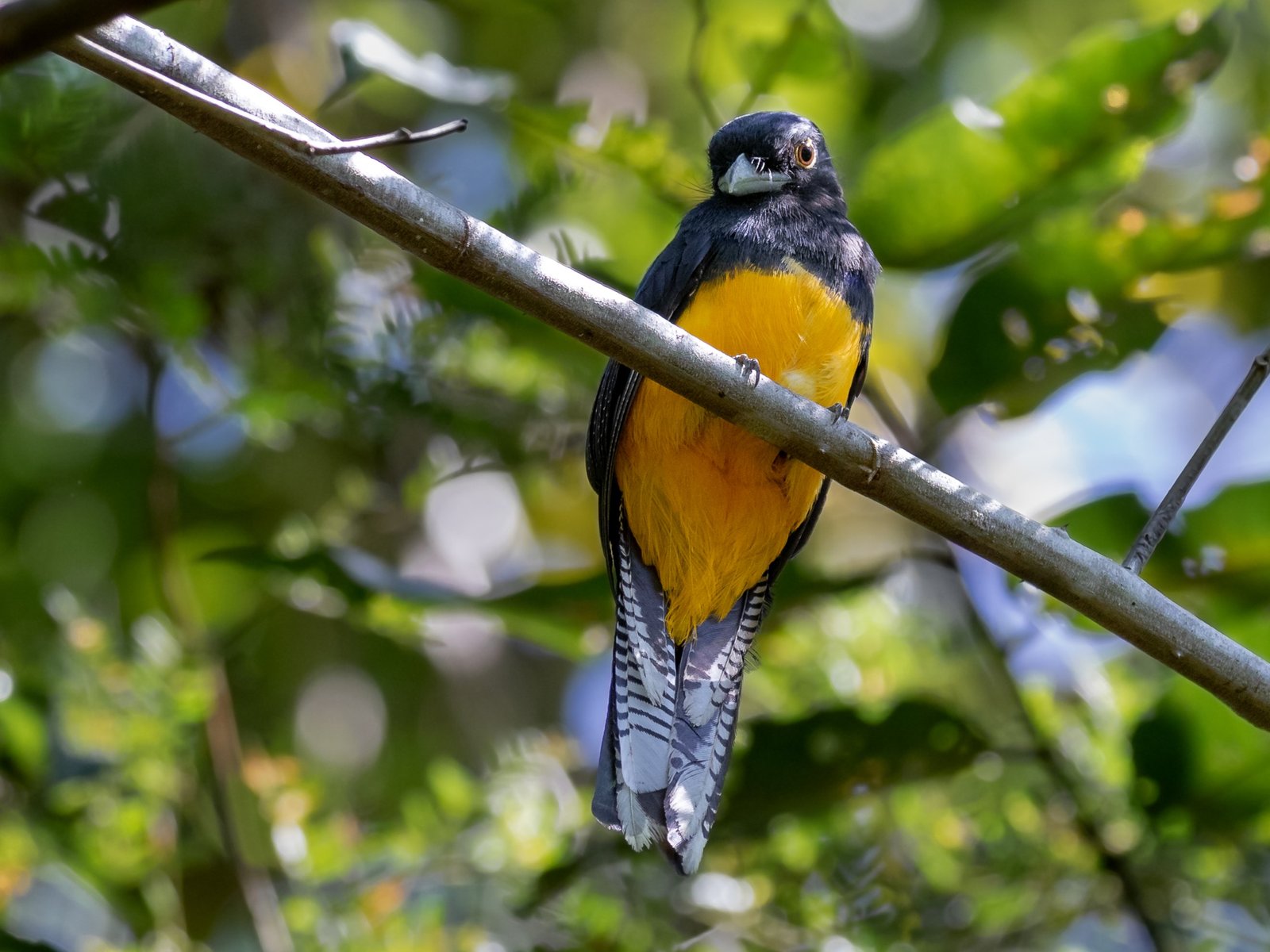
The Amazonian Trogon is a small, yellow-bellied trogon of western Amazonia. It was formerly included in Violaceous Trogon, which has now been split into three species; the form east of the Andes is the Amazonian Trogon. It usually sits in the middle and upper levels of the forest and sometimes joins mixed flocks.
Voice
The song is a fast series of ten to twenty short, even kyoo notes on the same pitch. The call is a soft, rattling chatter.
Recording: JAYRSON ARAUJO DE OLIVEIRA — CC BY-NC-SA 4.0 · xeno-canto
Identification
23–24 cm. The male has a violet-blue head and breast, with a black face and throat, a yellow eye-ring and a pale grey bill. The back is glossy green to bluish green, and the belly yellow. The undertail is finely barred black and white, with white tips. The female is dark grey on the head, breast and back, with a yellow belly and a broken white eye-ring; the undertail is barred. Juveniles resemble the female.
Confusion species
Green-backed Trogon Trogon viridis is larger, with a pale blue eye-ring and, in the male, a mainly white undertail. Amazonian Black-throated Trogon Trogon rufus has a green head and breast in the male, with a white breast band and a blue eye-ring; the female is brown. Gartered Trogon Trogon caligatus closely resembles Amazonian Trogon, but lives west of the Andes. Blue-crowned Trogon Trogon curucui has a red belly.
Habitat
Humid terra firme lowland forest and flooded forest, also forest edges, secondary forest and palm swamps, mainly below 800 m. It eats insects and fruit, taken in a short sally. It nests in a cavity in a termite nest, a wasp nest or rotten wood.
Where the bird is most at home, classified by the vegetation units of the Andes and the west coast.


Range and movements
In Colombia in the Amazonian south-east. In Ecuador and Peru in the lowlands east of the Andes. In Bolivia in the northern lowlands. Absent from the Galápagos. Outside the guide area in western Amazonian Brazil.
- Resident
- dark = core range, pale = thinly spread
How and when to look
In Amazonian lowland forest, listen for the fast, even series of notes and follow it to the middle levels of the forest. From canopy towers the species can often be seen at close range.
Conservation status
Not evaluated as a separate species; the former, broadly defined Violaceous Trogon was listed as Least Concern. The range is large.
Scientific name
Trogon ramonianus | Deville & des Murs, 1849
Deville & des Murs described the species in 1849 and placed it straight away in the genus where it still stands. The genus Trogon was introduced in 1760 by Brisson. The genus name comes from Greek trōgōn, 'nibbling', from trōgō, 'to gnaw'; trogons gnaw out their nest holes in rotten wood. The specific name honours Brother Ramón Busquet (1772–1846), a Spanish missionary in Peru, who drowned in the Sintulini rapids of the Urubamba River. The specimen the first description was based on came from Sarayacu and Pampa del Sacramento, Peru.