All species › Waterfowl › Ducks, swans and geese › American Black Duck
American Black Duck | Anas rubripes
Amerikaanse zwarte eend | Pato negro americano | Pato-escuro-americano
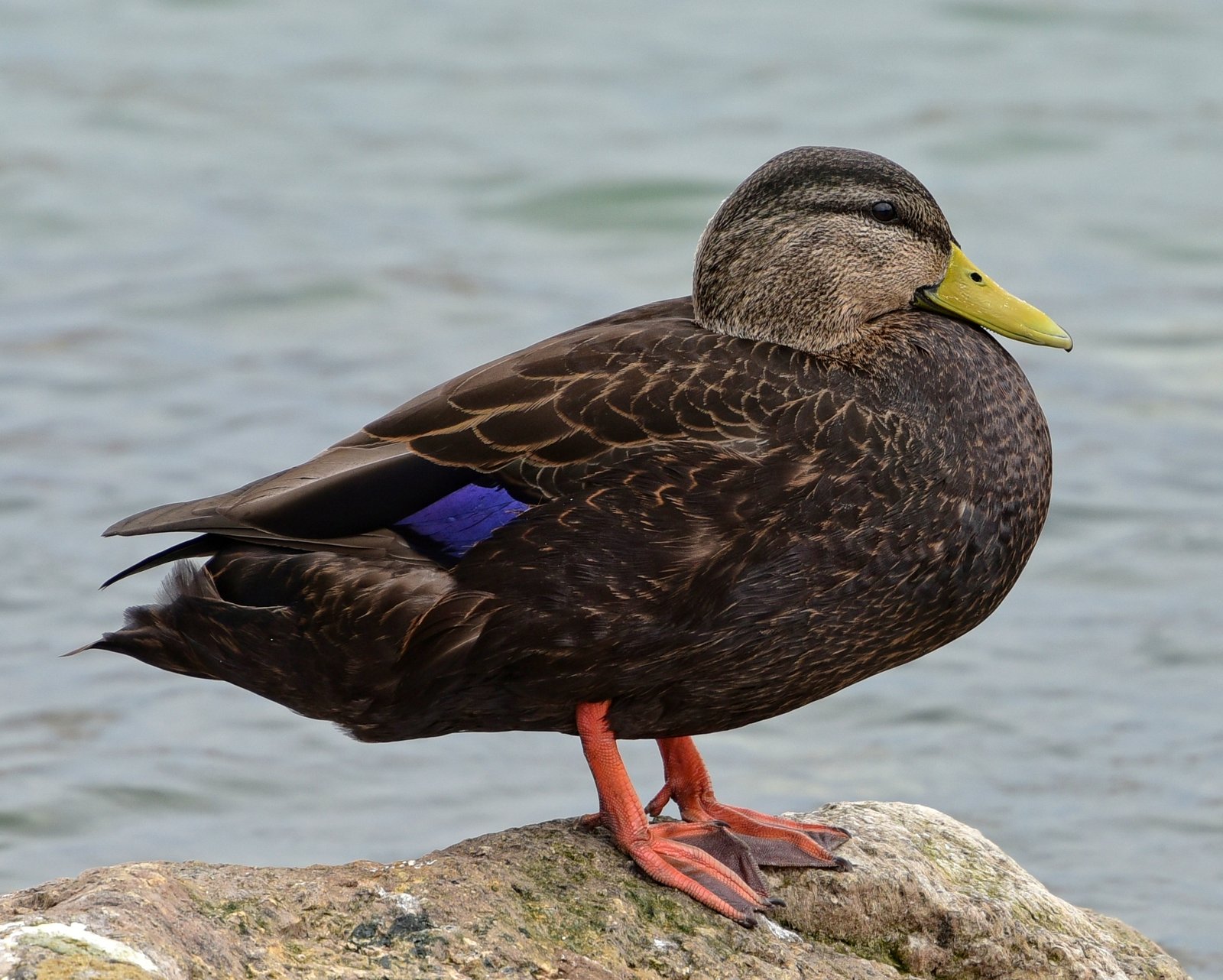
The American Black Duck is a large, dark dabbling duck of eastern North America, closely related to the Mallard. In the guide area it has been recorded only as a very rare vagrant. Both sexes resemble a very dark female Mallard.
Voice
The female gives loud, descending quacks, like a female Mallard; the male gives a soft, low rhaeb.
Recording: Stanislas Wroza — CC BY-NC-SA 4.0 · xeno-canto
Identification
54–59 cm, heavily built. The body is blackish brown with narrow pale fringes, clearly darker than the head and neck, which are greyish brown and finely streaked, with a dark crown and eye-stripe. The speculum is purplish blue, with no or a very narrow white border. In flight the white underwing coverts stand out against the dark body. The male has a yellowish-green bill, the female a duller, olive-green one. The legs are orange.
Confusion species
Female Mallard Anas platyrhynchos is paler and more variegated brown, with a blue speculum with broad white borders on both sides and a whitish tail. Yellow-billed Pintail Anas georgica is smaller and slimmer, with a yellow bill with a dark culmen, a pointed tail and a browner speculum with pale borders.
Habitat
In the breeding range marshes, lakes, beaver ponds and tidal marshes, in winter also salt marshes, estuaries and sheltered coastal bays. It dabbles for aquatic plants, seeds and invertebrates. It nests on the ground in dense vegetation near water.
Where the bird is most at home, classified by the vegetation units of the Andes and the west coast.


Range and movements
In the guide area recorded only as a very rare vagrant; there is no regular site or season of occurrence. It breeds in eastern Canada and the north-eastern United States and winters in the eastern United States. Absent from the Galápagos.
How and when to look
A vagrant may turn up among flocks of other ducks on lakes and marshes in the north of the guide area, mainly in the northern winter. Look for the dark body, pale head and white underwing in flight; hybrids with Mallard also occur.
Conservation status
Least Concern. The population declined strongly in the twentieth century through habitat loss and hybridisation with Mallard, and has since been largely stable.
Scientific name
Anas rubripes | Brewster, 1902
Brewster described the species in 1902 and placed it straight away in the genus where it still stands. The genus Anas was introduced in 1758 by Linnaeus. The genus name comes from Latin anas, 'duck'. The species name combines Latin ruber, 'red', with pes, 'foot', after the orange-red legs. The specimen the first description was based on came from Lake Umbagog, New Hampshire, United States.