All species › Gamebirds › Guans, curassows and chachalacas › Sickle-winged Guan
Sickle-winged Guan | Chamaepetes goudotii
Sikkelvleugelgoean | Pava falcialar | Jacu-de-asa-falcada
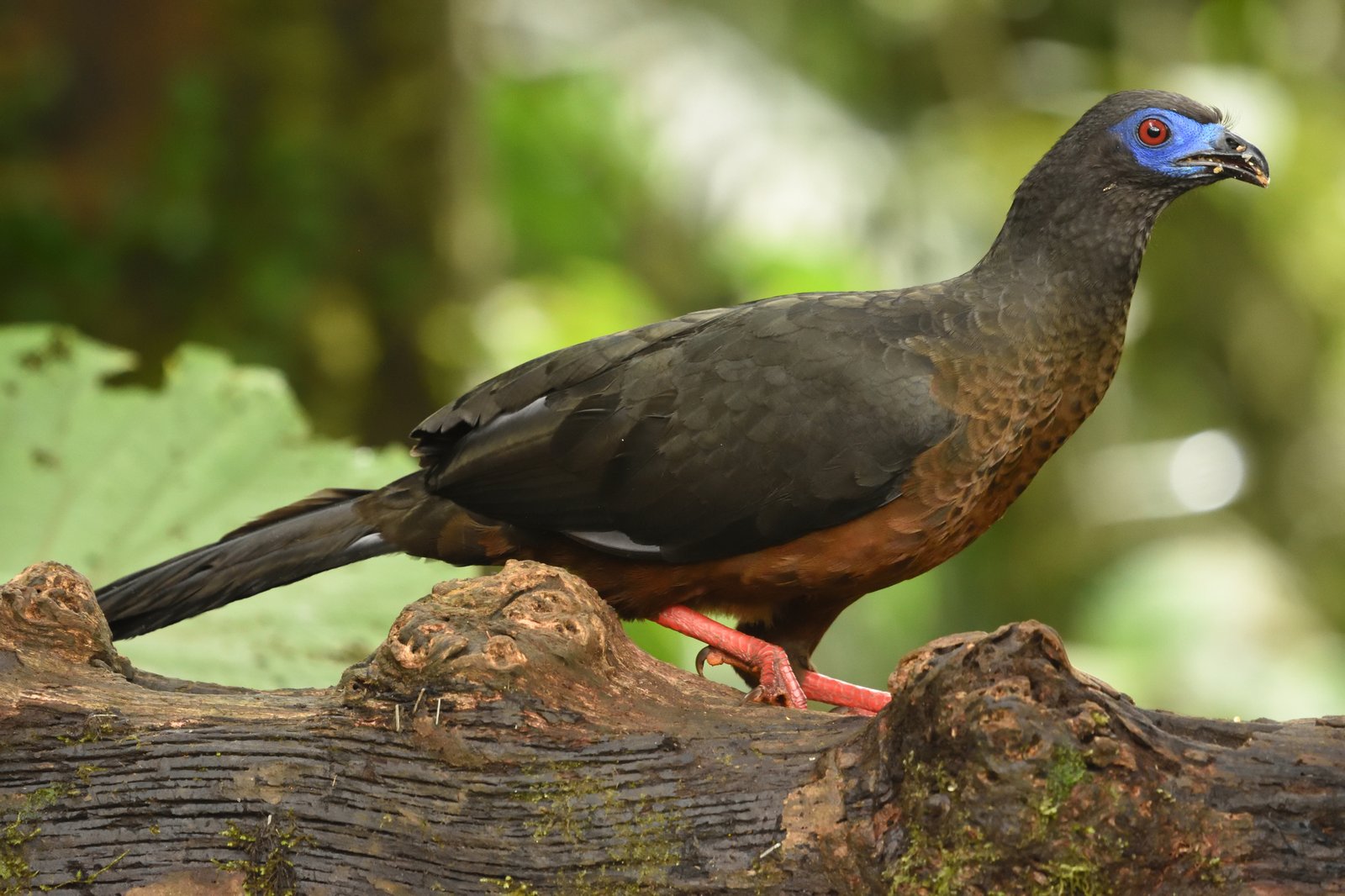
The Sickle-winged Guan is a slender, brown guan of humid Andean montane forest, with a rufous belly and blue bare skin on the face. The outer primaries are narrow and sickle-shaped at the tip; with them it makes a rattling, whirring wing sound in display flights at dusk and dawn. Unlike the Penelope guans it has no dewlap.
Voice
Usually silent. Gives thin, high whistles and soft, plaintive kee notes. At dusk and especially before dawn it makes a dry, rattling and whirring wing sound during short display flights between the trees.
Recording: Jacob Wijpkema — CC BY-NC-SA 4.0 · xeno-canto
Identification
51–58 cm, slender, with a small head, a rather short bill and a long tail. The head, neck, breast and upperparts are olive-brown, the breast slightly greyer, with fine pale fringes. The belly, flanks and undertail coverts are warm rufous-chestnut. Bare pale blue skin surrounds the eye and the base of the bill; the eye is red. There is no dewlap. The legs are red. The outer primaries are strongly narrowed at the tip. The sexes are alike; juveniles are duller, with less rufous on the belly.
Confusion species
Andean Guan Penelope montagnii has a grey-frosted head and neck, white-edged feathers on the foreneck, a small red dewlap and no rufous belly. Band-tailed Guan Penelope argyrotis has a red dewlap, a white-scaled breast and a pale terminal tail band; it lives only in northern Colombia. Wattled Guan Aburria aburri is larger and glossy black, with a yellow wattle on the throat. Spix's Guan Penelope jacquacu is larger, with a red dewlap, and lives lower, in the Amazonian lowlands.
Habitat
Humid montane forest and cloud forest, also old secondary forest and forest edge, roughly between 1100 and 3000 m, mostly between 1500 and 2700 m. It forages in the canopy and middle levels for fruit and berries, sometimes also leaves and flowers, and occasionally comes to the ground. It lives singly, in pairs or in small groups. The nest is a platform of twigs and leaves in a tree.
Where the bird is most at home, classified by the vegetation units of the Andes and the west coast.


Range and movements
In Colombia in all three Andean ranges and in the Sierra Nevada de Santa Marta. In Ecuador on both slopes of the Andes. In Peru on the eastern slope along almost the entire length of the country, locally also on the western slope in the north. In Bolivia in the north-west, in the Yungas of La Paz. Absent from the Galápagos. It does not occur outside the guide area.
- Resident
- dark = core range, pale = thinly spread
How and when to look
Search fruiting trees along roads and trails through cloud forest in the early morning, for example along the Manu road in Peru. At dusk and dawn the wing sound of displaying birds gives away their presence.
Conservation status
Least Concern. Locally common in well-preserved montane forest; it disappears where forest is cleared and where hunting is intense, but tolerates old secondary forest.
Scientific name
Chamaepetes goudotii | (Lesson, 1828)
Lesson described the species in 1828 as Ortalida Goudotii; because it was later moved to another genus, the author and year stand in brackets. The genus Chamaepetes was introduced in 1832 by Wagler. The genus name comes from Greek khamaipetēs, 'falling to the ground', from khamai, 'on the ground', and piptō, 'to fall down'. The species name honours Justin Goudot (1802–c. 1850), French explorer and natural-history collector in Colombia. The specimen the first description was based on came from Quindío, Colombia.