All species › Gamebirds › Guans, curassows and chachalacas › Wattled Guan
Wattled Guan | Aburria aburri
Lelgoean | Pava carunculada | Jacu-de-barbela
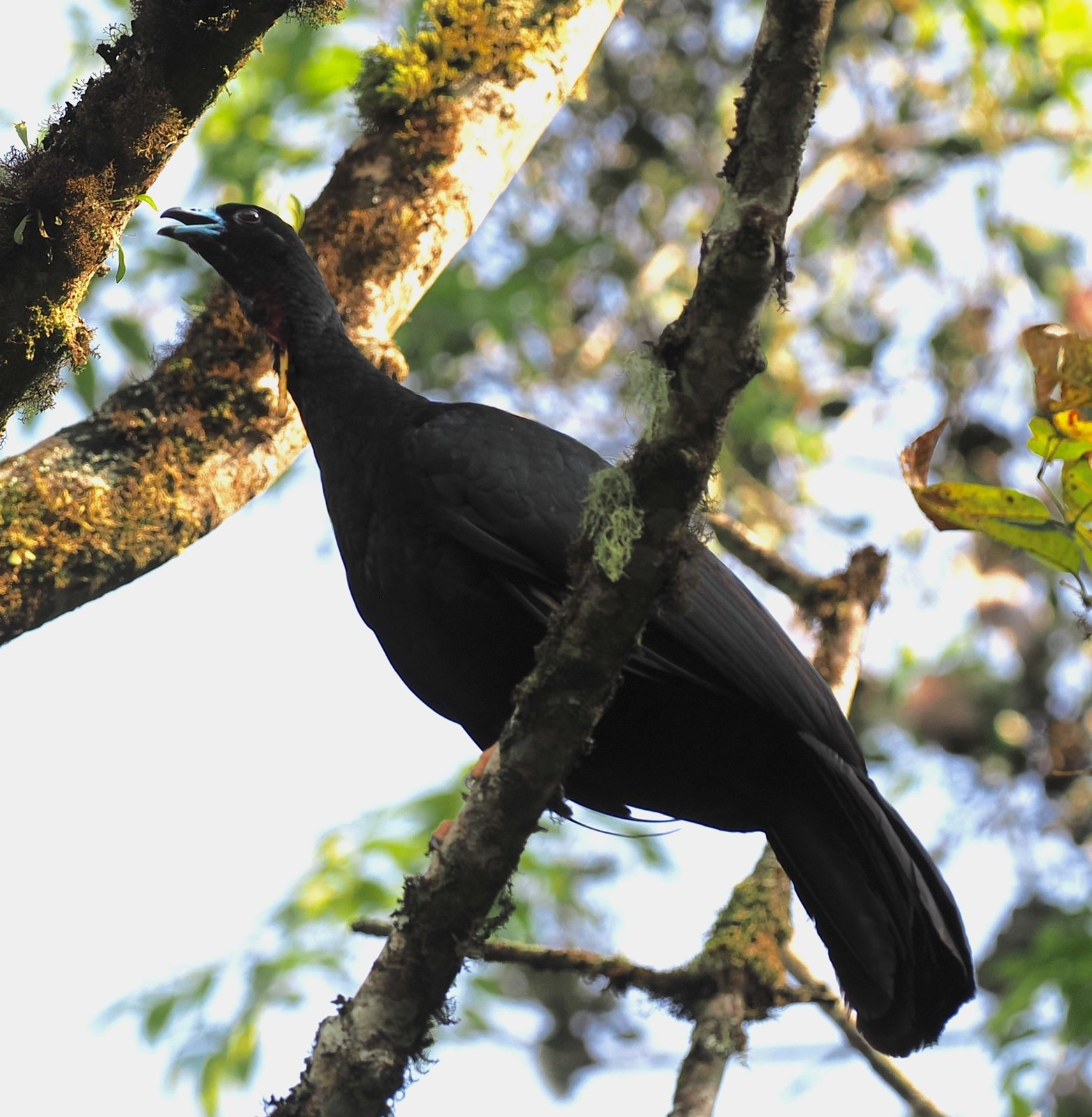
The Wattled Guan is a large, glossy black guan of montane forests on the slopes of the Andes. A long, thin, yellow wattle hangs from the throat, unique among the gamebirds of the guide area. Its scientific name aburri comes from the deep, rolling call that sounds mainly at night and before dawn.
Voice
A deep, rolling, slightly rising call, roughly a-burrr, repeated at intervals; given mainly at night and in the pre-dawn twilight and audible from far away. Also low, guttural notes.
Recording: Juan Freile — CC BY-NC-SA 4.0 · xeno-canto
Identification
70–78 cm, large and rather slender, with a long, broad tail and a small head. The whole plumage is black with a green to bronze gloss, strongest on the wings and tail. The bill is pale blue with a dark tip. A narrow, bright yellow wattle several centimetres long hangs from the throat. The legs are yellow. The sexes are alike; juveniles are duller and have a shorter wattle.
Confusion species
Sickle-winged Guan Chamaepetes goudotii is smaller and brown, with a rufous belly and blue face, and lacks a wattle. Blue-throated Piping Guan Pipile cumanensis has a white crest, white wing patches and a blue dewlap, and lives in the lowlands. Curassows such as Razor-billed Curassow Mitu tuberosum and Helmeted Curassow Pauxi pauxi are heavier, with a red bill or a casque on the bill, and walk mainly on the forest floor.
Habitat
Humid montane and foothill forest, especially on steep slopes and in ravines, also forest edge and tall secondary growth, mostly between 600 and 2500 m. It lives mainly in the canopy, singly or in pairs, and eats fruit, such as that of palms and laurels. Little is known about the nest; it is placed in a tree.
Where the bird is most at home, classified by the vegetation units of the Andes and the west coast.


Range and movements
In Colombia locally in all three Andean ranges. In Ecuador mainly on the eastern slope, rare and local on the western slope in the north. In Peru on the eastern slope, south to Cusco and Puno. Not known from Bolivia; absent from the Galápagos. Outside the guide area in the Andes and the Serranía de Perijá of Venezuela.
- Resident
- dark = core range, pale = thinly spread
How and when to look
At dusk and at night, listen for the rolling call from forest trails and lodges at middle elevations on the eastern slope; by day the bird often sits quietly high in fruiting trees.
Conservation status
Least Concern, but locally scarce and sensitive to hunting and to clearing of foothill forest; it disappears quickly where forest is opened up.
Scientific name
Aburria aburri | (Lesson, 1828)
Lesson described the species in 1828 as Penelope aburri; because it was later moved to another genus, the author and year stand in brackets. The genus Aburria was introduced in 1853 by Reichenbach. The genus name derives from the species name aburri, an onomatopoeic name used by Colombian Amerindians for this guan. The species name is aburri (also burria), an onomatopoeic name used by Colombian Amerindians for this guan; according to Lesson, the word, pronounced slowly, renders the bird's call well. The specimen the first description was based on came from Andes of Colombia.