All species › Gamebirds › Guans, curassows and chachalacas › Blue-throated Piping Guan
Blue-throated Piping Guan | Pipile cumanensis
Blauwkeelgoean | Pava silbosa goliazul | Jacutinga-de-garganta-azul
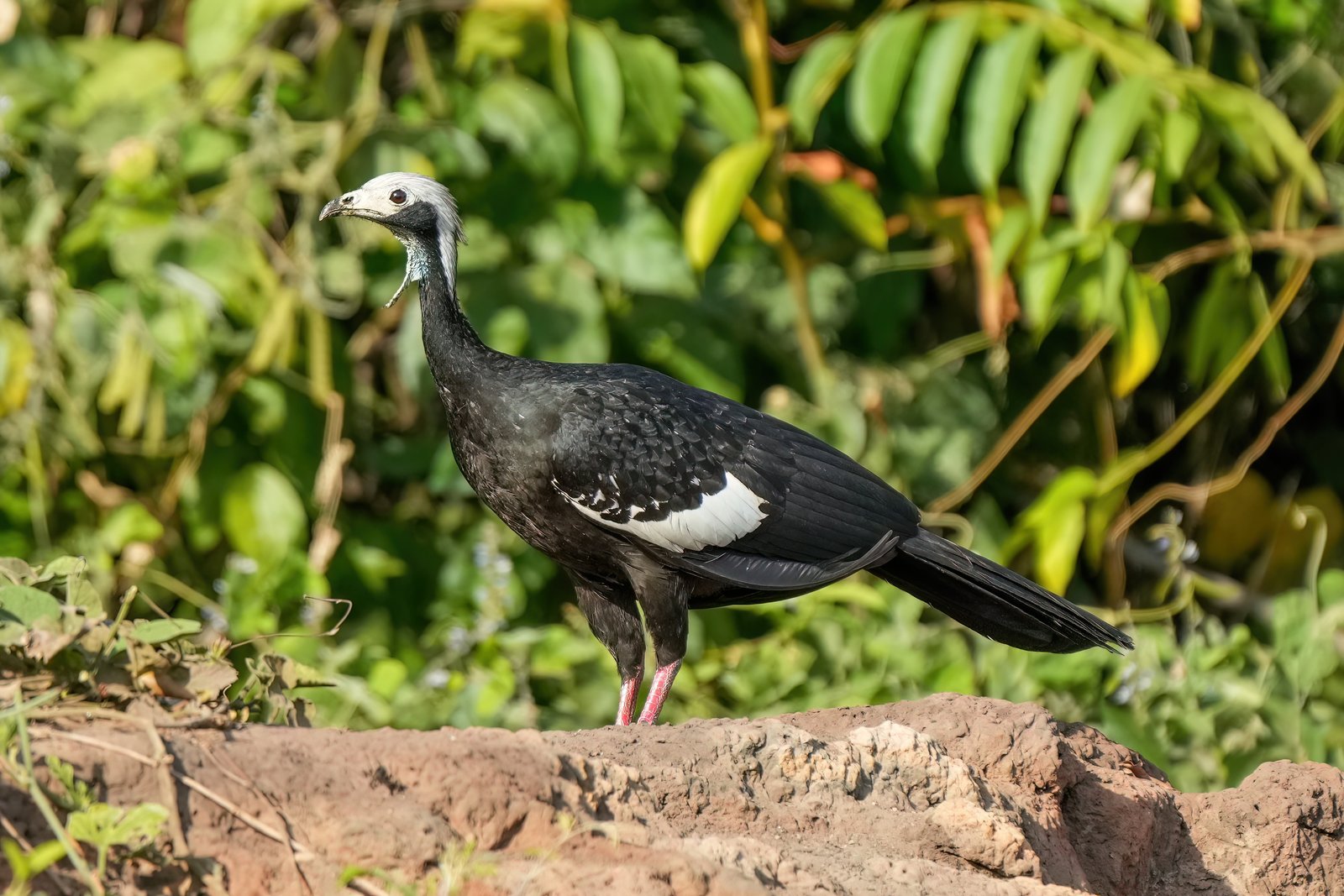
The Blue-throated Piping Guan is a black guan with a white crest and white wing patches of the Amazonian lowlands. Its hallmark is the cobalt-blue dewlap below the pale bare facial skin. At sunrise it makes display flights with a rattling wing sound and gives a series of thin, rising whistles.
Voice
A series of six to ten thin, drawn-out, rising whistles, roughly puu-eee, mainly before and around sunrise. During short display flights between the trees a dry, rattling wing sound. Also soft, creaking notes.
Recording: Jacob Wijpkema — CC BY-NC-SA 4.0 · xeno-canto
Identification
60–69 cm, with a rather small head, a long tail and red legs. The plumage is black with a blue to green gloss. The crown feathers form a shaggy white crest with fine black shaft streaks. A large white patch on the wing coverts is visible even on the perched bird. The bare skin around the eye is white to pale blue; the dewlap is dark cobalt blue. The bill is blue with a black tip. The sexes are alike. In Bolivia (subspecies grayi) the crest is more fully white.
Confusion species
Red-throated Piping Guan Pipile cujubi has a red dewlap and overlaps only in north-eastern Bolivia. Spix's Guan Penelope jacquacu is brown, with a red dewlap and no white crest or wing patches. Wattled Guan Aburria aburri has a yellow wattle and no white, and lives higher on the Andean slope. Nocturnal Curassow Nothocrax urumutum and Razor-billed Curassow Mitu tuberosum walk on the forest floor and have no white in the wing.
Habitat
Tall forest along rivers, várzea and gallery forest, also terra firme forest and forest edge in the lowlands, mostly below 1000 m, locally to about 1500 m in the foothills. It lives in pairs or small groups in the treetops and eats fruit, seeds, flowers and leaves; it sometimes comes down to riverbanks to drink or eat clay. The nest is a platform of twigs in a tree.
Where the bird is most at home, classified by the vegetation units of the Andes and the west coast.


Range and movements
In Colombia in the lowlands east of the Andes, from the edge of the Llanos to the Amazon basin. In Ecuador in the Amazonian lowlands. In Peru in the Amazonian lowlands and the foothills. In Bolivia in the lowlands of the north and east, including gallery forest in the Beni savannas. Absent from the Galápagos. Outside the guide area in southern Venezuela, western and south-western Brazil and northern Paraguay.
- Resident
- dark = core range, pale = thinly spread
How and when to look
On early-morning boat trips, search the bare tops of tall trees along rivers and oxbow lakes, for example at Tambopata and Manu in Peru or Yasuní in Ecuador. Birds often perch in the open on a branch in the first sunlight.
Conservation status
Least Concern. Heavily hunted, and scarce or gone around settlements and along busy rivers; locally common in protected areas.
Scientific name
Pipile cumanensis | (Jacquin, 1784)
Jacquin described the species in 1784 as Crax cumanensis; because it was later moved to another genus, the author and year stand in brackets. The genus Pipile was introduced in 1856 by Bonaparte. The genus name goes back to German Pipen, 'piping' (compare Latin pipilare, 'to chirp'). Von Jacquin (1784) wrote that the bird owed its name among the Americans to its soft piping call. The species name refers to Cumaná in Venezuela. The specimen the first description was based on came from Orinoco region near Cumaná, Venezuela.