All species › Waterfowl › Ducks, swans and geese › Chiloe Wigeon
Chiloe Wigeon | Mareca sibilatrix
Chileense smient | Pato overo | Marreca-oveira
The Chiloe Wigeon is a wigeon of southern South America, where the southernmost birds move north after breeding. In the guide area it has been recorded only as a rare vagrant, mainly in Peru. The male and female are almost alike in pattern.
Voice
The male gives a loud, whistled, descending whee-wheeoo, the female a low, growling quack.
Recording: Cristian Pinto Fernandez — CC BY-NC-SA 4.0 · xeno-canto
Identification
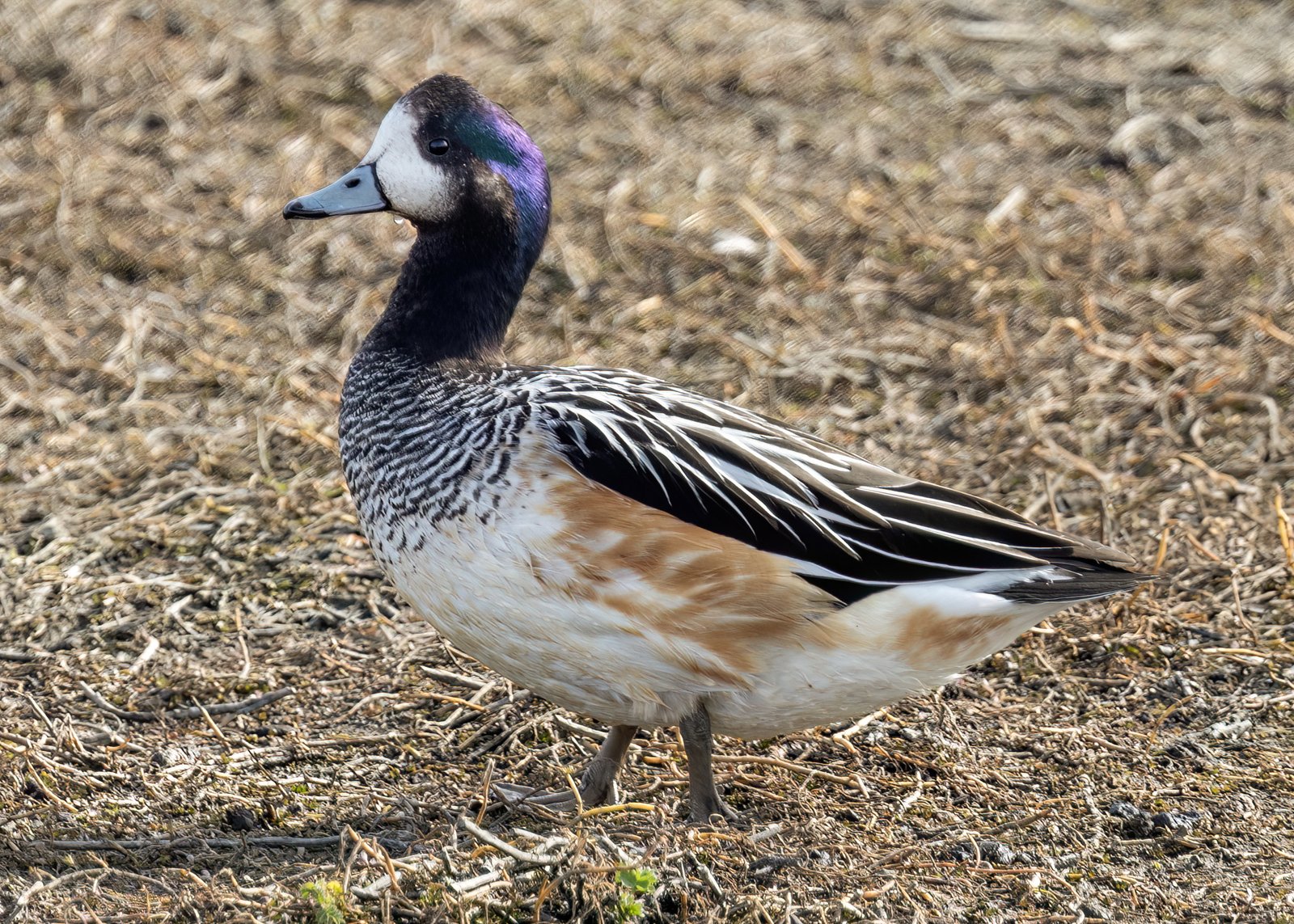
43–54 cm, a medium-sized duck with a round head and a short, blue-grey bill with a black tip. The head is white in front, with a black nape and a glossy green band behind the eye. The breast is scaled black and white, the flanks are rusty brown and the back is black with white edges. In flight the white forewing and white belly stand out. The female is duller and has less white in the wing than the male.
Confusion species
American Wigeon Mareca americana, a winter visitor from the north, has grey-speckled sides of the head with only a white crown and a pinkish-brown, unscaled breast. Crested Duck Lophonetta specularioides is larger and browner, with a ragged crest and a red iris.
Habitat
Freshwater lakes, lagoons, marshes and grassy shores. It eats mainly aquatic plants and grasses and often grazes on the shore. It does not breed in the guide area.
Where the bird is most at home, classified by the vegetation units of the Andes and the west coast.


Range and movements
In the guide area only a rare vagrant, mainly in Peru. Absent from the Galápagos. It breeds in Chile and Argentina south to Tierra del Fuego and on the Falkland Islands; southern birds move north in the austral winter to northern Argentina, Uruguay, Paraguay and southern Brazil.
How and when to look
A vagrant stands out among other ducks on lakes and coastal lagoons in southern Peru, mainly in the austral winter; note the white face with black nape and the scaled breast.
Conservation status
Least Concern. The population is large and stable.
Scientific name
Mareca sibilatrix | (Poeppig, 1829)
Poeppig described the species in 1829 as Anas sibilatrix; because it was later moved to another genus, the author and year stand in brackets. The genus Mareca was introduced in 1824 by Stephens. The genus name is from the Portuguese word marreco, 'small duck'. Latin sibilatrix means 'whistler', after the whistling call. The specimen the first description was based on came from Talcahuano, Concepción, Chile.