All species › Waterfowl › Ducks, swans and geese › Gadwall
Gadwall | Mareca strepera
Krakeend | Ánade friso | Frisada
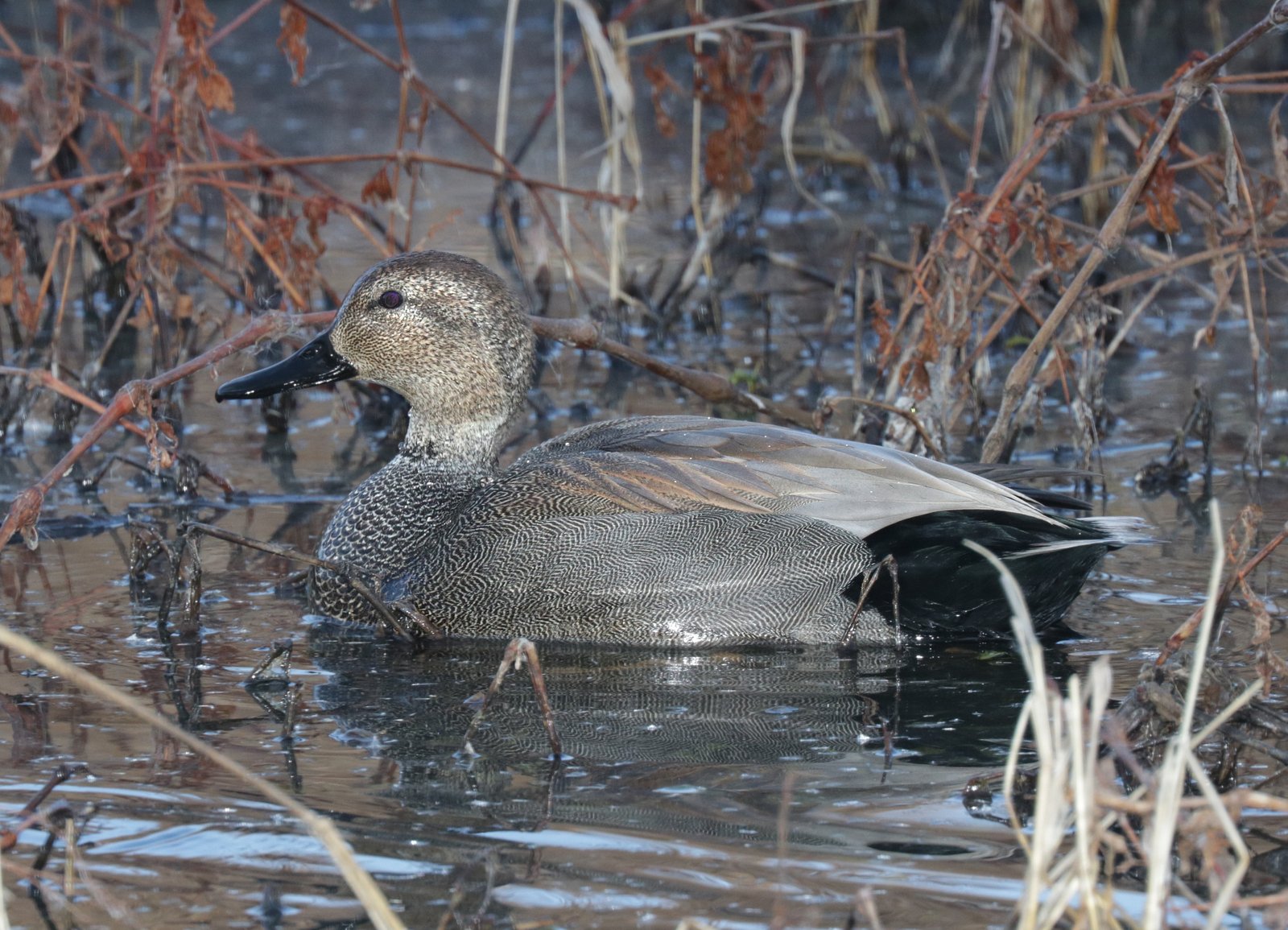
The Gadwall is a grey-brown dabbling duck of the northern hemisphere. North American birds winter south to Mexico and only rarely further south. In the guide area it has been recorded only as a very rare vagrant.
Voice
The male gives a short, low grunt, the female a nasal quack resembling that of Mallard but higher.
Recording: David Darrell-Lambert — CC BY-NC-SA 4.0 · xeno-canto
Identification
46–56 cm, a medium-sized duck with a fairly steep forehead and a narrow bill. The male is finely vermiculated grey, with a brownish-grey head, a black rear end and a dark bill. The female is mottled brown, with an orange edge and a dark ridge to the bill. Both sexes have a white speculum, visible in flight and often also at rest, and a white belly.
Confusion species
American Wigeon Mareca americana has a shorter, blue-grey bill with a black tip, a rounder head and, in the male, a white forewing. Females of Mallard Anas platyrhynchos are larger, with a blue speculum bordered white and an orange bill with a dark patch. Yellow-billed Pintail Anas georgica has a yellow bill, a longer neck and a pointed tail.
Habitat
Freshwater lakes, ponds and marshes with abundant aquatic plants. It feeds at the surface, mainly on aquatic plants and seeds. It does not breed in the guide area.
Where the bird is most at home, classified by the vegetation units of the Andes and the west coast.


Range and movements
In the guide area only a very rare vagrant, with a few records in the north. Absent from the Galápagos. It breeds in North America, Europe and Asia; North American birds winter south to Mexico.
How and when to look
A vagrant is most likely to be picked out among flocks of Blue-winged Teal or American Wigeon on lakes in northern Colombia; note the white speculum and the male's black rear end.
Conservation status
Least Concern. The world population is large and has increased in North America.
Scientific name
Mareca strepera | (Linnaeus, 1758)
Linnaeus described the species in 1758 as Anas strepera; because it was later moved to another genus, the author and year stand in brackets. The genus Mareca was introduced in 1824 by Stephens. The genus name is from the Portuguese word marreco, 'small duck'. Latin strepera means 'noisy', from strepere, 'to make a noise'. The specimen the first description was based on came from Sweden.