All species › Cranes, rails and allies › Rails, gallinules and coots › American Coot
American Coot | Fulica americana
Amerikaanse meerkoet | Gallareta americana | Carqueja-americana
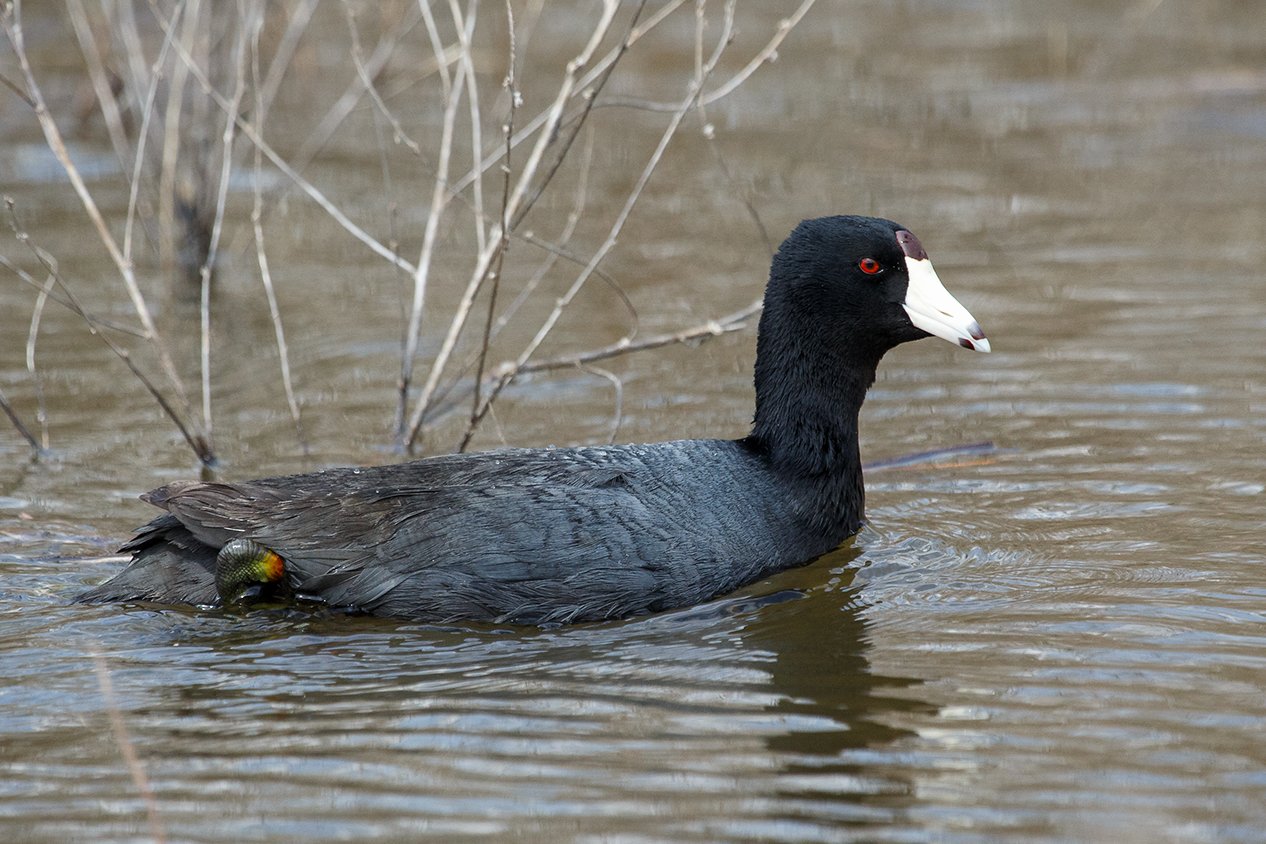
The American Coot is a compact, slate-grey coot with a white bill, ranging from North America to north-western South America. In the guide area the subspecies columbiana lives on lakes in the Andes of Colombia and northern Ecuador. Its relationship to Andean Coot, which occurs farther south, has long been debated.
Voice
A range of grunting, cackling and tooting sounds and a short, loud puhk.
Recording: Max Noack — CC BY-NC-SA 4.0 · xeno-canto
Identification
36–41 cm. Slate grey, with a blacker head and neck. The bill is white with a dark ring near the tip; the frontal shield is white to yellowish, in columbiana often larger and yellower, sometimes with a small dark reddish-brown knob at the top. The sides of the undertail are white. The legs are yellowish green with lobed toes. The sexes are alike. Juveniles are greyer with a pale throat and a dull bill.
Confusion species
Andean Coot Fulica ardesiaca is very similar, but often has a yellow, white or chestnut shield and usually no dark bill ring, and lives farther south in the Andes. Common Moorhen Gallinula chloropus is slimmer, with a red, yellow-tipped bill and a white flank line. Spot-flanked Gallinule Porphyriops melanops is smaller, with a greenish-yellow bill and white spots on the flanks.
Habitat
Lakes, lagoons, reservoirs and ponds with open water and waterside vegetation on the high plateaus of the Andes, roughly between 2000 and 3600 m. It eats aquatic plants, algae, seeds and small invertebrates, swimming, diving and grazing on the shore. The nest is a floating platform of plant material in reeds or rushes.
Where the bird is most at home, classified by the vegetation units of the Andes and the west coast.


Range and movements
In Colombia in the Andes, mainly in the Eastern Andes (Sabana de Bogotá, Laguna de Fúquene, Laguna de Tota) and south to Nariño. In Ecuador in the northern Andes, where the boundary with Andean Coot is not sharp. Absent from Peru, Bolivia and the Galápagos. Outside the guide area from North America through Central America to the Caribbean.
- Resident
- dark = core range, pale = thinly spread
How and when to look
On the lakes of the Sabana de Bogotá and at Laguna de Tota, where birds feed in groups on open water; also in parks with ponds.
Conservation status
Least Concern. In Colombia the species suffers locally from drainage, pollution and silting up of the high-plateau lakes.
Scientific name
Fulica americana | Gmelin, 1789
Gmelin described the species in 1789 and placed it straight away in the genus where it still stands. The genus Fulica was introduced in 1758 by Linnaeus. The genus name is the Latin word fulica for the Eurasian Coot; Conrad Gessner used the name in 1555. The species name refers to America. The specimen the first description was based on came from North America.