All species › Cranes, rails and allies › Rails, gallinules and coots › Giant Coot
Giant Coot | Fulica gigantea
Reuzenkoet | Focha gigante | Carqueja-gigante
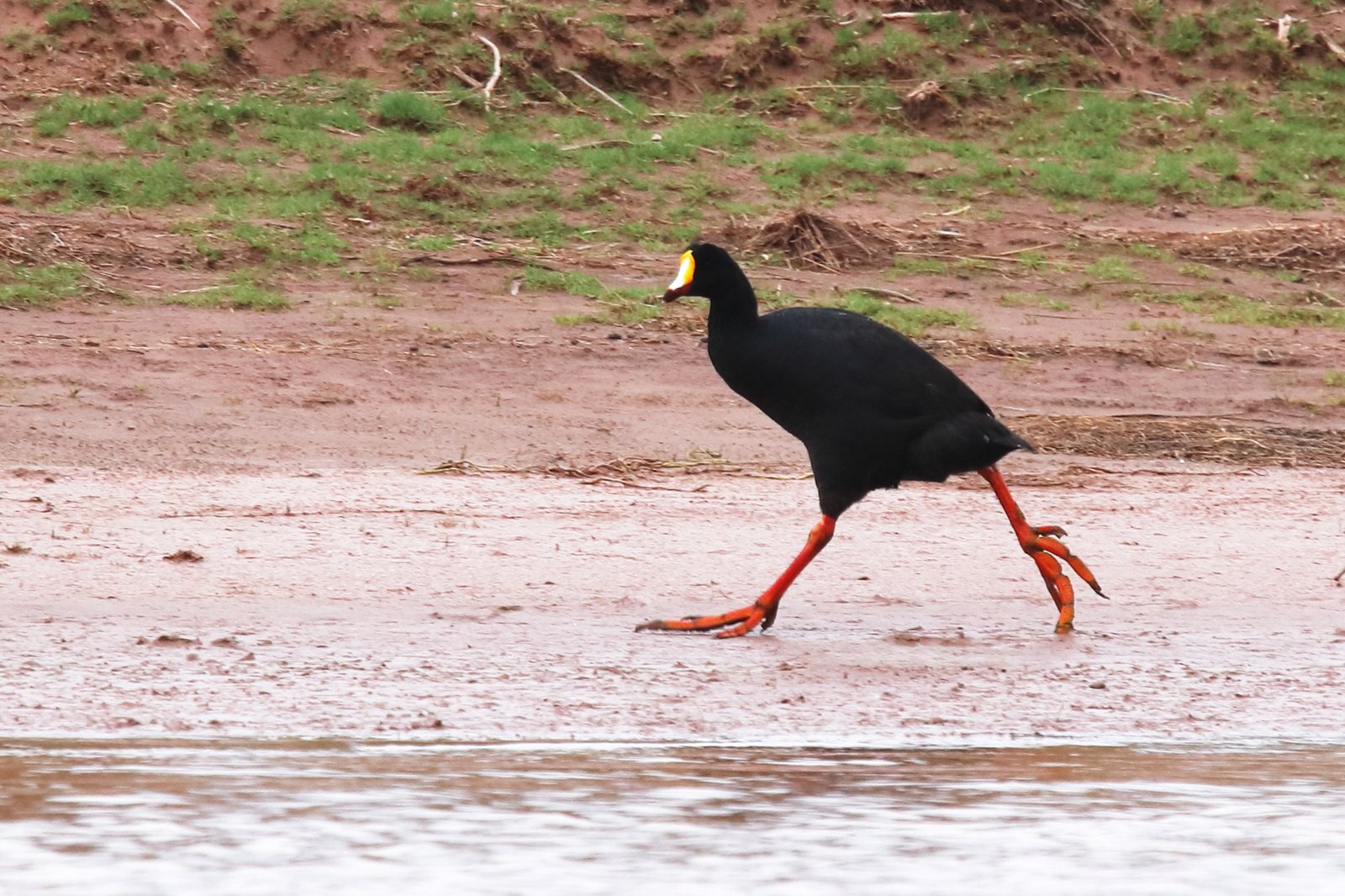
The Giant Coot is the largest coot in the world, a heavy bird of the lakes and lagoons of the high Andes. Adults are so heavy that they can barely fly, if at all; they patter away over the water or dive. Pairs build large floating nests of aquatic plants, which they defend all year round.
Voice
Loud, hoarse and grunting sounds and trumpeting calls, often in duet; when defending the territory loud splashing and growling.
Recording: Jacob Wijpkema — CC BY-NC-SA 4.0 · xeno-canto
Identification
55–60 cm, massively built, with large red legs with yellowish lobes. The plumage is uniform slate black. The bill is dark red with a white to yellow base and tip; the frontal shield is yellow to white and ends in two knobs at the sides. The sexes are alike. Juveniles are greyer, with a duller bill and legs.
Confusion species
Horned Coot Fulica cornuta is equally large, but has a yellowish bill, a black wattle on the forehead and greenish legs, and lives on salt lakes farther south. Andean Coot Fulica ardesiaca is much smaller, with greyish-green legs and a white or yellow bill, and flies well. Common Moorhen Gallinula chloropus has a red shield, a white flank line and yellowish-green legs.
Habitat
Lakes, lagoons and pools of the puna and altiplano with rich submerged vegetation, mostly between 3600 and 5000 m, locally lower. It eats mainly aquatic plants and algae, gathered by dabbling. The nest is a large floating platform of aquatic plants, often anchored in vegetation or in a shallow spot, and is maintained for a long time.
Where the bird is most at home, classified by the vegetation units of the Andes and the west coast.


Range and movements
In Peru in the Andes of the southern and south-central parts, including Puno, Arequipa, Moquegua and Tacna. In Bolivia on the western altiplano in La Paz, Oruro and Potosí. Absent from Colombia, Ecuador and the Galápagos. Outside the guide area in northern Chile and north-western Argentina.
- Resident
- dark = core range, pale = thinly spread
How and when to look
On puna lagoons, for example in the Salinas y Aguada Blanca National Reserve near Arequipa, in Lauca National Park on the Chilean side, or on the lakes of the Bolivian altiplano; nests and birds are often in open water and can be watched from the shore.
Conservation status
Least Concern. The population is locally sensitive to water extraction, desiccation, pollution from mining and egg collecting.
Scientific name
Fulica gigantea | Eydoux & Souleyet, 1841
Eydoux & Souleyet described the species in 1841 and placed it straight away in the genus where it still stands. The genus Fulica was introduced in 1758 by Linnaeus. The genus name is the Latin word fulica for the Eurasian Coot; Conrad Gessner used the name in 1555. The species name is Latin giganteus, 'gigantic', after the bird's size. The specimen the first description was based on came from Peru.