All species › Cranes, rails and allies › Rails, gallinules and coots › Horned Coot
Horned Coot | Fulica cornuta
Hoornkoet | Focha cornuda | Carqueja-de-chifre
The Horned Coot is a very large, heavy coot of the high salt lakes and lagoons of the dry puna. On its forehead it carries a black, forward-hanging fleshy 'horn'. It builds a unique nest: a cone of thousands of pebbles piled up in the water, topped by a platform of aquatic plants.
Voice
Low grunting and growling sounds and loud, piercing calls, often as a duet at the nest.
No recording with a suitable Creative Commons licence is available for this species yet.
Identification
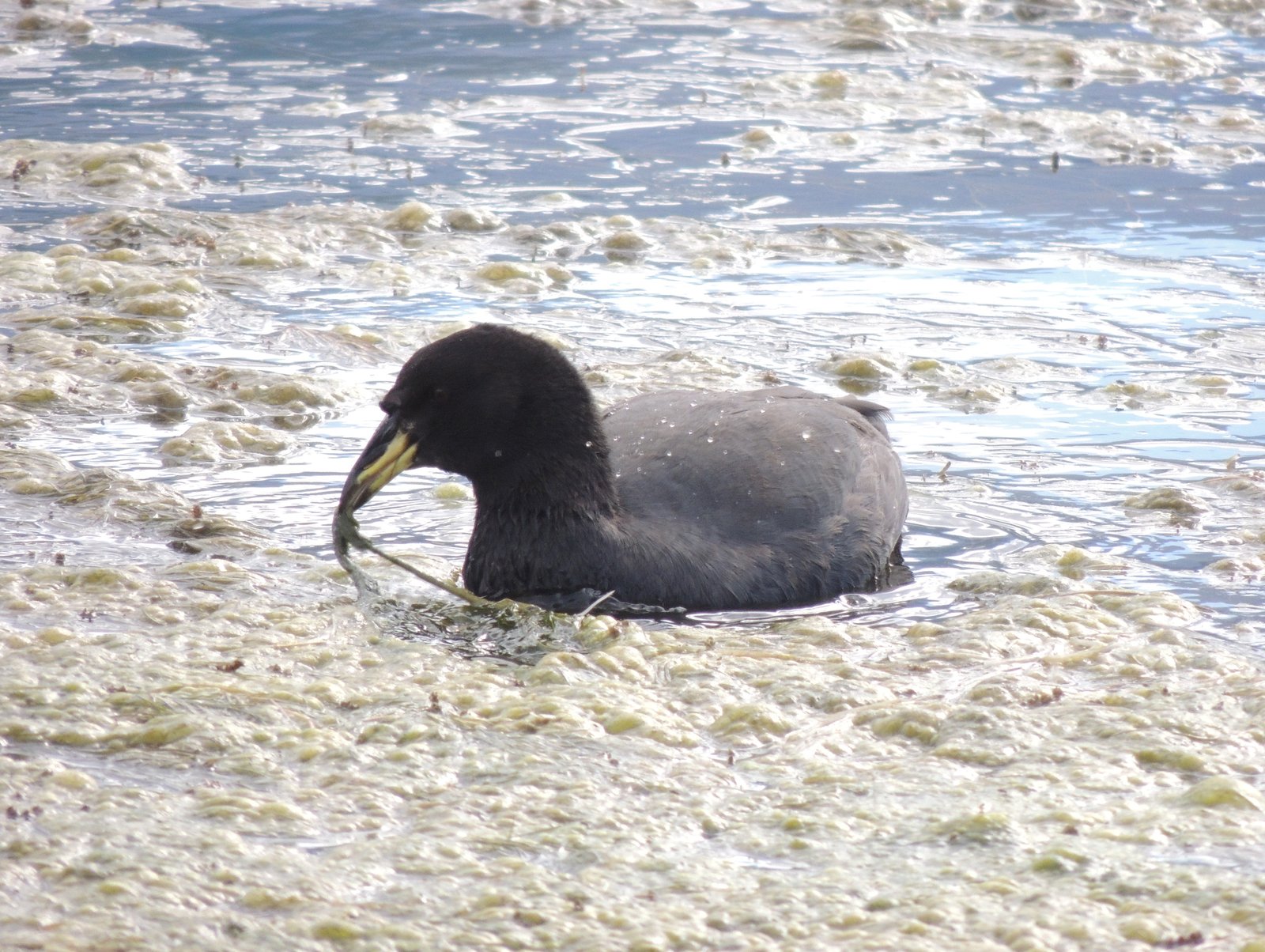
46–56 cm, heavily built. The plumage is uniform slate black, with white on the sides of the undertail. On top of the bill base sits a long, black, mobile wattle with tufts of small feathers, hanging forward over the bill like a horn. The bill is yellowish to olive-yellow with a dark culmen. The legs are olive-green to yellowish green. The sexes are alike. Juveniles are greyer and have a smaller wattle.
Confusion species
Giant Coot Fulica gigantea is equally large, but has a dark red bill with a white and yellow frontal shield, red legs and no wattle. Andean Coot Fulica ardesiaca is much smaller, with a white, yellow or chestnut shield and no wattle.
Habitat
Shallow, open lakes and lagoons on the dry puna and altiplano, often brackish or saline, with submerged plants, between about 3600 and 5200 m. It feeds almost exclusively on aquatic plants, gathered by dabbling or diving. The nest sits on a self-built cone of stones on the lake bed, topped by a large platform of plant material; it is used for years in succession.
Where the bird is most at home, classified by the vegetation units of the Andes and the west coast.


Range and movements
In Bolivia on the lakes of the south-western altiplano, mainly in the Lípez region of Potosí. Not reliably recorded in Peru. Absent from Colombia, Ecuador and the Galápagos. Outside the guide area in northern Chile and north-western Argentina.
- Resident
- dark = core range, pale = thinly spread
How and when to look
On the lagoons of the Eduardo Avaroa Andean Fauna National Reserve in Sur Lípez; the stone nest mounds are often close to shore and can be watched well with a telescope.
Conservation status
Near Threatened. The population is small and concentrated on a limited number of lakes. Threats include water extraction for mining, desiccation, disturbance and egg collecting.
Scientific name
Fulica cornuta | Bonaparte, 1853
Bonaparte described the species in 1853 and placed it straight away in the genus where it still stands. The genus Fulica was introduced in 1758 by Linnaeus. The genus name is the Latin word fulica for the Eurasian Coot; Conrad Gessner used the name in 1555. The species name is Latin cornutus, 'horned', after the horn-like wattle on the forehead. The specimen the first description was based on came from Potosí, Bolivia.