All species › Cranes, rails and allies › Rails, gallinules and coots › Red-fronted Coot
Red-fronted Coot | Fulica rufifrons
Roodschildkoet | Focha frentirroja | Carqueja-de-escudo-vermelho
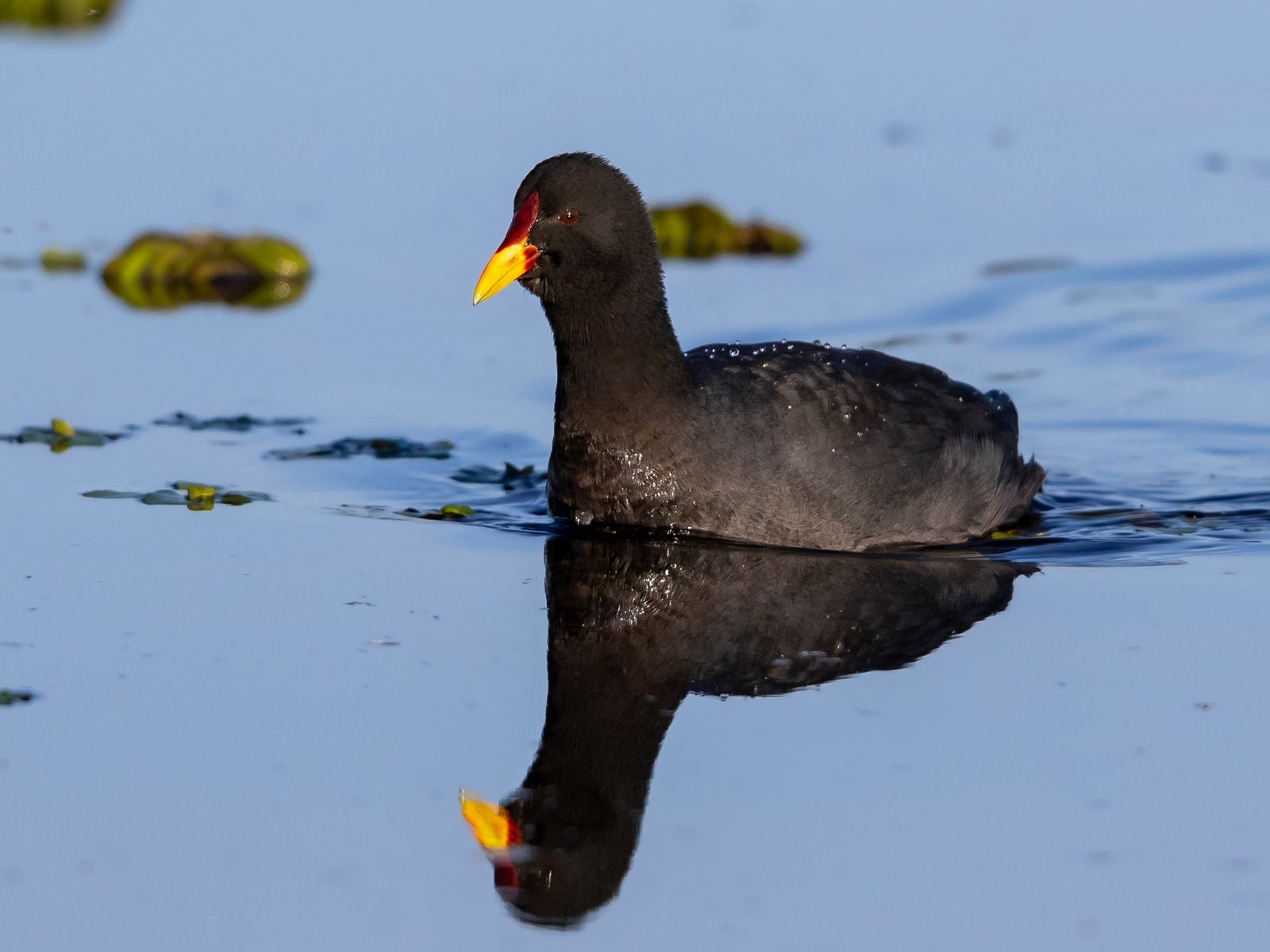
The Red-fronted Coot is a coot of reedy marshes and lakes in southern South America that reaches the guide area only at its margins. It is recognised by its dark red frontal shield, which tapers to a point at the rear, and its conspicuous white undertail, held high when swimming.
Voice
Long, chattering series such as togo togo togo or poo-hoo poo-hoo, and a short tuk as an alarm.
Recording: Bernabe Lopez-Lanus — CC BY-NC-SA 3.0 · xeno-canto
Identification
38–43 cm. Almost entirely dark slate grey, with a blacker head and neck. The bill is yellow with a dark red base that continues into a narrow, pointed dark red frontal shield. The undertail coverts are white and stand out because the tail is often raised. The legs are olive-green. The sexes are alike. Juveniles are greyer brown, with a dark bill and white flecks on the throat, but also with the white undertail.
Confusion species
Andean Coot Fulica ardesiaca has a white or yellow bill and a white to yellow or chestnut shield that is rounded, not pointed, and less white under the tail; it lives in the high Andes. White-winged Coot Fulica leucoptera has a yellow, rounded shield and white trailing edges to the wings. Common Moorhen Gallinula chloropus has a red, yellow-tipped bill and a white flank line.
Habitat
Shallow, reedy freshwater marshes, lakes and coastal lagoons with floating plants such as duckweed, mostly in the lowlands but locally also in Andean valleys. It eats aquatic plants and seeds, and to a lesser extent small invertebrates. The nest is a cup of plant material low above the water, in floating or emergent vegetation.
Where the bird is most at home, classified by the vegetation units of the Andes and the west coast.


Range and movements
In Peru only a few records from coastal marshes in the far south, such as the Ite wetlands in Tacna. In Bolivia locally, including at Laguna Alalay near Cochabamba. Absent from Colombia, Ecuador and the Galápagos. Outside the guide area along the coast of Chile, and from south-eastern Brazil through Uruguay to central Argentina.
- Resident
- dark = core range, pale = thinly spread
How and when to look
In the guide area, check the other coots at Laguna Alalay and in the coastal marshes of southern Peru for a bird with a pointed red shield and a raised white undertail.
Conservation status
Least Concern. The species is common in southern South America; drainage of marshes plays a role locally.
Scientific name
Fulica rufifrons | Philippi & Landbeck, 1861
Philippi & Landbeck described the species in 1861 and placed it straight away in the genus where it still stands. The genus Fulica was introduced in 1758 by Linnaeus. The genus name is the Latin word fulica for the Eurasian Coot; Conrad Gessner used the name in 1555. The species name comes from Latin rufus, 'rufous', and frons, 'forehead', after the reddish frontal shield. The specimen the first description was based on came from Chile.