All species › Cranes, rails and allies › Rails, gallinules and coots › Common Moorhen
Common Moorhen | Gallinula chloropus
Waterhoen | Gallineta común | Galinha-d'água
The Common Moorhen is the most widespread rail of the guide area, from marshes and ponds in the lowlands to lakes high on the altiplano. It swims with a bobbing head and flicking tail and also walks a great deal on banks and floating plants. Birds of the high Andes (garmani) are distinctly larger than lowland birds.
Voice
An explosive, rolling krrruk and a series of cackling notes that gradually slow down; also short, sharp kik calls.
Recording: Roger Ahlman — CC BY-NC-SA 4.0 · xeno-canto
Identification
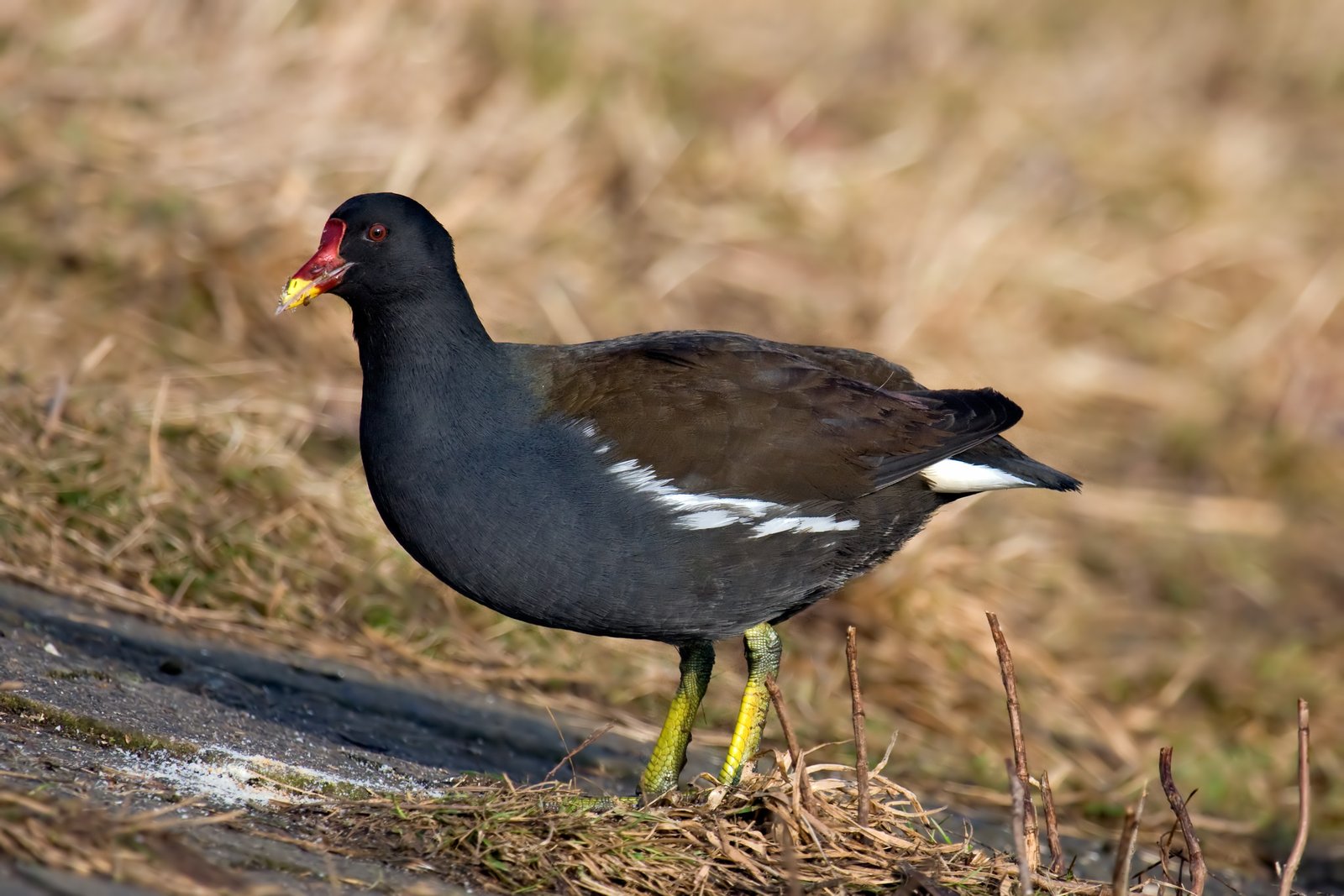
32–35 cm, larger in the high Andes. Adults are slate grey to blackish, with a dark brown back. The frontal shield and bill are red, the bill tip yellow. A white line runs along the flank; the undertail is white at the sides and black in the centre and is shown when swimming. The legs are yellowish green with a red 'garter'. The sexes are alike. Juveniles are greyish brown with a pale throat and a dark bill with a dull shield.
Confusion species
Spot-flanked Gallinule Porphyriops melanops is smaller, with a greenish-yellow bill without a red shield and white spots on the flanks. Purple Gallinule Porphyrio martinica is bluish purple with a green back, a pale blue shield and yellow legs. American Coot Fulica americana and Andean Coot Fulica ardesiaca are bulkier, plain greyish black, with a white or yellowish bill and no white flank line.
Habitat
Lakes, lagoons, ponds, marshes, ditches, rice fields and fish ponds with waterside vegetation, from sea level to over 4000 m on the altiplano. It eats aquatic plants, seeds, algae, insects, snails and other small food, both while swimming and walking on the shore. The nest is a cup of plant material in waterside vegetation or on floating plants.
Where the bird is most at home, classified by the vegetation units of the Andes and the west coast.


Range and movements
In Colombia widespread in the lowlands and in the Andes, up to the high plateaus of the Eastern Andes. In Ecuador along the coast and in the inter-Andean valleys. In Peru along the coast, in the Andes and locally in the eastern lowlands; the large highland form on puna lakes. In Bolivia on the altiplano, including around Lake Titicaca, and locally in the lowlands. In the Galápagos a scarce breeder on a few islands with fresh water. Outside the guide area in large parts of North, Central and South America.
- Resident
- dark = core range, pale = thinly spread
How and when to look
At almost any lake or marsh with reedy margins; in parks and at fish ponds birds often show themselves in the open.
Conservation status
Least Concern. The species benefits locally from artificial waters, but suffers from drainage and pollution.
Scientific name
Gallinula chloropus | (Linnaeus, 1758)
Linnaeus described the species in 1758 as Fulica Chloropus; because it was later moved to another genus, the author and year stand in brackets. The genus Gallinula was introduced in 1760 by Brisson. The genus name is Latin gallinula, 'little hen', a diminutive of gallina, 'hen'. The species name comes from Ancient Greek khlōros, 'green', and pous, 'foot', after the green legs. The specimen the first description was based on came from England.