All species › Cranes, rails and allies › Rails, gallinules and coots › Sora
Sora | Porzana carolina
Soraral | Polluela sora | Sanã-carolina
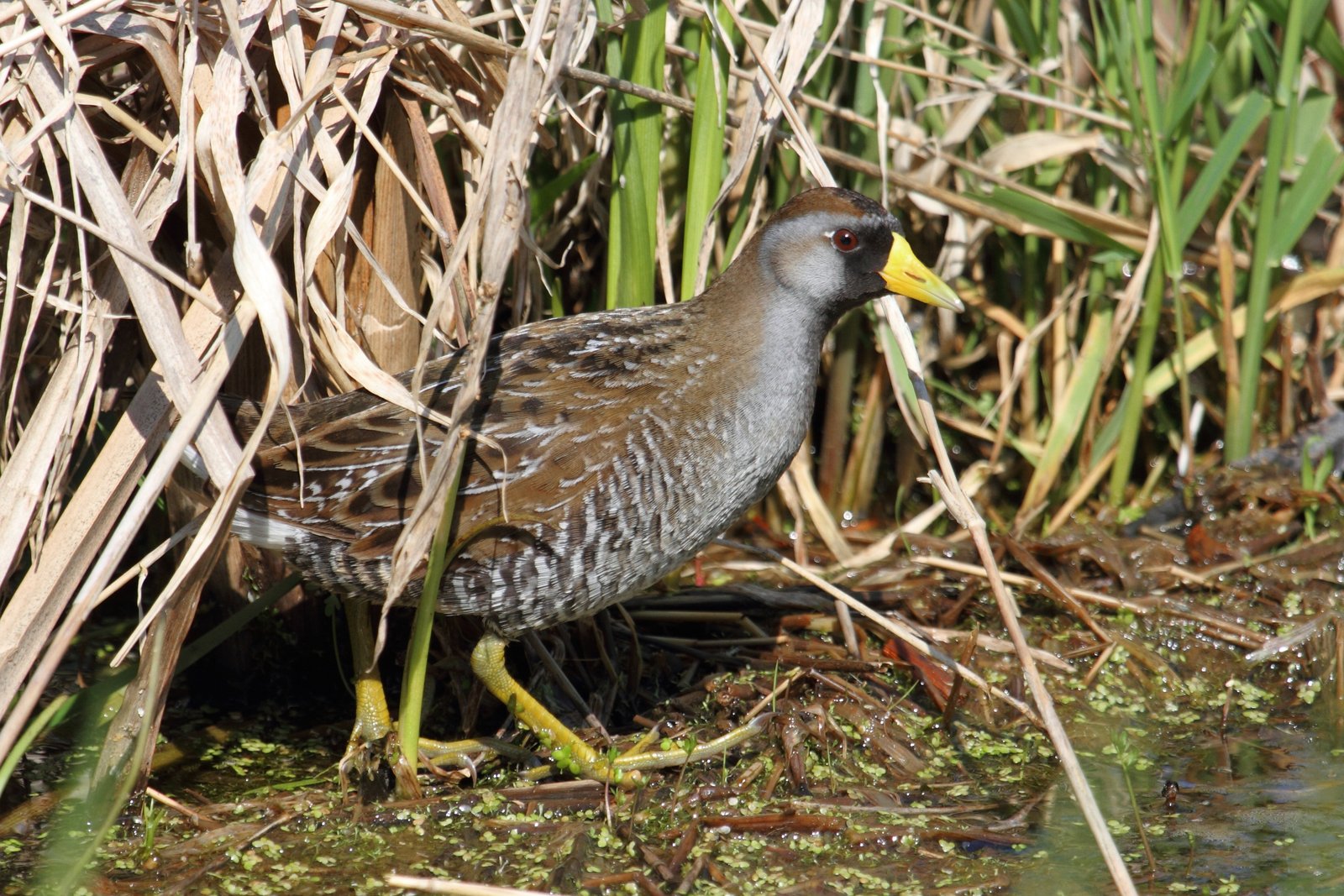
The Sora is a small, compact rail with a short yellow bill that breeds in North America and winters in north-western South America. In the guide area it stays in marshes from the lowlands to high in the Andes. It usually keeps hidden in dense waterside vegetation.
Voice
A descending, whinnying series of high notes; also a rising, whistled ker-wee and a sharp keek. On the wintering grounds mostly the short calls.
Recording: Don Profota — CC BY-NC-SA 4.0 · xeno-canto
Identification
20–25 cm, with a short, conical yellow bill and greenish-yellow legs. Adults have a black face and throat and grey sides of the head and breast. The upperparts are brown with black and white streaks. The flanks are greyish brown with white bars; the undertail is white and often flicked up. The sexes are nearly alike. Juveniles lack the black, are browner and buffier on the breast and have a white throat.
Confusion species
Ash-throated Crake Mustelirallus albicollis has a greenish bill, a grey throat and unstreaked flanks above the bars, and lives in the lowlands. Paint-billed Crake Mustelirallus erythrops has a green bill with a red base and red legs. Spot-flanked Gallinule Porphyriops melanops is larger, with white spots on the flanks, and swims in open water more often.
Habitat
Freshwater marshes with reeds, cattails and rushes, edges of lakes and lagoons, wet meadows, rice fields and ditches, from sea level to over 3000 m. It eats seeds of marsh plants, insects, snails and other small invertebrates. It does not breed in the guide area.
Where the bird is most at home, classified by the vegetation units of the Andes and the west coast.


Range and movements
In Colombia rather scarce but widespread, in the lowlands and in the Andes, including the Sabana de Bogotá. In Ecuador scattered, mainly in marshes and at lakes in the inter-Andean valleys and along the coast. In Peru scarce to rare, mainly in the north. Only a few records are known from Bolivia. It breeds in North America and winters from the southern United States through Central America and the Caribbean to north-western South America.
- Winter visitor (c. Oct–Mar)
- dark = core range, pale = thinly spread
How and when to look
Wait in the early morning or at dusk at the edge of a marsh with open muddy margins; birds then sometimes walk briefly out of cover, tail cocked. It often answers the calls of other birds with its short keek.
Conservation status
Least Concern. The species is numerous in North America; loss of wetlands on the breeding and wintering grounds is the main threat.
Scientific name
Porzana carolina | (Linnaeus, 1758)
Linnaeus described the species in 1758 as Rallus carolinus; because it was later moved to another genus, the author and year stand in brackets. The genus Porzana was introduced in 1816 by Vieillot. The genus name comes from Venetian dialect words for small rails. The species name refers to Carolina in North America. The specimen the first description was based on came from Hudson Bay, Canada.