All species › Cranes, rails and allies › Rails, gallinules and coots › Spot-flanked Gallinule
Spot-flanked Gallinule | Porphyriops melanops
Vlekflankwaterhoen | Pollona pintada | Galinha-d'água-carijó
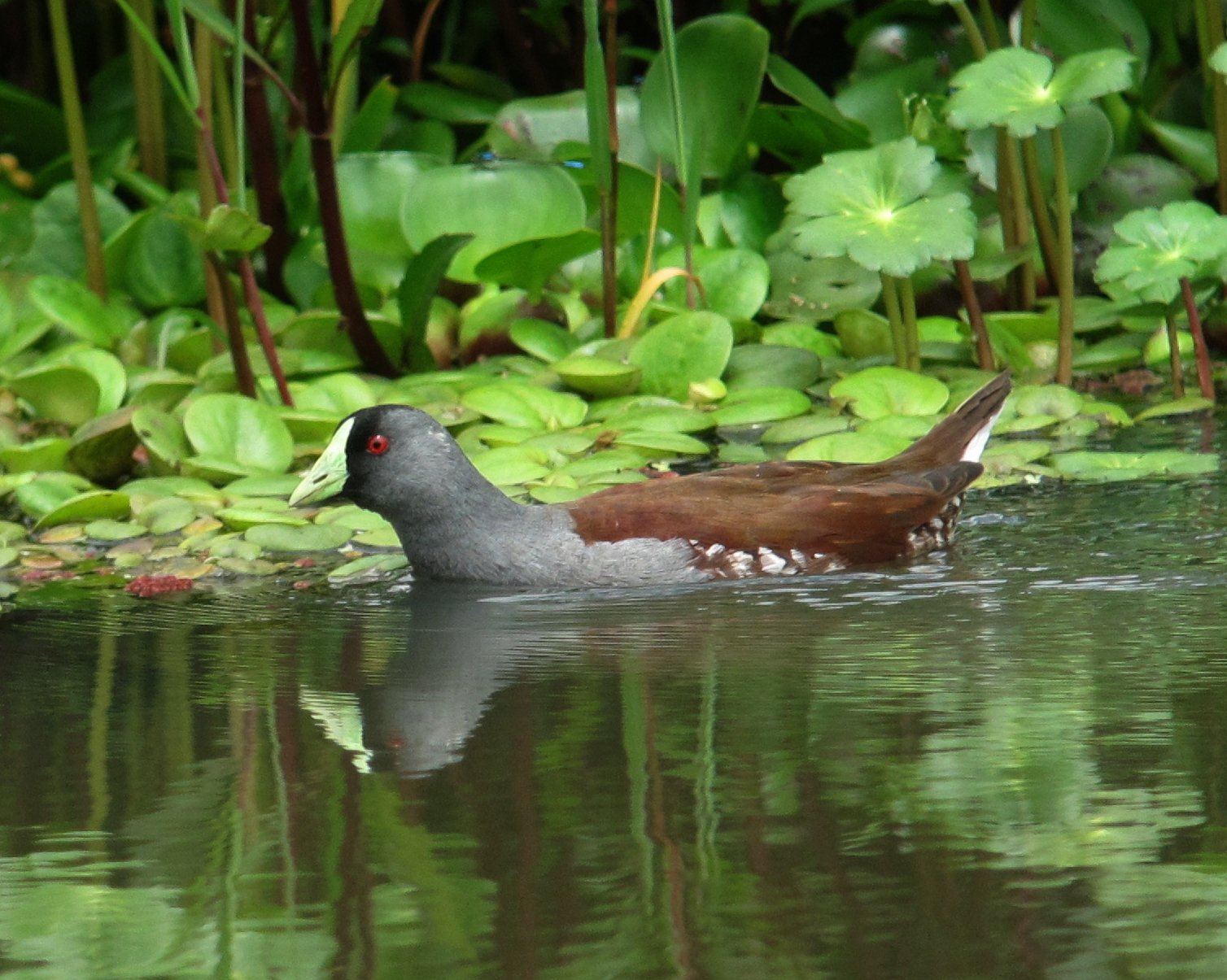
The Spot-flanked Gallinule is a small, compact gallinule with a greenish-yellow bill and white spots on its dark flanks. It often swims among floating plants, bobbing its head. In the guide area an isolated subspecies (bogotensis) lives on the Bogotá plateau; the main range lies in southern South America.
Voice
A rapid, cackling series of high notes, like ke-ke-ke-ke, and dry, ticking calls; also low, whooping sounds.
Recording: Fernando Castro — CC BY-NC-SA 4.0 · xeno-canto
Identification
25–28 cm, with a short, greenish-yellow bill without a frontal shield and greenish legs. The head and foreneck are slate grey, with a blackish face around the bill base. The back and wings are olive-brown, the wings partly chestnut. The flanks are dark slate to brown with distinct white spots; the undertail is white with black in the centre. The sexes are alike. Juveniles are browner and greyer, without the black face and with less distinct spots.
Confusion species
Common Moorhen Gallinula chloropus is larger, with a red frontal shield and a red, yellow-tipped bill, and a white line along the flank. Sora Porzana carolina is smaller, with a short yellow bill and streaked brown upperparts, and stays more within vegetation. Bogota Rail Rallus semiplumbeus has a long red bill and seldom swims in open water.
Habitat
Freshwater marshes, shallow lakes and lagoons with floating and emergent vegetation, ditches, ponds and wet grassland; in Colombia at about 2500–3100 m, farther south mainly in the lowlands. It eats aquatic plants, seeds, insects and small invertebrates, picked from the water surface and floating plants. The nest is a cup of plant material at or above the water, hidden in dense vegetation.
Where the bird is most at home, classified by the vegetation units of the Andes and the west coast.


Range and movements
In Colombia only the subspecies bogotensis, in the Eastern Andes on the Sabana de Bogotá and the Ubaté–Chiquinquirá plateau. In Peru rare and local, mainly in the south-east. In Bolivia in the eastern and southern lowlands, partly as a migrant from the south. Absent from Ecuador and the Galápagos. Outside the guide area in Paraguay, Uruguay, Argentina, Chile and southern Brazil.
- Resident
- dark = core range, pale = thinly spread
How and when to look
In the humedales of Bogotá, scan the edges of floating vegetation; birds often swim briefly in the open and dash into cover when disturbed.
Conservation status
Least Concern. The Colombian subspecies bogotensis is small in number and suffers from drainage and pollution of the marshes around Bogotá.
Scientific name
Porphyriops melanops | (Vieillot, 1819) (GBIF: Gallinula melanops)
Vieillot described the species in 1819 as Rallus melanops; because it was later moved to another genus, the author and year stand in brackets. The genus Porphyriops was introduced in 1845 by Pucheran. The genus name combines the genus Porphyrio with Greek ōps, 'appearance': 'resembling a swamphen'. The species name comes from Greek melas, 'black', and ōps, 'face'. The specimen the first description was based on came from Paraguay.