All species › Cranes, rails and allies › Rails, gallinules and coots › White-winged Coot
White-winged Coot | Fulica leucoptera
Witvleugelkoet | Focha aliblanca | Carqueja-de-bico-amarelo
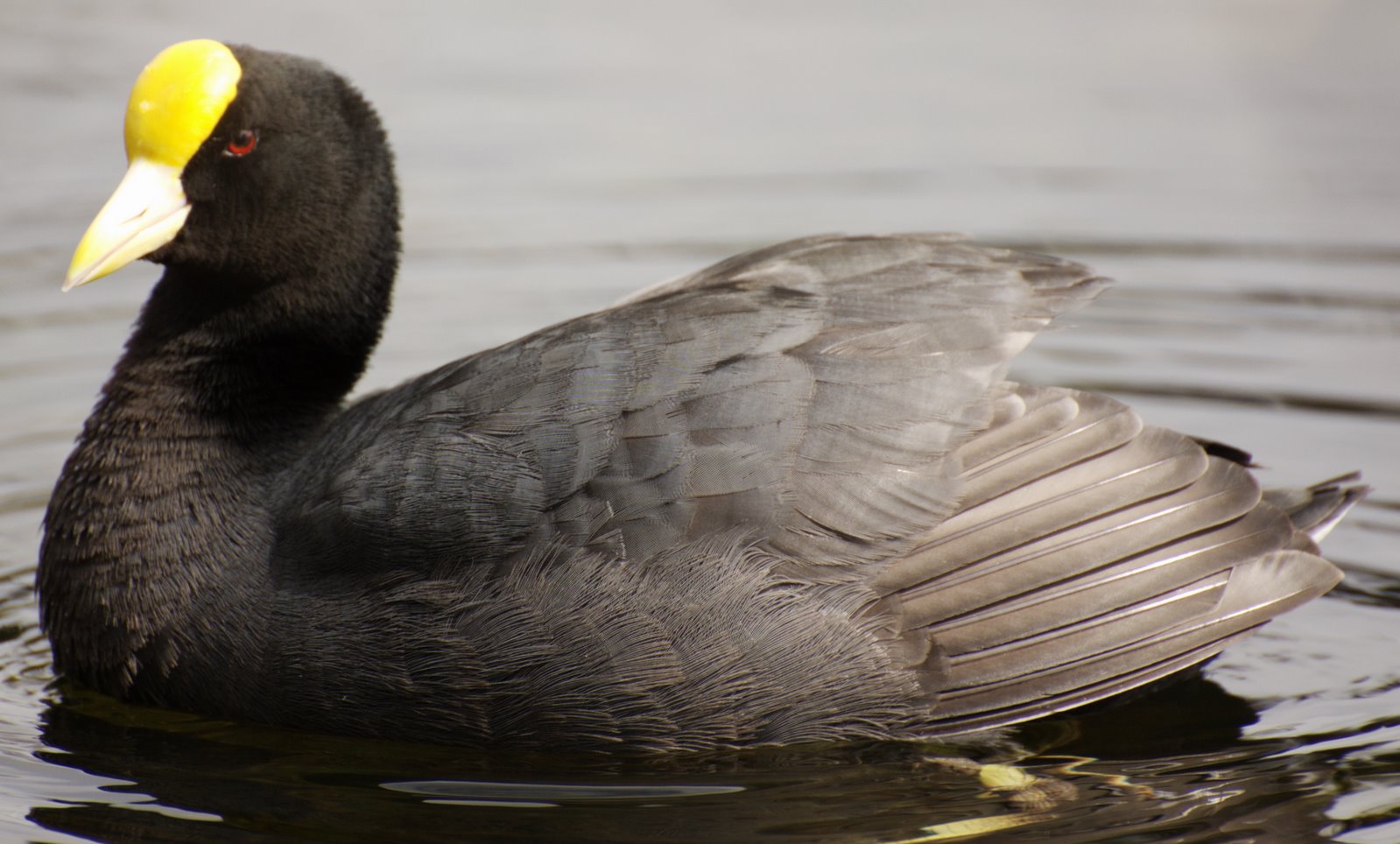
The White-winged Coot is a coot of southern South America that reaches only southern Peru and Bolivia in the guide area. It is smaller than Andean Coot and has a yellow frontal shield that is rounded at the top. In flight it shows a white trailing edge to the inner wing, which gives the species its name.
Voice
Short cackling and grunting calls and a high, sharp kuk; flocks give a continuous cackling.
Recording: Bernabe Lopez-Lanus — CC BY-NC-SA 3.0 · xeno-canto
Identification
36–43 cm. Slate grey, with a blacker head and neck. The bill is yellow to yellowish white, the frontal shield bright yellow, sometimes orange-yellow, and rounded at the top. The secondaries have white tips that form a narrow white trailing edge in flight; the leading edge of the wing is also white. The legs are greenish. The sexes are alike. Juveniles are greyer, with a pale throat and a dull bill without a yellow shield.
Confusion species
Andean Coot Fulica ardesiaca is larger and heavier, with a white, yellow or chestnut shield that is narrower and more pointed at the top, and lacks the white trailing edge to the wing. Giant Coot Fulica gigantea is much larger, with red legs and a dark red bill with a white shield. Horned Coot Fulica cornuta is also much larger and has a black, horn-like extension on the forehead.
Habitat
Lakes, lagoons and ponds with open water and aquatic plants, both in the lowlands and high in the Andes, locally above 4000 m. It eats aquatic plants, algae and small invertebrates, swimming, diving and grazing on the shore. The nest is a floating platform of plant material among reeds or rushes.
Where the bird is most at home, classified by the vegetation units of the Andes and the west coast.


Range and movements
Absent from Colombia, Ecuador and the Galápagos. In Peru scarce in the south, mainly in Puno around Lake Titicaca. In Bolivia on lakes of the altiplano and in the lowlands of the south and east. Outside the guide area in Chile, Argentina, Uruguay, Paraguay and southern Brazil.
- Resident
- dark = core range, pale = thinly spread
How and when to look
Search among flocks of Andean Coots on the altiplano lakes of Bolivia and around Lake Titicaca; look for the yellow, rounded shield and, when a bird takes off, the white trailing edge to the wing.
Conservation status
Least Concern. Locally the species suffers from drainage and pollution of lakes.
Scientific name
Fulica leucoptera | Vieillot, 1817
Vieillot described the species in 1817 and placed it straight away in the genus where it still stands. The genus Fulica was introduced in 1758 by Linnaeus. The genus name is the Latin word fulica for the Eurasian Coot; Conrad Gessner used the name in 1555. The species name comes from Greek leukos, 'white', and pteron, 'wing'. The specimen the first description was based on came from Paraguay.