All species › Cranes, rails and allies › Rails, gallinules and coots › Andean Coot
Andean Coot | Fulica ardesiaca
Punakoet | Focha andina | Carqueja-andina
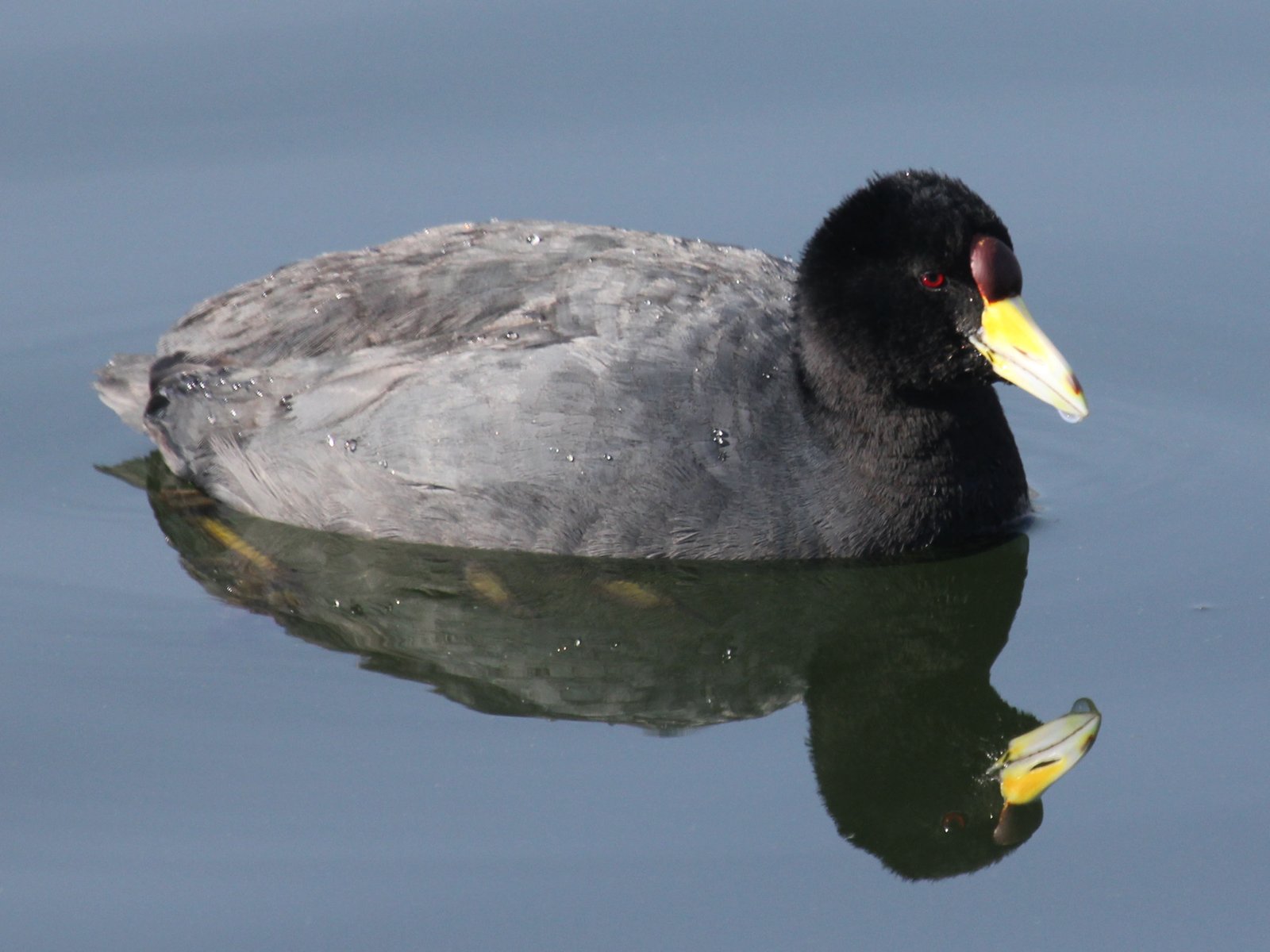
The Andean Coot is the most widespread coot of the Andes, from southern Colombia to Bolivia, and in Peru also occurs on coastal lagoons. The colour of the bill and frontal shield varies greatly: in the north both are mostly white, farther south often a yellow bill with a chestnut shield. Because of this, and because of intermediates with American Coot, its taxonomy has long been debated.
Voice
A varied repertoire of cackling, grunting and squeaking sounds, including a high keek and a low kruk.
Recording: Patricio Mena Valenzuela — CC BY-NC-SA 4.0 · xeno-canto
Identification
40–46 cm, compact and heavy. Slate grey, with a blacker head and neck. Bill and shield are mostly white in birds of Ecuador and northern Peru; farther south birds with a yellow bill and a dark chestnut to reddish-brown shield predominate, but both forms occur together. The legs are greenish grey with lobed toes. The sexes are alike. Juveniles are greyer, with a pale throat and foreneck and a dull bill.
Confusion species
American Coot Fulica americana has a white bill with a dark ring near the tip and lives in Colombia and northern Ecuador. White-winged Coot Fulica leucoptera is smaller, with a bright yellow shield rounded at the top and a white trailing edge to the wing in flight. Giant Coot Fulica gigantea is much larger, with red legs. Horned Coot Fulica cornuta has a black extension on the forehead. Red-fronted Coot Fulica rufifrons has a red shield and a raised tail with much white on the undertail.
Habitat
Lakes, lagoons, ponds and slow rivers with open water and submerged aquatic plants in the Andes, mostly between 2500 and 4500 m; in Peru also on lagoons and marshes along the coast down to sea level. It feeds mainly on submerged aquatic plants and algae, gathered while diving or swimming, and also grazes on shores and in bofedales. The nest is a floating platform among reeds or totora.
Where the bird is most at home, classified by the vegetation units of the Andes and the west coast.


Range and movements
In Colombia only in the far south, in Nariño. In Ecuador on lakes in the Andes. In Peru throughout the Andes and on coastal lagoons. In Bolivia on the altiplano, including Lake Titicaca and Lake Poopó. Absent from the Galápagos. Outside the guide area in northern Chile and north-western Argentina.
- Resident
- dark = core range, pale = thinly spread
How and when to look
On almost any lake with aquatic plants in the high Andes, such as Lake Junín and Lake Titicaca, and on lagoons in Cotopaxi National Park; in Lima at the Pantanos de Villa. On large lakes often in flocks of hundreds of birds.
Conservation status
Least Concern. The species suffers locally from drainage, pollution and water extraction, but the population is large.
Scientific name
Fulica ardesiaca | Tschudi, 1843
Tschudi described the species in 1843 and placed it straight away in the genus where it still stands. The genus Fulica was introduced in 1758 by Linnaeus. The genus name is the Latin word fulica for the Eurasian Coot; Conrad Gessner used the name in 1555. The species name comes from Latin ardesiacus, 'slate-coloured', after the slate-grey plumage. The specimen the first description was based on came from Lake Junín, Peru.