All species › Cranes, rails and allies › Rails, gallinules and coots › Purple Gallinule
Purple Gallinule | Porphyrio martinica
Amerikaans purperhoen | Gallineta morada | Frango-d'água-azul
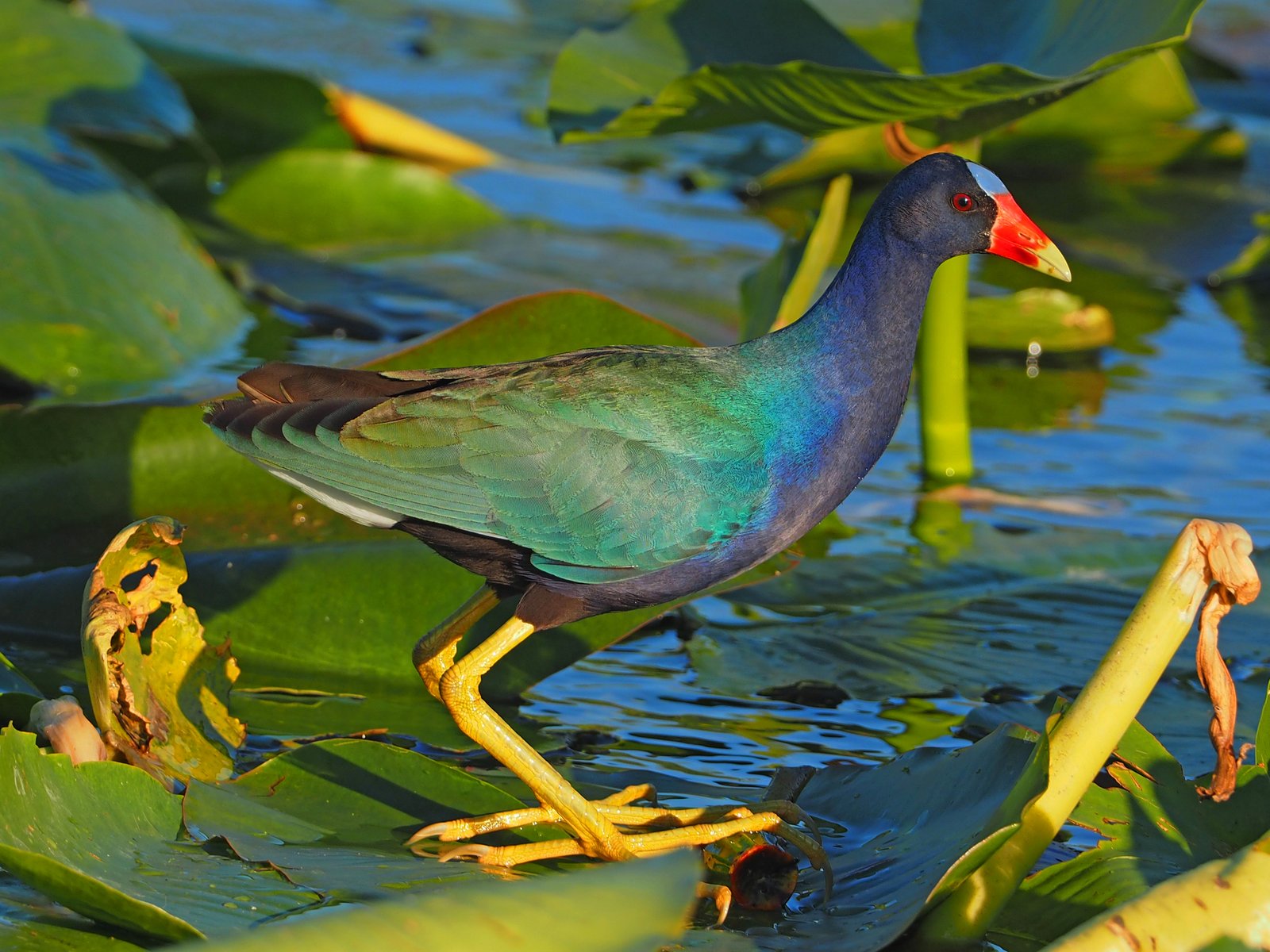
The Purple Gallinule is a bluish-purple and green rail of lowland marshes with floating plants. With its long toes it walks across water lilies and water hyacinth and also clambers in reeds and shrubs. Young birds wander widely and turn up far outside the normal habitat, high in the Andes and on oceanic islands.
Voice
A cackling, chicken-like kek-kek-kek and various grunting and squeaking calls; birds in flight sometimes give a high keek.
Recording: AUDEVARD Aurélien — CC BY-NC-SA 4.0 · xeno-canto
Identification
30–36 cm. Head, neck and underparts are deep bluish purple, the back and wings bronzy green. The bill is red with a yellow tip, the frontal shield pale blue. The undertail is entirely white. The legs are bright yellow, with very long toes. The sexes are alike. Juveniles are pale buffy brown, with a paler belly, a greenish-blue tinge to the wings and a dull bill.
Confusion species
Azure Gallinule Porphyrio flavirostris is smaller and much paler, with a pale blue head and neck, a white belly, an olive-brown back and a greenish-yellow bill; young Purple Gallinules resemble it, but are larger and lack the dark feather centres on the back. Common Moorhen Gallinula chloropus is slate grey, with a white flank line, a red shield and greenish-yellow legs.
Habitat
Freshwater marshes, lake margins, oxbow lakes and rice fields with floating vegetation, reeds and low shrubs, mainly in the lowlands up to about 1000 m; wanderers also higher. It eats seeds, fruit, leaves, insects, snails and sometimes eggs or young of other birds. The nest is a cup of plant material in dense vegetation above water.
Where the bird is most at home, classified by the vegetation units of the Andes and the west coast.


Range and movements
In Colombia in the Caribbean lowlands, in the Magdalena and Cauca valleys and east of the Andes. In Ecuador in the western lowlands and in Amazonia. In Peru locally along the north coast and in the Amazonian lowlands. In Bolivia in the lowlands. In the Galápagos a rare vagrant. Outside the guide area from the south-eastern United States to northern Argentina.
- Resident
- dark = core range, pale = thinly spread
How and when to look
Search marshes with water hyacinth and water lilies, such as around Guayaquil and along oxbow lakes in Amazonia; in the early morning birds often walk in the open across the floating plants.
Conservation status
Least Concern. The species benefits locally from rice fields, but suffers from drainage of marshes.
Scientific name
Porphyrio martinica | (Linnaeus, 1766)
Linnaeus described the species in 1766 as Fulica martinica; because it was later moved to another genus, the author and year stand in brackets. The genus Porphyrio was introduced in 1760 by Brisson. The genus name is the Latin name porphyrio for the swamphen. The species name refers to the island of Martinique. The specimen the first description was based on came from Martinique.