All species › Cranes, rails and allies › Rails, gallinules and coots › Azure Gallinule
Azure Gallinule | Porphyrio flavirostris
Azuurpurperhoen | Calamoncillo celeste | Frango-d'água-pequeno
The Azure Gallinule is a small, pale gallinule of flooded grasslands and floating vegetation in the lowlands east of the Andes. It lives hidden in tall grass and among aquatic plants and moves with seasonal water levels. Little is known about its migratory movements.
Voice
Poorly known; short, soft trills and frog-like calls, and a dry kek.
Recording: JAYRSON ARAUJO DE OLIVEIRA — CC BY-NC-SA 4.0 · xeno-canto
Identification
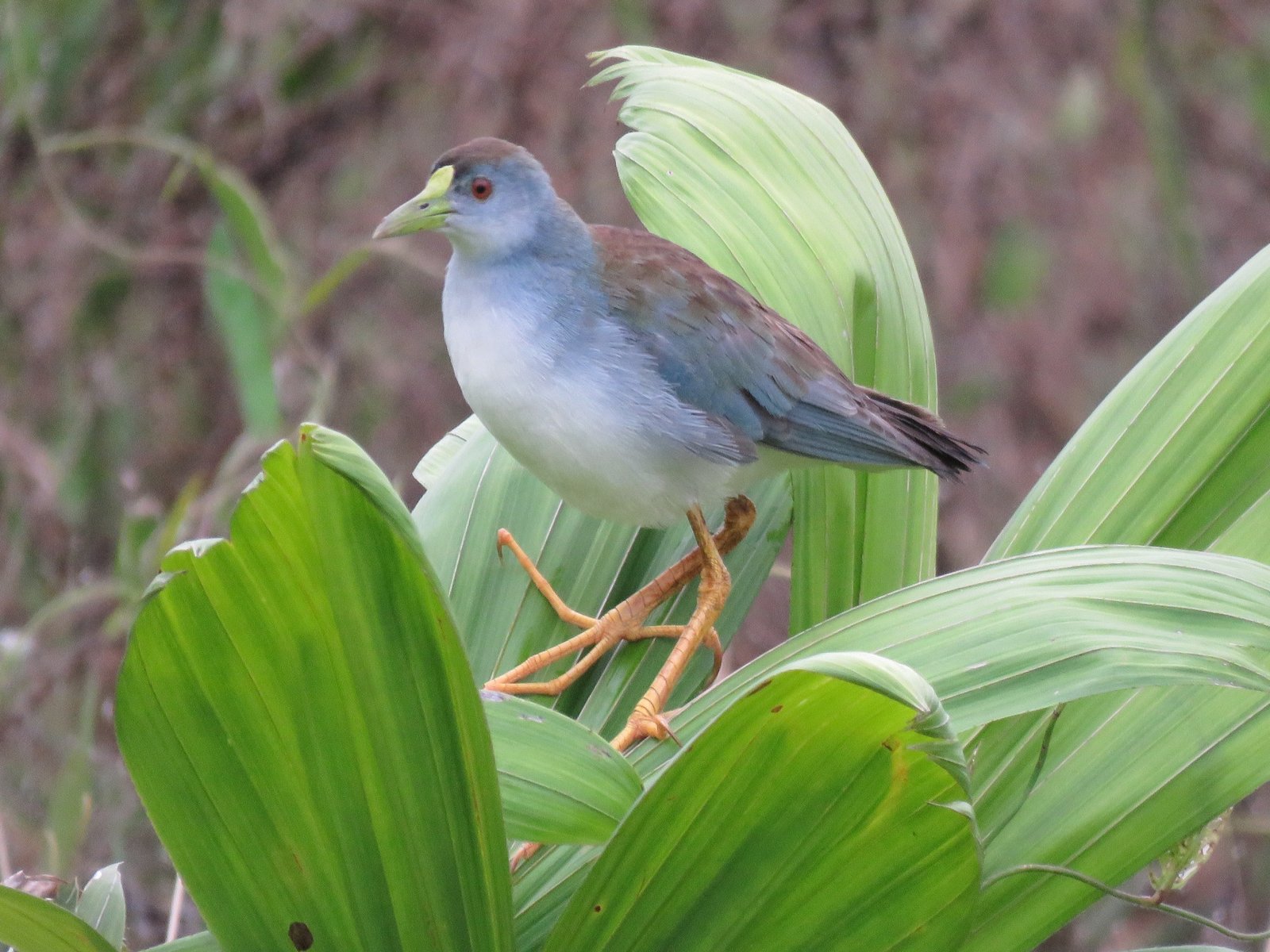
23–26 cm, slender. Head, neck and breast are pale greyish blue to azure, the belly and undertail white. The back and wing coverts are olive-brown with dark feather centres; the flight feathers have a bluish-green tinge. Bill and frontal shield are greenish yellow, the legs yellow. The sexes are alike. Juveniles are browner and buffier on the head and breast, with less blue.
Confusion species
Young Purple Gallinules Porphyrio martinica are larger and plainer brown on the back, with a browner neck and head. Spot-flanked Gallinule Porphyriops melanops is darker, with a grey head, white spots on the flanks and a greenish-yellow bill without blue tones. Common Moorhen Gallinula chloropus is larger, slate grey, with a red shield.
Habitat
Seasonally flooded grassland, marshes with tall grass, margins of oxbow lakes and rivers with floating vegetation and locally rice fields, in the lowlands up to about 500 m. It eats seeds, green plant matter and insects. It breeds in the rainy season; the nest is a cup of grass in vegetation above shallow water.
Where the bird is most at home, classified by the vegetation units of the Andes and the west coast.


Range and movements
In Colombia east of the Andes, in the Llanos and Amazonia. In Ecuador scarce in the Amazonian lowlands. In Peru in the Amazonian lowlands. In Bolivia in the lowlands of the north and east, including the Beni savannas. Absent from the Galápagos. Outside the guide area in Venezuela, the Guianas, Brazil, Paraguay and northern Argentina.
- Resident
- Summer visitor (c. Apr–Sep)
- Winter visitor (c. Oct–Mar)
- Passage (Mar–Apr, Oct–Nov)
- dark = core range, pale = thinly spread
How and when to look
Search flooded grasslands and margins with floating plants in the Llanos and the Beni savannas; birds sometimes climb tall grass stems and are then briefly in the open.
Conservation status
Least Concern. The range is large; locally habitat is lost through drainage and conversion of grasslands.
Scientific name
Porphyrio flavirostris | (Gmelin, 1789)
Gmelin described the species in 1789 as Fulica flavirostris; because it was later moved to another genus, the author and year stand in brackets. The genus Porphyrio was introduced in 1760 by Brisson. The genus name is the Latin name porphyrio for the swamphen. The species name comes from Latin flavus, 'yellow', and rostrum, 'bill'. The specimen the first description was based on came from Cayenne, French Guiana.