All species › Cranes, rails and allies › Rails, gallinules and coots › Ocellated Crake
Ocellated Crake | Rufirallus schomburgkii
Schomburgks ral | Polluela ocelada | Maxalalagá
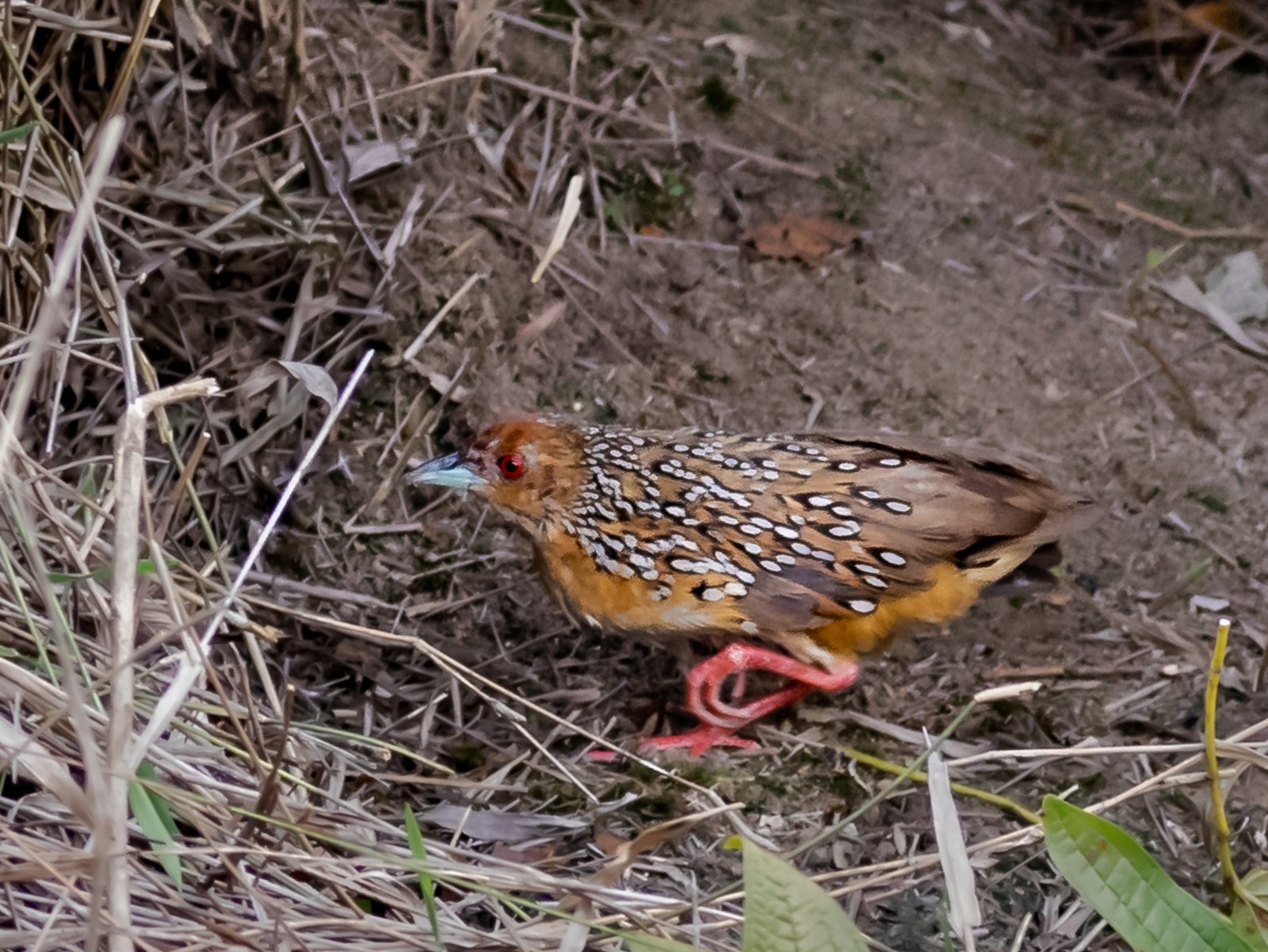
The Ocellated Crake is one of the smallest rails in the world, an inhabitant of dry, tall grassland and savanna. In the guide area it is known from only a few scattered savanna areas east of the Andes. The bird almost never leaves the cover of the grass and is noticed mainly by its long trill.
Voice
A loud, drawn-out trill of pr-pr-pr notes, 20 to 30 seconds long, rising slightly at first and then level, sometimes followed by raspier, drawn-out notes. Alarm call a sizzling, whirring sound. Mainly at dawn and dusk.
No recording with a suitable Creative Commons licence is available for this species yet.
Identification
14–16 cm, small and round, with a short tail and a short, dark bill. The upperparts are olive-brown, sprinkled with small black-edged white spots. Forehead, face, neck, breast and flanks are warm ochre to rufous, the belly whiter. The legs are pink to red, the iris red. The male is heavier than the female; in plumage the sexes are almost alike. Juveniles are darker and greyer.
Confusion species
Russet-crowned Crake Rufirallus viridis is larger, with plain olive-brown upperparts without white spots, a rufous crown and a grey face. Yellow-breasted Crake Laterallus flaviventer is also small, but has a white supercilium, black-and-white barred flanks and yellow legs, and lives in wet marsh vegetation. Grey-breasted Crake Laterallus exilis has a grey head and breast, a rufous nape and barred flanks.
Habitat
Tall, dense grassland and savanna, mostly on dry, well-drained ground, sometimes also in wetter parts; often in grassland recovering after fire, up to about 1700 m. It eats insects, spiders and seeds, searched for among the grass tussocks. The nest is a domed cup of grass on the ground.
Where the bird is most at home, classified by the vegetation units of the Andes and the west coast.


Range and movements
In Colombia locally in the savannas of the Llanos in the east. In Peru in the south-east, in the Pampas del Heath. In Bolivia in savannas in the north. Not known with certainty from Ecuador; absent from the Galápagos. Outside the guide area in Venezuela, the Guianas, Brazil and Paraguay, with a separate population in Costa Rica.
How and when to look
Listen at dawn and dusk in extensive grasslands of the Llanos or the Pampas del Heath; the bird almost always stays hidden in the grass.
Conservation status
Least Concern. Habitat is lost locally through conversion of savanna to farmland and pasture and through altered fire regimes.
Scientific name
Rufirallus schomburgkii | (Schomburgk, 1848)
Schomburgk described the species in 1848 as Crex Schomburgkii; because it was later moved to another genus, the author and year stand in brackets. The genus Rufirallus was introduced in 1856 by Bonaparte. The genus name combines Latin rufus, 'rufous', with the genus Rallus. The species name honours Moritz Richard Schomburgk (1811–1890 or 1891), German-born, later Australian, botanist and collector, who explored Guiana from 1840 to 1844 and was Director of the Botanic Gardens, Adelaide, from 1866 to 1890. The specimen the first description was based on came from interior of Guyana.