All species › Passerines › New World warblers › American Yellow Warbler
American Yellow Warbler | Setophaga aestiva
Gele zanger | Reinita amarilla | Mariquita-amarela
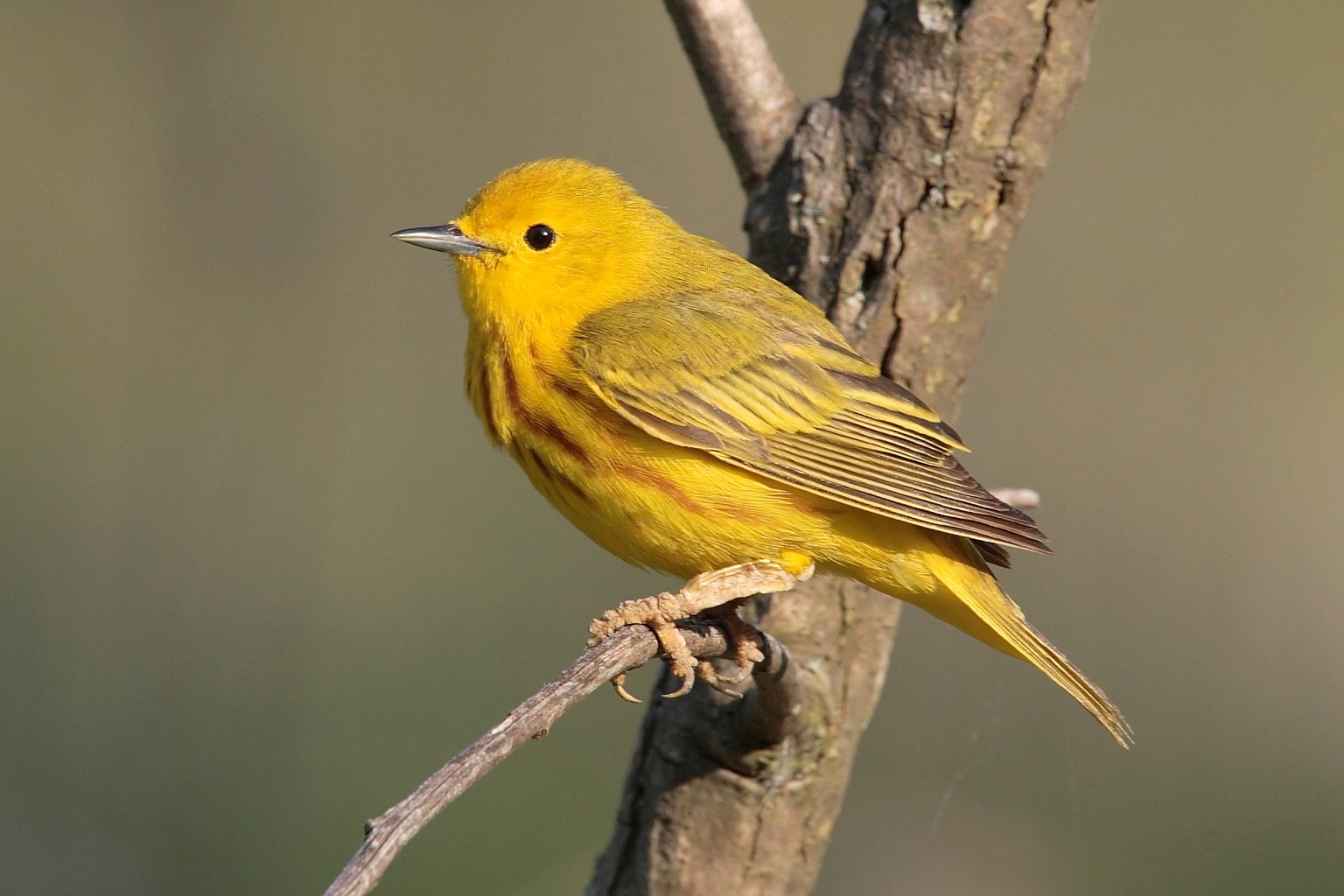
The American Yellow Warbler is an almost entirely yellow warbler that breeds from Alaska and Canada to northern Mexico. It winters from Mexico to northern South America and is a common winter visitor in semi-open lowland country in the guide area. The resident birds of the mangroves and the Galápagos, with a chestnut head or crown, are now regarded as a separate species, the Mangrove Warbler.
Voice
The call is a loud, full chip. The song is a rapid, clear series of whistled notes, roughly sweet-sweet-sweet-tee-tee-sweet; in the guide area it is heard mainly in spring.
Recording: Rory Nefdt — CC BY-NC-SA 4.0 · xeno-canto
Identification
12–13 cm, with a fairly short tail and a dark eye in a plain face. Olive-yellow above and yellow below; the flight feathers have yellow edges and the tail feathers yellow inner webs, which appear as yellow panels from below. The male has fine reddish-brown streaks on the breast and flanks. Females and young birds are duller, sometimes greyish or pale yellow, with few or no streaks. Before departure in spring males are brighter yellow.
Confusion species
Mangrove Warbler Setophaga petechia is very similar; males have a chestnut head or, on the Galápagos, a rufous crown, but females and young birds often cannot be separated in the field; in mangroves between October and April both species may occur side by side. Prothonotary Warbler Protonotaria citrea has blue-grey wings and white in the tail. Wilson's Warbler Cardellina pusilla has a dark cap or an olive crown, a longer tail without yellow and no yellow wing edges.
Habitat
In winter in semi-open country with shrubs and trees, riparian woodland, scrub along rivers and lakes, pasture with trees, gardens and parks, and the edges of mangroves, mainly in the lowlands up to about 1500 m, higher on passage. It searches for insects in the foliage of shrubs and low trees. It does not breed in the guide area; the nest is a sturdy cup in a shrub in the north.
Where the bird is most at home, classified by the vegetation units of the Andes and the west coast.


Range and movements
Colombia: common winter visitor throughout the lowlands and in the lower Andean valleys, also on San Andrés and Providencia. Ecuador: fairly common winter visitor, mainly in the western lowlands, also in the east. Peru: winter visitor, mainly in the north and in the Amazonian lowlands, scarcer to the south. Bolivia: scarce winter visitor in the north. Outside the guide area the species breeds from Alaska and Canada to northern Mexico and winters from Mexico to Venezuela, the Guianas and northern Brazil.
- Resident
- Winter visitor (c. Oct–Mar)
- Passage (Mar–Apr, Oct–Nov)
- dark = core range, pale = thinly spread
How and when to look
Look between October and March in scrub along rivers, in gardens and in pasture with trees in the lowlands. Its loud call often gives it away before you see it.
Conservation status
Not evaluated in this circumscription. The species in the broad sense, including Mangrove Warbler, has been assessed as Least Concern; the population is large and the species tolerates man-made landscapes well.
Scientific name
Setophaga aestiva | (Gmelin, 1789)
Gmelin described the species in 1789 as Motacilla aestiva; because it was later moved to another genus, the author and year stand in brackets. The genus Setophaga was introduced in 1827 by Swainson. The genus name comes from Greek sēs (genitive sētos), 'moth', and -phagos, '-eating', so 'moth-eater'. The species name comes from Latin aestivus, 'of summer', for a bird present only in summer. The specimen the first description was based on came from Quebec City, Canada.