All species › Passerines › New World warblers › Mangrove Warbler
Mangrove Warbler | Setophaga petechia
Mangrovezanger | Reinita de manglar | Mariquita-do-mangue
The Mangrove Warbler is the resident member of the yellow warblers: it breeds in mangroves along the coasts of tropical America and on the Galápagos. On the Galápagos it is one of the commonest land birds and lives from the beach to the highlands. The Nearctic American Yellow Warbler, which spends the winter in the same area, is now a separate species.
Voice
The call is a loud, full chip. The song is a rapid, clear series of whistled notes, similar to that of American Yellow Warbler but often more varied, roughly sweet-sweet-sweet-chee-chee-sweet; heard all year, especially in the breeding season.
Recording: Denis Dujardin — CC BY-NC-SA 4.0 · xeno-canto
Identification
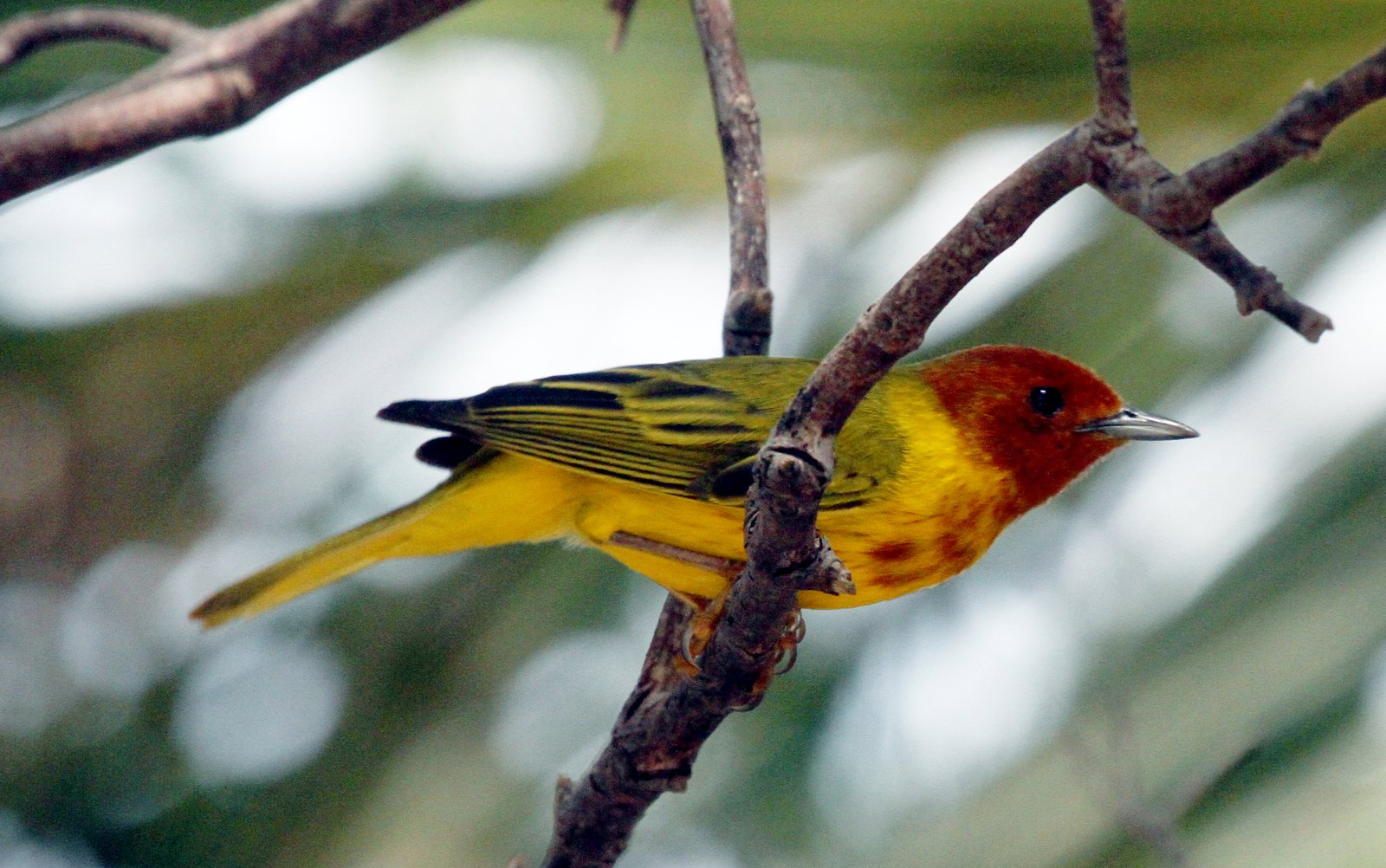
12–13 cm, built like American Yellow Warbler, olive-yellow above and yellow below, with yellow edges to the flight feathers and yellow inner webs in the tail. The male of the mainland subspecies has a chestnut head or hood and reddish-brown streaks on the breast. On the Galápagos the male has a rufous crown patch and reddish-brown breast streaks, but a yellow face. Females are olive-yellow to greyish, without chestnut; on the Galápagos females and young birds are often distinctly grey.
Confusion species
American Yellow Warbler Setophaga aestiva is a winter visitor between October and April, also in and around mangroves; males lack chestnut on the head, but females and young birds often cannot be separated in the field. On the Galápagos the species is the only breeding warbler; grey young birds there resemble female ground finches or Galapagos Flycatcher Myiarchus magnirostris, but have a fine, pointed warbler bill and yellow edges to the wing and tail.
Habitat
On the mainland almost only in mangroves and adjacent coastal scrub, mudflat edges and brackish lagoons, at sea level. On the Galápagos in all zones: coast, lava fields, arid lowlands, Scalesia forest and humid highlands, also gardens and villages. It searches for insects in foliage, on the ground and on beaches, on the Galápagos also among the sea lions. The nest is a sturdy cup in a shrub or mangrove tree.
Where the bird is most at home, classified by the vegetation units of the Andes and the west coast.


Range and movements
Colombia: resident in mangroves along the Caribbean and Pacific coasts; also on San Andrés and Providencia. Ecuador: along the Pacific coast, especially in the large mangrove areas of Esmeraldas and the Gulf of Guayaquil. Peru: in the mangroves of Tumbes in the far north-west. Galápagos: on all larger islands and many islets, endemic subspecies. Absent from Bolivia. Outside the guide area along the coasts of Mexico, Central America and Venezuela and on the islands of the Caribbean.
- Resident
- dark = core range, pale = thinly spread
How and when to look
On the Galápagos you see it almost everywhere, from the landing jetties to the highlands. On the mainland you need to enter the mangroves, for example by boat in the Gulf of Guayaquil or at Tumbes; between October and April beware of confusion with the wintering birds.
Conservation status
Not evaluated in this circumscription. The species in the broad sense, including American Yellow Warbler, has been assessed as Least Concern. On the mainland the species is tied to mangroves, which have been strongly reduced locally by shrimp farms.
Scientific name
Setophaga petechia | (Linnaeus, 1766)
Linnaeus described the species in 1766 as Motacilla petechia; because it was later moved to another genus, the author and year stand in brackets. The genus Setophaga was introduced in 1827 by Swainson. The genus name comes from Greek sēs (genitive sētos), 'moth', and -phagos, '-eating', so 'moth-eater'. The species name comes from Italian petecchia, 'a small red spot on the skin', for the reddish streaks on the breast. The specimen the first description was based on came from Barbados.