All species › Passerines › New World warblers › Prairie Warbler
Prairie Warbler | Setophaga discolor
Prairiezanger | Reinita galana | Mariquita-das-pradarias
The Prairie Warbler is a small yellow warbler with a striped face that, despite its name, breeds not on the prairie but in young woodland and scrub in the eastern United States. It winters in Florida, the Caribbean islands and along the coasts of Central America. In the guide area it occurs mainly on the Colombian islands of San Andrés and Providencia; there are few records from the mainland.
Voice
A soft, slightly dull chip. The song on the breeding grounds is a series of buzzy notes rising evenly in pitch, zee-zee-zee-zee-zee.
Recording: Mario Reyes Jr — CC BY-NC-SA 4.0 · xeno-canto
Identification
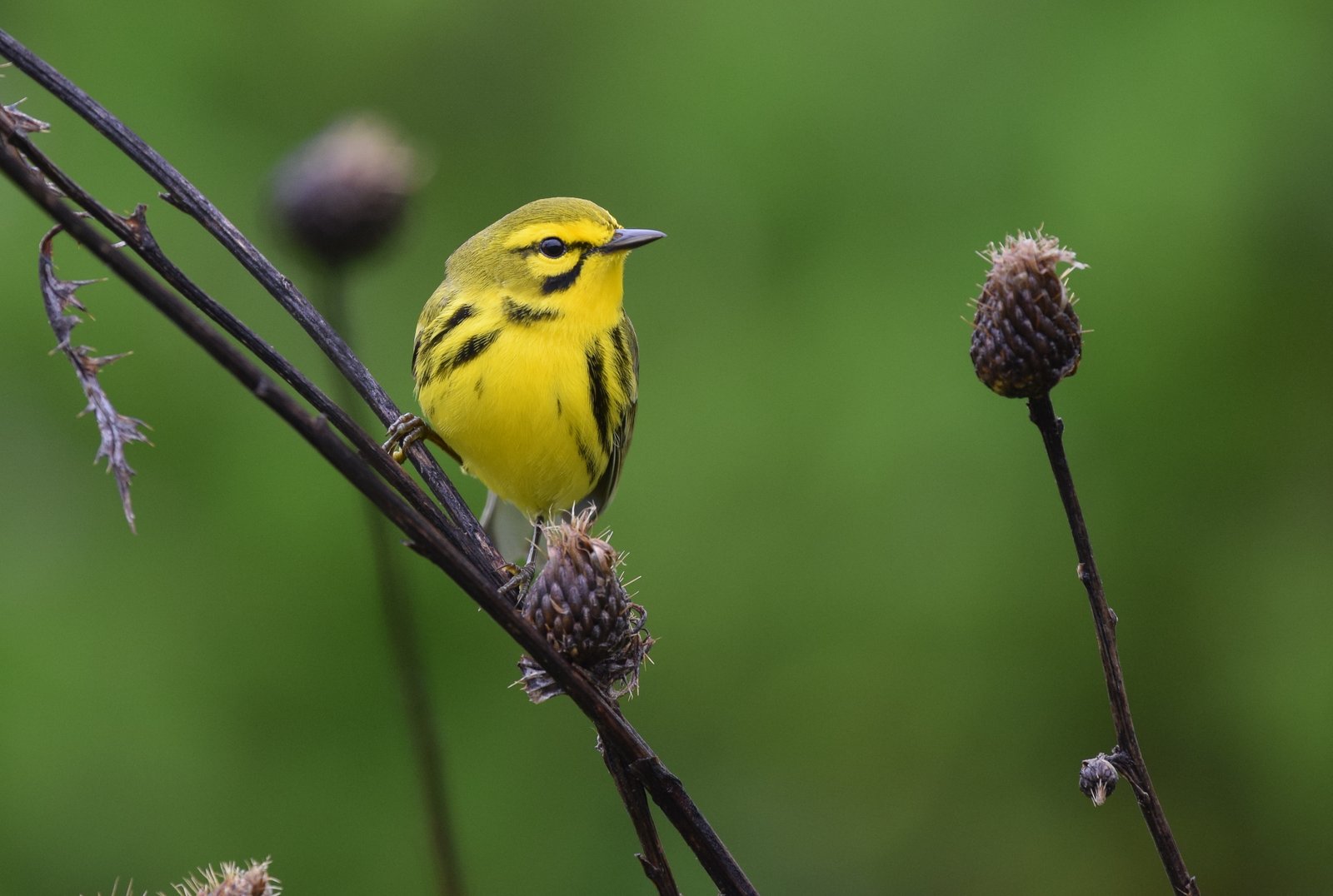
12 cm, small, with a fairly long tail that it pumps constantly. The upperparts are olive-green; the male has rufous spots on the mantle. The underparts are bright yellow, with black streaks on the flanks. The face shows a black eye-line and a black, crescent-shaped stripe below the eye, with yellow in between. Two faint pale wing bars. The female and young birds are duller, with a greyish rather than black face pattern.
Confusion species
Palm Warbler Setophaga palmarum also pumps its tail, but is browner, with an olive-green rump and no stripe below the eye. Mangrove Warbler Setophaga petechia lacks the black face and flank stripes and has yellow tail spots. Magnolia Warbler Setophaga magnolia has a grey crown, a yellow rump and a white band across the middle of the tail.
Habitat
In winter quarters open country with shrubs and low trees: coastal scrub, mangroves, gardens, dry thickets and forest edges, mainly in the lowlands. It forages low in the vegetation for insects and spiders and also catches them in short flights. It breeds in young woodland, clearings and scrub.
Where the bird is most at home, classified by the vegetation units of the Andes and the west coast.


Range and movements
Colombia: rare winter visitor, mainly on San Andrés and Providencia, with a few records from the Caribbean mainland. Not known from Ecuador, Peru, Bolivia or the Galápagos. Outside the guide area it breeds in the eastern United States and winters in Florida, the Caribbean islands and along the Caribbean coast of Central America.
- Winter visitor (c. Oct–Mar)
- Passage (Mar–Apr, Oct–Nov)
- dark = core range, pale = thinly spread
How and when to look
Between October and April on San Andrés and Providencia, search coastal scrub and gardens for a small yellow warbler pumping its tail.
Conservation status
Least Concern. The population has declined markedly since the 1960s, partly because young woodland and scrub in the breeding range are growing up into forest.
Scientific name
Setophaga discolor | (Vieillot, 1809)
Vieillot described the species in 1809 as Sylvia discolor; because it was later moved to another genus, the author and year stand in brackets. The genus Setophaga was introduced in 1827 by Swainson. The genus name comes from Greek sēs (genitive sētos), 'moth', and -phagos, '-eating', so 'moth-eater'. The species name comes from Latin discolor, 'of different colours, variegated', for the varied plumage. The specimen the first description was based on came from Antilles.