All species › Passerines › New World warblers › Black-throated Green Warbler
Black-throated Green Warbler | Setophaga virens
Gele zwartkeelzanger | Reinita dorsiverde | Mariquita-verde-de-garganta-preta
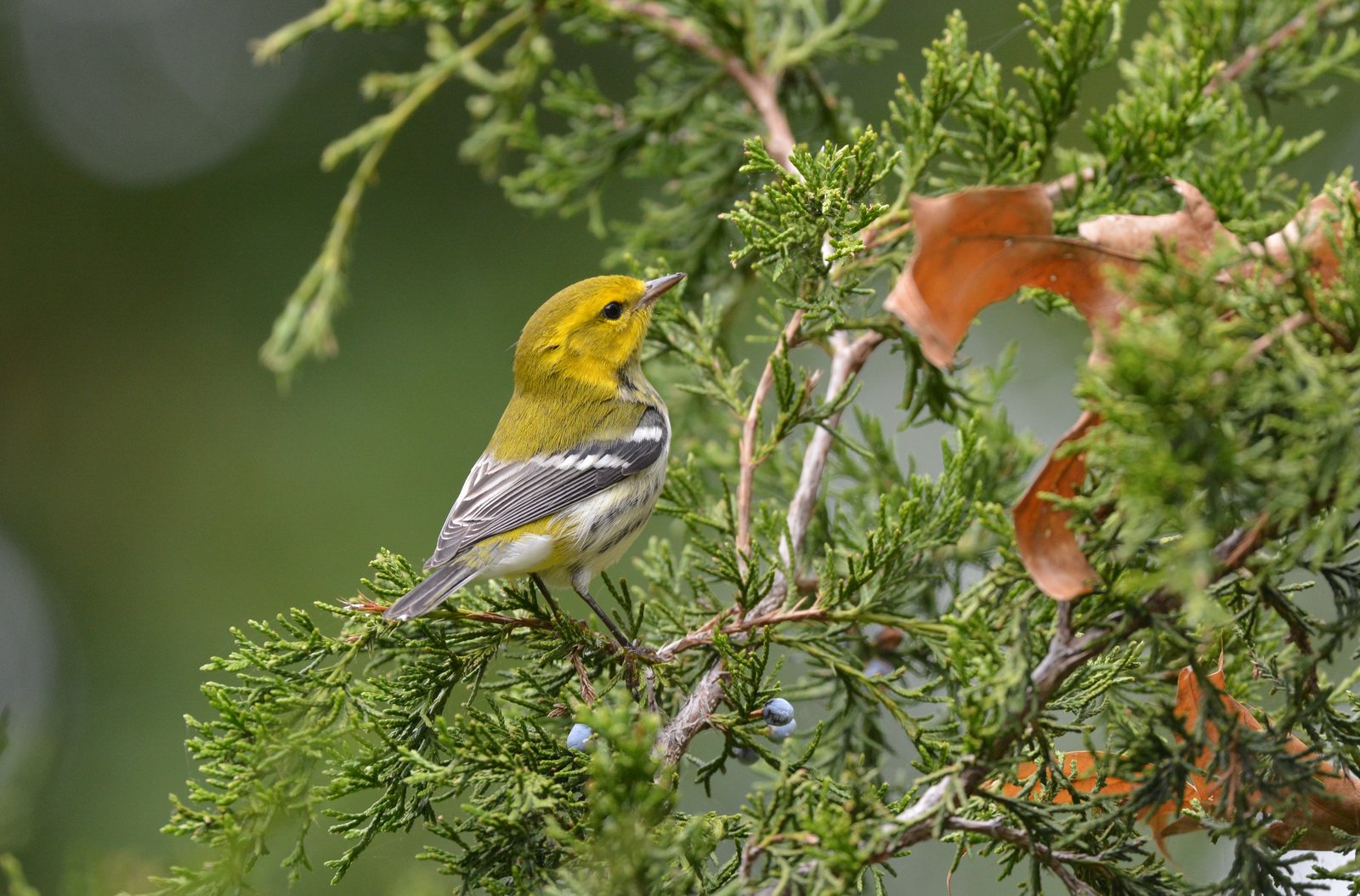
The Black-throated Green Warbler is a green warbler with a yellow face and, in the male, a black throat, which breeds in coniferous and mixed forest in eastern North America. It winters mainly in the montane forests of Mexico and Central America. In the guide area it is a scarce winter visitor to the mountains of northern Colombia, where it travels with mixed flocks through cloud forest.
Voice
A soft tsip. The song on the breeding grounds is buzzy and lazy, zee-zee-zoo-zee or zoo-zee-zoo-zoo-zee.
Recording: Bobby Wilcox — CC BY-NC-SA 4.0 · xeno-canto
Identification
12–13 cm. The crown and back are olive-green, the wings grey with two white wing bars. The face is bright yellow, with an olive-green ear patch. The male has a black throat and breast and black streaks on the flanks; the belly is white, with a yellow wash at the vent. In the female and young birds the throat is yellowish or white and there is black only on the breast sides.
Confusion species
Townsend's Warbler Setophaga townsendi has a dark ear patch bordered with yellow and a yellow breast. Blackburnian Warbler Setophaga fusca has an orange or yellow-orange throat, a black or dark ear patch and a streaked back. Yellow-throated Warbler Setophaga dominica is grey with a yellow throat and a black mask.
Habitat
In winter quarters cloud forest, upper montane forest, forest edges and shade coffee, mainly between about 1000 and 3000 m. It gleans insects from foliage in the middle and upper levels, nearly always in mixed flocks. It breeds in coniferous and mixed forest in Canada and the eastern United States.
Where the bird is most at home, classified by the vegetation units of the Andes and the west coast.


Range and movements
Colombia: scarce winter visitor to the mountains of the north: the Sierra Nevada de Santa Marta, the Serranía de Perijá and the northern Andes; rare farther south. Ecuador: very rare winter visitor in the north. Not known from Peru, Bolivia or the Galápagos. Outside the guide area it breeds in Canada and the eastern United States and winters from Texas and Mexico to Panama, in the Greater Antilles and in the mountains of Venezuela.
- Winter visitor (c. Oct–Mar)
- dark = core range, pale = thinly spread
How and when to look
Between October and April, walk cloud forest edges in the Sierra Nevada de Santa Marta and follow mixed flocks; look for a warbler with a yellow face among the Blackburnian Warblers.
Conservation status
Least Concern. The population is large and fairly stable.
Scientific name
Setophaga virens | (Gmelin, 1789)
Gmelin described the species in 1789 as Motacilla virens; because it was later moved to another genus, the author and year stand in brackets. The genus Setophaga was introduced in 1827 by Swainson. The genus name comes from Greek sēs (genitive sētos), 'moth', and -phagos, '-eating', so 'moth-eater'. The species name comes from Latin virens, 'green', for the olive-green upperparts. The specimen the first description was based on came from Philadelphia, Pennsylvania, United States.